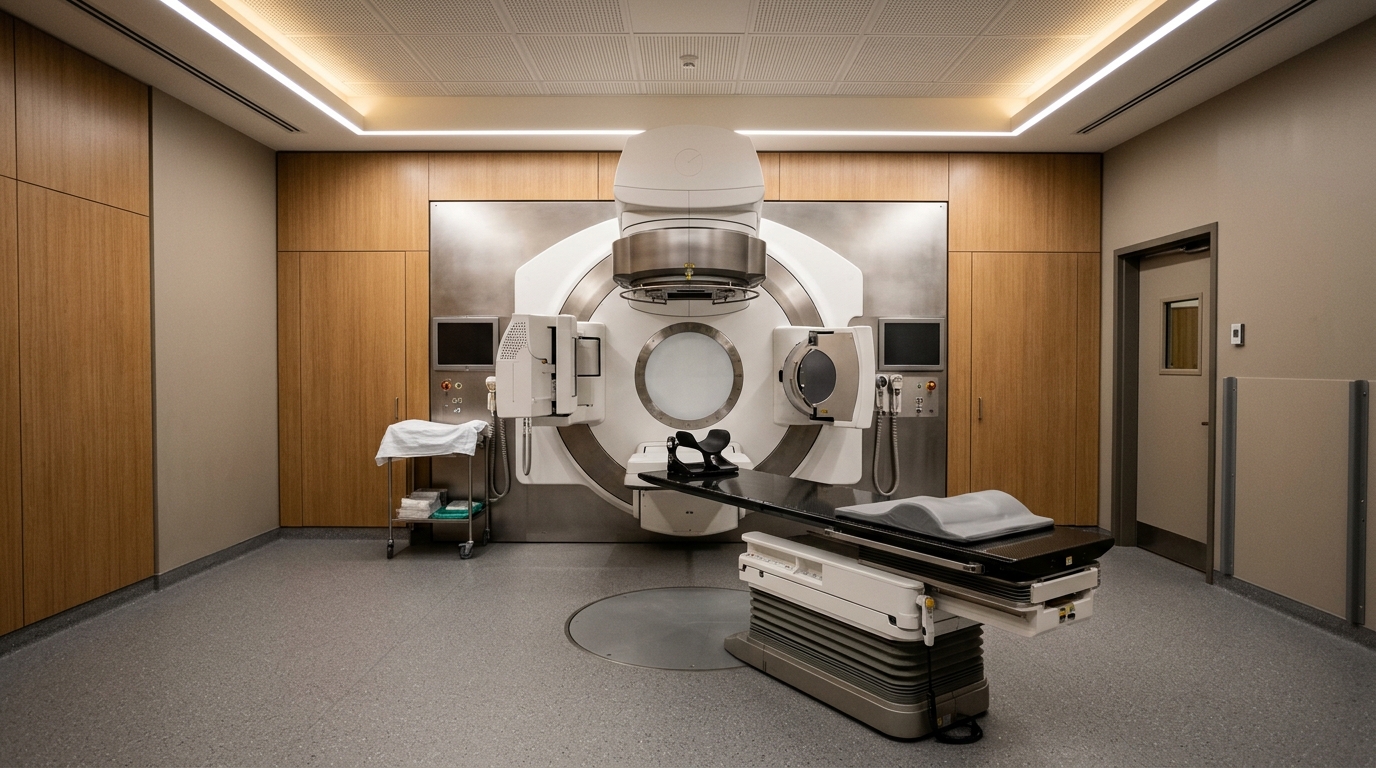
A computational framework designed to estimate the five-year likelihood of subsequent primary malignancies among cancer patients who underwent radiotherapy demonstrates how machine-learning architectures can balance predictive accuracy with clinically verified interpretability. Radiation therapy serves as a cornerstone in cancer management and substantially enhances survival, yet longer survival expands the clinical need to monitor secondary primary malignancies that may emerge over time. Traditional statistical risk models provide transparent predictions but depend on predefined functional structures that can fail to capture complex nonlinear dependencies among demographic, tumour, and treatment variables. Conversely, deep neural networks effectively map nonlinear relationships but frequently operate as uninterpretable black boxes, which restricts clinical auditing. To address these limitations, researchers formulated the Monotonicity-Constrained Interaction-Aware Neural Additive Network, designated as MC-IA-NAN, using large-scale observational cancer registry records from the Surveillance, Epidemiology, and End Results program.
The study cohort was drawn from the SEER 17 Registries database covering diagnoses recorded between 2000 and 2017 to secure a consistent five-year observation window. From an initial identification of 72,500 cancer records, researchers executed a multi-step eligibility screening protocol that excluded 8,200 records involving ineligible primary sites, 1,500 records failing adult age criteria, and 1,100 records lacking valid index-date details. Additional exclusions removed 3,400 records with insufficient clinical or demographic information, 6,800 records failing predefined radiotherapy-related criteria, and 2,880 records lacking classifiable outcome data. The resulting analytical cohort comprised 48,620 adult patients diagnosed with initial solid organ malignancies, including breast, prostate, lung and bronchus, colorectal, and other solid tumors. Within this analytical cohort, 3,184 patients, or 6.55 percent, developed a documented subsequent primary malignancy within five years of their primary cancer diagnosis, while 45,436 patients did not experience a subsequent primary cancer.
To prevent temporal information leakage across model inputs, the investigators restricted all predictive features strictly to characteristics established at or before the index diagnosis date. Predictors included continuous age at diagnosis, sex, race and ethnicity, primary cancer site, ordinal tumor stage, ordinal tumor grade, and diagnosis year. Post-baseline temporal measures, such as follow-up duration and event latency, were deliberately excluded from the input vector because using measurements collected after the index diagnosis introduces spurious predictive signals into baseline risk evaluation. Continuous variables were standardized using min-max scaling parameters derived solely from the training cohort, while categorical features underwent numerical encoding. During cohort follow-up, 3,286 individuals were censored prior to five years without a subsequent cancer, and 2,150 patients died before any subsequent primary malignancy occurred. Competing mortality was formally tracked during outcome evaluation rather than classified as a simple non-event, ensuring that death before a subsequent malignancy was recognized as a competing risk.
The internal architecture of the MC-IA-NAN framework assigns each clinical input variable to an independent neural additive subnetwork rather than routing all predictors through shared hidden layers. Each individual subnetwork comprises two fully connected layers with thirty-two and sixteen neurons, rectified linear unit activation, and dropout rates between 0.10 and 0.20 to restrict overfitting. Each subnetwork generates a scalar value representing the isolated risk contribution of that predictor. To ensure that the mathematical relationships adhere to medical biological plausibility, explicit directional monotonicity constraints were imposed during network training. For example, the age-related shape function was strictly constrained to be non-decreasing, ensuring that advancing age cannot arbitrarily reduce predicted baseline risk. These directional requirements were enforced across both the individual feature subnetworks and the corresponding interaction components, satisfying mathematical derivative conditions so that the aggregated risk score and its subsequent sigmoid probability mapping reliably preserved clinically sound directional behavior.
To overcome the strict additive limitation of conventional neural additive architectures without compromising model transparency, the framework integrates a sparse, clinically guided pairwise interaction module. The system evaluates candidate interactions initially grounded in clinical rationale and filters them using empirical thresholds across training data. Interactions were retained only if their interaction strength reached at least 0.10 on the log-odds scale and their removal caused a validation discrimination decrement of at least 0.005 in area under the receiver operating characteristic curve. Three primary interaction pairs met these criteria under the leakage-free configuration: age at diagnosis interacting with primary cancer site, age interacting with disease stage, and primary cancer site interacting with disease stage. Each selected pair was modeled by a dedicated subnetwork containing sixteen and eight hidden units, yielding an explicit two-dimensional response contribution that captures joint dependencies while leaving the broader model auditable.
Model training was executed using weighted binary cross-entropy to handle class imbalance, Adam optimization with a learning rate of 0.001, a batch size of 128, and a maximum of 150 epochs regulated by early stopping across a ten-epoch patience window. Hyperparameters were established through a thirty-trial Bayesian optimization scheme based on validation log-loss across five-fold cross-validation on the development data, without accessing the independent test split. To assess the reliability of predictions for individual patients, the model implemented Monte Carlo dropout inference. By executing one hundred stochastic forward passes with active dropout for each test patient, the architecture computed both the mean predicted probability and the predictive variance, where higher variance explicitly signaled greater prediction uncertainty. Post-hoc probability calibration was subsequently conducted via temperature scaling fitted on validation predictions, transforming the raw output into calibrated risk probabilities without modifying underlying model parameters or discrimination rankings.
Across the independent testing partition, the fully calibrated MC-IA-NAN framework demonstrated robust discriminative performance and probability calibration, achieving an accuracy of 98.27 percent, a precision of 87.61 percent, a recall of 85.77 percent, and an F1-score of 86.68 percent. The model attained an area under the receiver operating characteristic curve of 0.948 and an area under the precision-recall curve of 0.861. Application of post-hoc temperature scaling adjusted probability calibration substantially, reducing the expected calibration error from 0.0230 to 0.0140 and lowering the Brier score from 0.0530 to 0.0508. The calibration slope adjusted from 0.86 to 0.96 while the calibration intercept shifted from minus 0.12 to minus 0.03, reflecting closer agreement between estimated probabilities and observed empirical event frequencies across probability bins without compromising rank-order discrimination.
Controlled comparative evaluations conducted on identical patient partitions and predictor sets demonstrated that the proposed model surpassed several standard clinical modeling approaches. Baseline models evaluated under identical leakage-free parameters included logistic regression, random forest, gradient boosted decision trees through XGBoost and LightGBM, a conventional multilayer perceptron deep neural network, and a standard neural additive model. Logistic regression achieved an accuracy of 89.72 percent, an AUROC of 0.912, and an expected calibration error of 0.068. The conventional multilayer perceptron achieved an accuracy of 91.08 percent with an AUROC of 0.929, whereas standard neural additive modeling yielded 89.92 percent accuracy and an AUROC of 0.918. The proposed framework achieved superior discrimination and probability calibration relative to each comparator while preserving explicit structural interpretability that standard multilayer perceptron architectures cannot provide.
Component-wise ablation experiments systematically confirmed the performance contributions made by each architectural addition to the baseline framework. Standard neural additive models without constraints achieved an AUROC of 0.918 and a Brier score of 0.078. Incorporating monotonicity constraints increased the AUROC to 0.929, while adding interaction-aware subnetworks further elevated discrimination to 0.936. Combining both monotonicity constraints and sparse interactions yielded an AUROC of 0.941. Incorporating Monte Carlo uncertainty estimation and post-hoc temperature scaling further optimized the pipeline, reducing the expected calibration error from 0.048 in the intermediate network to 0.0140 in the fully realized configuration. In parallel, analysis across uncertainty quartiles revealed that patients situated within the lowest uncertainty quartile exhibited an error rate of only 0.8 percent and an AUROC of 0.992, whereas those in the highest uncertainty quartile exhibited an error rate of 2.9 percent and an AUROC of 0.941, confirming that model-derived variance effectively separates reliable predictions from uncertain outputs.
Sensitivity analyses examining alternative survival and censoring adjustments affirmed the consistency of the risk estimates across different statistical assumptions. Comparative testing against cause-specific Cox proportional hazards models and Fine-Gray subdistribution hazard models at the five-year mark showed that the primary MC-IA-NAN model attained a five-year AUROC of 0.948 and a concordance index of 0.932, compared to an AUROC of 0.872 and C-index of 0.851 for the cause-specific Cox formulation and an AUROC of 0.884 and C-index of 0.863 for the Fine-Gray model. Sensitivity evaluations that incorporated inverse-probability-of-censoring weighting demonstrated stable discrimination with an AUROC of 0.945. Furthermore, temporal validation dividing the SEER cohort chronologically between a development window spanning 2000 through 2012 and an independent temporal validation window spanning 2013 through 2017 showed minimal performance decay, maintaining an accuracy of 98.05 percent, an AUROC of 0.943, and an AUPRC of 0.852.
Individual patient-level risk decomposition verified that the model generates transparent audit trails for clinical decision support. The aggregate logit risk score decomposes into the global intercept, individual main-effect shape functions, and active pairwise interaction terms. In representative patient evaluations, a low-risk case yielded an estimated probability of 2.4 percent driven by negative logit contributions from main effects and interactions, whereas an intermediate-risk case yielded 6.6 percent and a high-risk case reached 14.8 percent, with age at diagnosis identified as the dominant positive contributor. Evaluation of explanation stability across five independent random seeds and one hundred bootstrap resamples demonstrated high reproducibility, showing a mean pointwise standard deviation of 0.018 for normalized shape functions and a mean Spearman rank correlation of 0.94 for feature importance rankings. Sex emerged as the most stable feature across resamples, whereas primary cancer site exhibited the highest variability.
Despite these technical and discriminative strengths, the authors emphasize critical methodological and data limitations that prevent immediate translation into routine clinical workflows. Because the SEER cancer registry lacks granular radiotherapy details such as precise anatomical radiation fields, delivered radiation doses, fractionation regimens, and molecular or genomic biomarkers, the recorded associations cannot be interpreted as direct causal effects between radiotherapy exposure and subsequent malignancies. Furthermore, the binary classification formulation with a fixed five-year horizon simplifies underlying time-to-event dynamics and does not model competing mortality as an independent explicit endpoint. The researchers note that before clinical implementation or surveillance planning can occur, the framework requires prospective multicenter validation in independent cohorts with complete dosimetric records, alongside formal evaluation by clinicians to gauge the practical utility and stability of the provided explanations.
Subject of Research: Prediction of radiotherapy-associated subsequent primary malignancy risk using an interpretable monotonicity-constrained neural additive network
Article Title: Monotonicity-constrained neural additive models for interpretable prediction of radiotherapy-associated secondary malignancy risk
Article References: Alharithi, F. S. (2026). Monotonicity-constrained neural additive models for interpretable prediction of radiotherapy-associated secondary malignancy risk. Journal of Radiation Research and Applied Sciences, 19(4), Article 102856. https://doi.org/10.1016/j.jrras.2026.102856
Image Credits: AI Generated
DOI: 10.1016/j.jrras.2026.102856
Keywords: Neural Additive Models, Secondary Malignancy, Radiation Therapy, Monotonicity Constraints, SEER Database, Predictive Modeling, Uncertainty Estimation, Probability Calibration, Temperature Scaling, Machine Learning, Risk Stratification, Monte Carlo Dropout, Cancer Survivorship, Brier Score, Explainable AI, Additive Risk Formulation, Pairwise Interactions
News Source: Nathaniel Bowman. (November 27, 2026). Interpretable Neural Additive Model Predicts Radiotherapy Secondary Malignancy Risk in Registry Data. Scienmag.