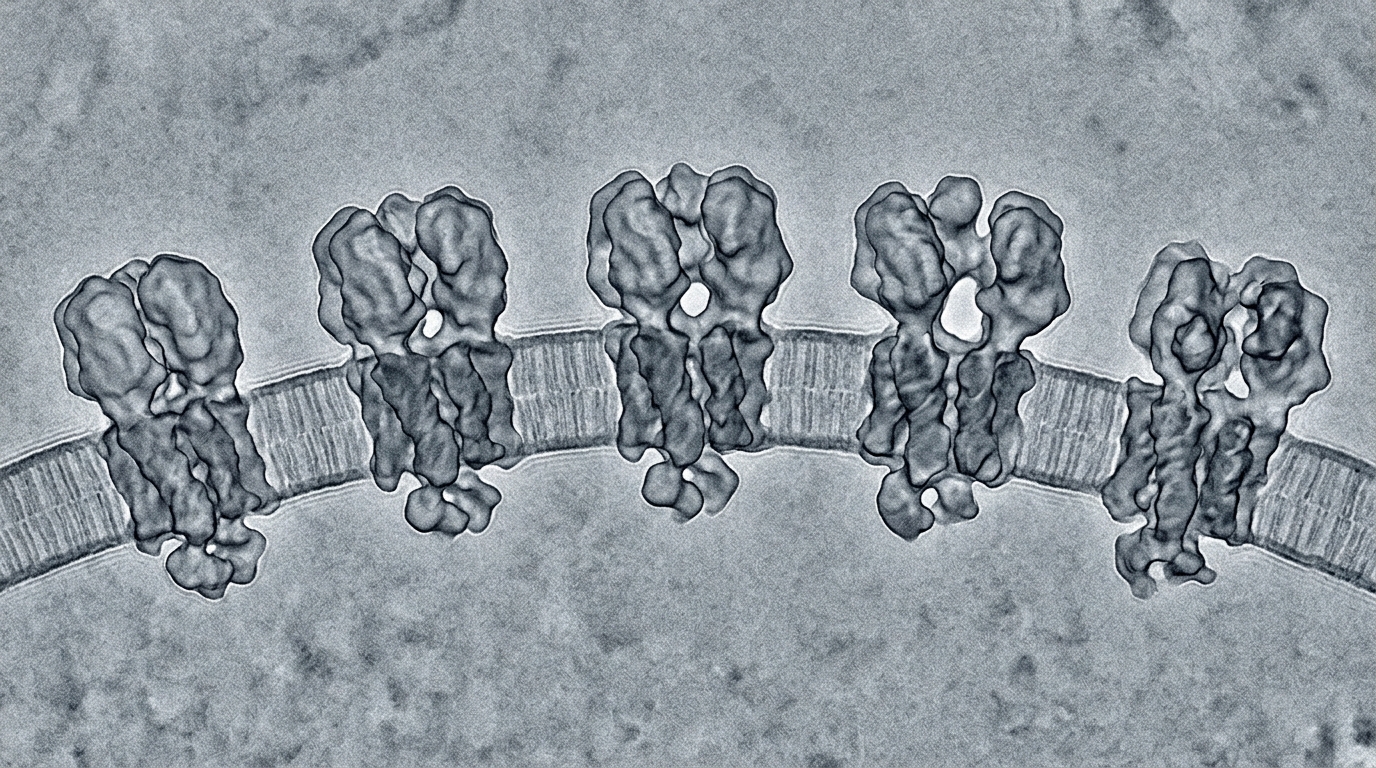
Using rapid agonist photolysis combined with nonequilibrium cryo-electron microscopy, structural biologists have resolved five distinct conformational states of the human muscle nicotinic acetylcholine receptor during channel activation. The investigated receptor functions as the archetypal ligand-gated ion channel at neuromuscular junctions, initiating skeletal muscle contraction by opening its intrinsic central pore in response to neurotransmitter binding. Because activated channel states are exceptionally fleeting, with receptors typically desensitizing within tens of milliseconds, capturing the precise structural sequence linking agonist binding to channel opening has long posed a significant technical challenge. By pairing a photoactivatable caged carbachol ligand with a millisecond-precision optical vitrification system, the researchers captured structural transitions occurring within tens of milliseconds of agonist uncaging, detailing how asymmetric subunit reorganizations drive progressive pore dilation toward a conductive architecture.
The experimental setup was specifically designed to maximize the occupancy of metastable intermediate conformations before desensitization predominated. Receptor protein purified from human embryonic kidney cells stably expressing the adult muscle acetylcholine receptor was pre-incubated under saturating concentrations of carbachol protected by a 6-nitropiperonyloxymethylene photolabile cage. Electrophysiological recordings revealed that although caged carbachol exhibited weak agonist activity above one hundred micromolar and voltage-dependent channel-blocking effects at millimolar concentrations, zero-membrane-potential conditions during preparation prevented the stabilization of blocked states. To capture activation, samples held at four degrees Celsius were applied to carbon-coated grids, blotted inside a vitrification chamber, and passed directly through a 455-nanometer light guide beam for seventeen milliseconds during plunging. Following a fifty-four-millisecond post-exposure delay, the specimens were vitrified in liquid ethane, enabling the imaging of channel particles within approximately seventy milliseconds of ligand liberation.
Cryo-electron microscopy imaging of the light-exposed sample yielded more than ten thousand micrographs, which underwent comprehensive single-particle analysis and classification. Initial three-dimensional classification separated the dataset into two major categories. Roughly half of the particles exhibited collapsed conformations wherein pore-lining helices translated directly into the channel lumen, a known structural instability seen in isolated Cys-loop receptors outside a native lipid membrane. The remaining noncollapsed particles exhibited notable conformational heterogeneity across the extracellular end of the transmembrane domain. Subsequent three-dimensional variability and cluster analyses resolved this population into five structural classes with resolutions ranging from 2.6 to 3.3 angstroms, comprising an initial agonist-bound resting state, three distinct preactivated intermediates, and a dilated open state.
The resolved series of structural classes demonstrates a continuous gradient of structural rearrangement, outlining a stepwise trajectory of activation rather than an instantaneous allosteric transition. In the earliest resting class, the overall structure aligns closely with previously solved resting apo structures of human and Torpedo muscle receptors, while harboring carbachol within the classic neurotransmitter-binding pocket. In this initial pose, the bound carbachol displays its amide group oriented outward and away from the aromatic binding pocket. As activation proceeds across the intermediate states, loop C over the binding pocket undergoes transient disorder before stabilizing into a closed, capped configuration, while surrounding aromatic residues converge into a canonical aromatic box. Concurrently, the agonist rotates into a final pose identical to equilibrium carbachol-bound configurations, reflecting a structural conversion from a low-affinity encounter complex into a high-affinity bound state.
Structural comparisons indicate that the two distinct neurotransmitter-binding sites in the muscle receptor pentamer do not behave identically during activation. The receptor comprises two alpha subunits together with beta, delta, and epsilon subunits, forming two separate agonist-binding interfaces denoted alpha-epsilon and alpha-delta. Cryo-electron density maps revealed that the alpha-delta binding pocket undergoes loop C capping and aromatic compaction earlier along the intermediate trajectory than the alpha-epsilon pocket. This structural difference aligns with longstanding electrophysiological observations that the two binding pockets contribute unequally to gating and exhibit differential binding affinities. The researchers noted that while this sequential rearrangement provides a plausible structural foundation for coincidence detection—ensuring channel opening occurs preferentially during high local neurotransmitter concentrations—the observed states cannot be strictly ordered in absolute time.
The structural changes initiated within the extracellular ligand-binding domain are transmitted directly to the transmembrane pore through an intricate coupling interface. Agonist binding induces a global compaction and twisting of the extracellular domain, displacing loop F upward toward the binding site. Within the coupling region, the beta one-beta two loop presses directly against the extracellular top of the second transmembrane helix, known as the M2 helix, shifting it outward while displacing the adjacent M2-M3 loop. The M2-M3 loop subsequently pushes against the beta eight-beta nine loop, propagating the mechanical signal into the transmembrane domain. This observed structural hierarchy corresponds closely with previous phi-value analyses of channel gating kinetics, which indicated that these specific coupling loops and upper transmembrane elements undergo the earliest energetic transitions during receptor activation.
Pore expansion itself proceeds with pronounced asymmetry among the individual subunits rather than a concerted outward dilation. While the intracellular ends of the M2 helices remain relatively stationary and serve as a mechanical pivot, their extracellular segments tilt radially away from the central pore axis, transforming a constricted resting tunnel into a wide, funnel-shaped architecture. Across the intermediate states, the alpha-epsilon subunit tilts outward gradually, whereas the alpha-delta subunit reaches an activated-like orientation earlier through fewer, larger displacements. The greatest divergence occurs between the beta and delta subunits: the beta M2 helix remains largely immobile through intermediate classes before undergoing an abrupt outward shift of approximately four angstroms during the transition to the open state, whereas the delta M2 helix shifts by only about one angstrom across the entire activation pathway.
Analysis of pore-lining amino acid residues reveals the structural basis governing channel conductance and ion selectivity. In the resting conformation, rings of conserved hydrophobic leucine residues located at the 9-prime position form a closed hydrophobic gate that occludes the pore and prevents water and ion passage. Upon transition to the open state, these 9-prime leucines rotate outward into hydrophobic crevices between neighboring helices, relieving the barrier to conduction. However, the delta-subunit 9-prime leucine remains directed toward the channel lumen. This incomplete rotation is sterically dictated by a bulky phenylalanine unique to the muscle beta subunit at the 6-prime position, which rotates outward into an adjacent interhelical pocket and prevents the delta leucine from occupying the same space. In contrast to these dynamic hydrophobic gates, polar residues at the cytoplasmic 2-prime ring remain structurally fixed throughout activation, preserving the narrow electrostatic filter required for selective cation permeation.
To evaluate whether the intermediate structural classes represent genuine metastable thermodynamic states rather than cryo-EM classification artifacts, the investigators compared them to independent structures of muscle receptors perturbed by disease-causing mutations and autoantibodies. Strikingly, intermediate 2 closely superimposed onto an equilibrium structure of the human receptor bound to a pathogenic autoantibody isolated from an individual with myasthenia gravis, in which inhibitory antibody contacts at the alpha-delta interface trap the receptor in a partially activated state. Similarly, intermediate 3 closely matched the independently determined structure of a congenital myasthenic syndrome fast-channel mutant carrying an epsilon-subunit proline-to-leucine substitution at position 121, which impairs coupling between the extracellular domain and pore-lining helices. These structural convergences indicate that distinct genetic and autoimmune perturbations independently stabilize intermediate conformations that the wild-type channel samples transiently during physiological gating.
The functional validity of the final open-state conformation was corroborated through comparisons with desensitized channels, homologous receptor structures, and molecular dynamics simulations. In contrast to the closed desensitized state where the 9-prime gate diameter measures roughly four angstroms, the open conformation displays an expanded 9-prime gate diameter of approximately 6.5 angstroms while maintaining an identical 5.4-angstrom constriction at the 2-prime ring. Restrained molecular dynamics simulations under an applied electric field demonstrated that the open-state pore remained continuously hydrated throughout the trajectories, conducting sodium ions with an estimated conductance of approximately 65 picosiemens. Conversely, desensitized and intermediate structures remained predominantly dehydrated and nonconductive. Furthermore, the open conformation closely aligned with the structure of a slow-channel myasthenic mutant, beta V266M, wherein an engineered bulky methionine wedges into an interhelical cavity, sterically preventing the beta subunit from collapsing back into a desensitized state.
Collectively, these structural observations establish an empirical, stepwise framework for the physical trajectory of muscle nicotinic acetylcholine receptor activation. Rather than undergoing a concerted, symmetrical transition, the pentameric channel relies on sequential, asymmetric subunit reorganizations that coordinate agonist binding, extracellular compaction, and loop coupling to overcome the energetic barrier for pore opening. The authors emphasized that because experimental restraints were necessary to prevent spontaneous pore dehydration during molecular dynamics simulations, further work is required to fully resolve kinetic parameters and force-field stability in computational models. Nonetheless, the direct visualization of transient resting, intermediate, and open states illuminates the fundamental biophysical mechanism by which chemical neurotransmission triggers electrical signaling at the neuromuscular junction.
Subject of Research: Structural mechanism of human muscle acetylcholine receptor activation revealed by rapid photolysis and cryo-electron microscopy
Article Title: Visualizing activation of the muscle acetylcholine receptor
Article References: Dalton, M. P., Teng, J., Bhattacharjee, B., Haloi, N., Howard, R. J., Worrell, B. T., Lindahl, E., Stowell, M. H. B., & Hibbs, R. E. (2026). Visualizing activation of the muscle acetylcholine receptor. Nature Structural & Molecular Biology. https://doi.org/10.1038/s41594-026-01929-x
Image Credits: AI Generated
DOI: 10.1038/s41594-026-01929-x
Keywords: acetylcholine receptor, cryo-electron microscopy, ion channel gating, ligand-gated ion channels, structural biology, photolysis, caged carbachol, neuromuscular junction, channel conductance, molecular dynamics, myasthenia gravis, congenital myasthenic syndrome, pore dilation, Cys-loop receptors, protein conformation, transmembrane domain
News Source: Drew Townsend. (November 27, 2026). Cryo-EM Visualizes Five Sequential Conformational States During Muscle Acetylcholine Receptor Activation. Scienmag.