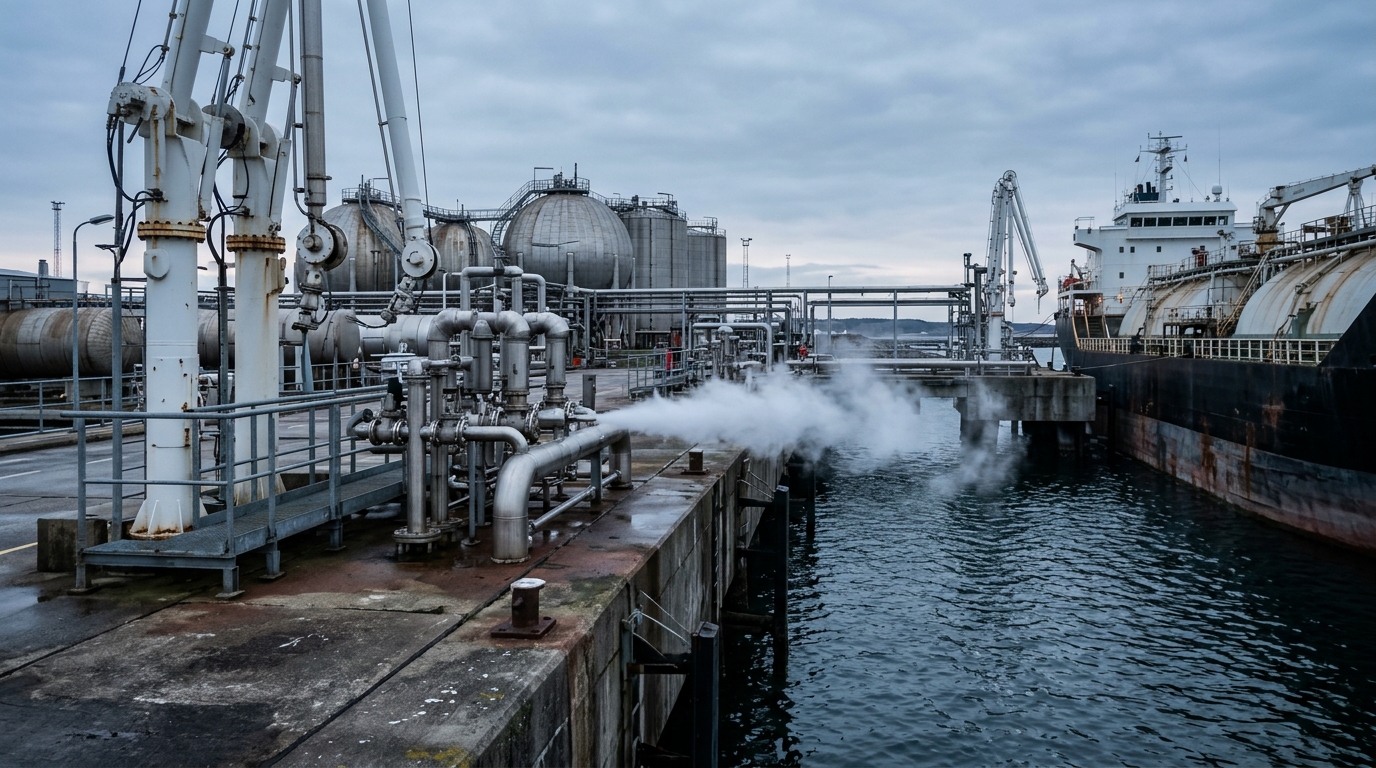
Large Eddy Simulation computational fluid dynamics provides realistic predictions of ammonia dispersion in complex port environments, outperforming standard integral models according to a comparative evaluation. Researchers evaluated the predictive performance of Large Eddy Simulation against two widely used integral models, SLAB and ALOHA. The assessment revealed that while simpler integral tools perform acceptably in open terrain, they exhibit significant predictive limitations when applied to built-up coastal infrastructure with dense structural obstacles.
Model predictive performance was first assessed against experimental data under three distinct chemical leakage conditions: gas-phase releases, two-phase releases, and two-phase releases with physical obstacles present. Following these baseline experimental evaluations, the researchers conducted full-scale port case studies examining potential toxic releases originating from a ship. These realistic maritime scenarios evaluated ammonia dispersion under both unobstructed seaward wind conditions and urban wind flows moving directly toward built-up port structures.
The study results showed that Large Eddy Simulation-based computational fluid dynamics provided realistic predictions of ammonia concentration distributions for both unobstructed seaward releases and built-up port scenarios. In addition, the SLAB and ALOHA integral models also exhibited acceptable predictive performance for the experimental cases and unobstructed seaward release scenarios when an appropriate phase model was selected, confirming their baseline utility in open, obstacle-free environments.
In contrast, the integral models consistently overpredicted ammonia concentrations behind the buildings in the urban scenario. Because integral models cannot adequately represent building-induced turbulent mixing, they overestimate hazardous concentrations along the downwind axis. Furthermore, these simplified tools cannot capture the lateral spreading of hazard zones caused by architectural obstacles, whereas Large Eddy Simulation provides substantially more reliable consequence predictions in obstructed environments.
Acute Exposure Guideline Level analyses further revealed distinct chemical hazard distributions between the two investigated release settings. For seaward releases, the high-severity AEGL-3 zone covered most of the dispersing plume. In the urban scenario, however, the AEGL-3 zone remained located near the leakage point, demonstrating how surrounding port structures directly alter concentration distributions during an accidental chemical discharge.
The Acute Exposure Guideline Level analyses also revealed that the lower-threshold AEGL-1 and AEGL-2 hazard zones spread irregularly through the gaps between buildings in the urban scenario. Because Large Eddy Simulation accounts for complex building-induced turbulent mixing, it accurately captures the irregular lateral spreading of hazardous concentrations, whereas integral models fail to represent lateral hazard development between structures.
Accordingly, the study findings indicate that integral models are better suited to dispersion in open, unobstructed environments. The researchers concluded that safety planners should use integral models with caution in built-up areas, limiting their application strictly to preliminary screening. For complex port environments with architectural obstacles, Large Eddy Simulation-based computational fluid dynamics provides the necessary predictive accuracy for dependable chemical hazard assessments.
Subject of Research: Atmospheric dispersion modeling and hazard assessment of ammonia in port environments
Article Title: Comparative evaluation of CFD and integral models for ammonia dispersion and hazard assessment in a complex port environment
Article References: Cui, Q. C., Oh, C. B., & Lee, C. Y. (2026). Comparative evaluation of CFD and integral models for ammonia dispersion and hazard assessment in a complex port environment. Air Quality, Atmosphere & Health, 19(12), Article 276. https://doi.org/10.1007/s11869-026-02169-0
Image Credits: AI Generated
DOI: 10.1007/s11869-026-02169-0
Keywords: ammonia dispersion, computational fluid dynamics, Large Eddy Simulation, SLAB model, ALOHA model, integral models, port environments, hazard assessment, Acute Exposure Guideline Levels, AEGL zones, turbulent mixing, gas-phase leakage, two-phase leakage, obstacle dispersion, seaward release, urban dispersion
News Source: Audrey Campbell. (November 27, 2026). Large Eddy Simulation Outperforms Integral Models in Port Ammonia Dispersion. Scienmag.