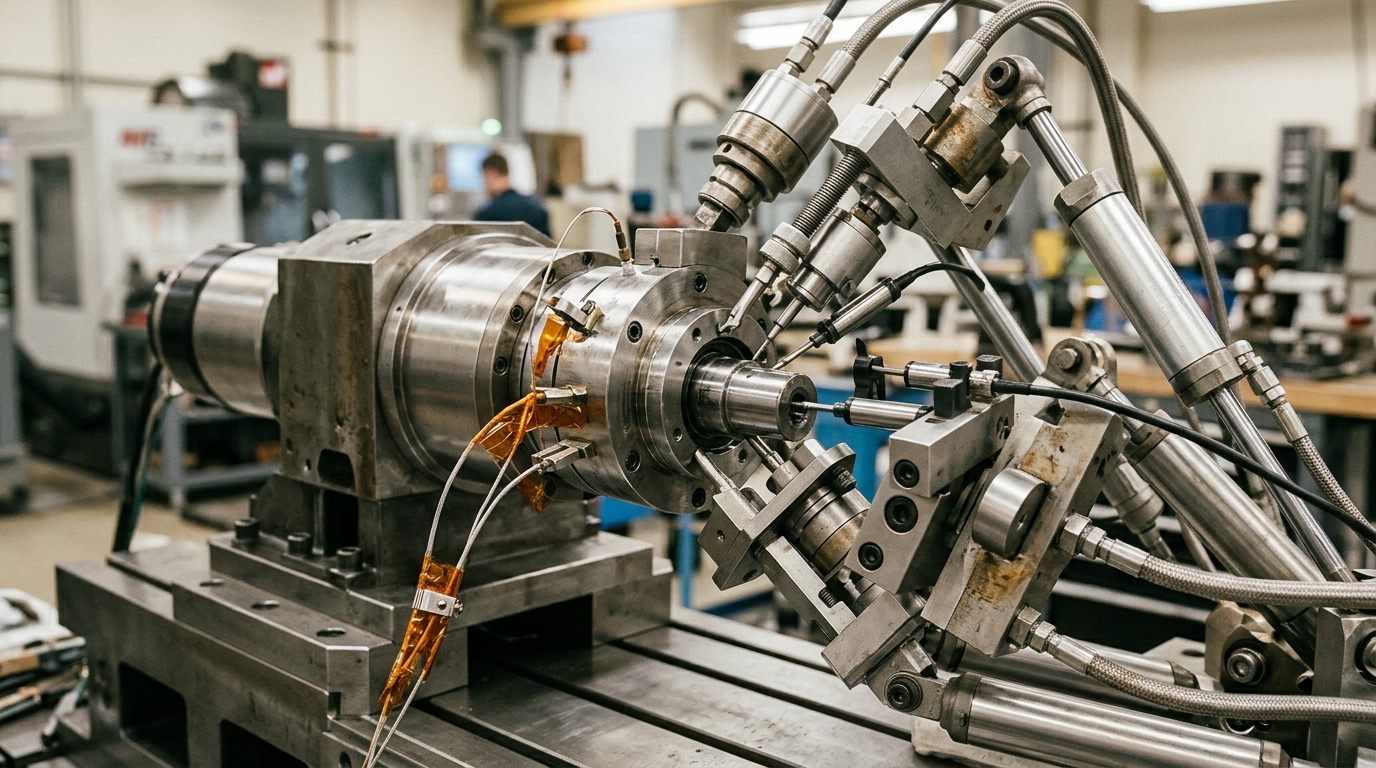
A research team led by Hongqiang Liu and colleagues at Dalian University of Technology, alongside collaborators from the Liaoning Province Research Institute of Industry and Information Technology and Smart Manufacturing Longcheng Laboratory, has engineered a compact on-machine testing device and an intelligent control architecture designed to evaluate how computer numerical control machine tools preserve their precision over time. In a paper published in Mechanical Sciences, the investigators describe how their system combines a three-degree-of-freedom Delta parallel mechanism with a backpropagation neural network and genetic algorithm model predictive control scheme to simulate cutting loads while compensating for force errors caused by thermal expansion in the machine tool spindle.
Evaluating machine tool accuracy retention requires applying controlled dynamic loads that mimic the multidimensional forces generated during actual metal-cutting processes such as milling, turning, and drilling. In service, machining forces resolve along the three orthogonal axes of the machine tool, driving mechanical wear and structural degradation over extended operating periods. However, introducing multi-axis dynamic loads inside the cramped operational envelope of a standard vertical machining center has historically posed severe design challenges. Conventional multi-axis test rigs tend to be bulky, limiting their application in compact machine tools, while simpler single-axis load devices fail to capture the complex, coupled multidirectional stress states experienced during real manufacturing runs.
To overcome spatial constraints without sacrificing mechanical robustness, the authors constructed a custom three-degree-of-freedom parallel mechanism based on the kinematic architecture of a Delta robot. The researchers replaced conventional rotary joints with three high-stiffness electric cylinders arranged symmetrically around a fixed base platform. In this configuration, the passive arms translate and rotate while the active pushrods move purely in translation, driving a mobile platform that delivers translational motion along the three Cartesian axes without allowing parasitic rotations.
The physical device measures 442 millimeters by 392 millimeters by 437 millimeters at rest, allowing it to be mounted directly onto the worktables of industrial vertical machining centers. Mechanical analysis based on cutting-load spectra and accelerated degradation criteria established target operating parameters, including a maximum load capacity of 2000 Newtons in each of the three orthogonal directions, an operational loading frequency capability of up to 25 Hertz, and a platform stroke range of plus or minus 5 millimeters per axis.
To establish baseline control, the investigators derived closed-loop kinematic constraint equations and solved the forward and inverse position problems for the parallel linkage. Using the principle of virtual work, they modeled the coupled inertial, gravitational, and external forces acting across the motor shafts, lead screws, pushrods, and passive limbs to synthesize a dynamics-based feedforward controller. Under this baseline formulation, desired force commands are converted into target pushrod displacements via kinematic and dynamic transformations, while discrepancies detected by the three-axis force sensor generate linear corrective displacements that are superimposed onto the primary drive commands.
Despite dynamic feedforward compensation, operational testing revealed a critical physical disturbance: sustained high-speed rotation of the machine spindle generates friction and motor heating, driving temperatures from an ambient 18 degrees Celsius up to approximately 29 degrees Celsius. This thermal rise induces substantial structural expansion along the machine tool spindle, displacing the tool holder relative to the table-mounted loading device. Under baseline feedforward control, while mean force deviations in the transverse plane remained relatively insensitive to temperature changes at approximately 30 to 50 Newtons along the horizontal axis and 180 Newtons along the perpendicular horizontal axis, axial thermal drift caused force deviation along the vertical spindle axis to expand from 150 Newtons up to roughly 630 Newtons at thermal equilibrium.
To counteract this thermally induced force deviation, the researchers developed an intelligent model predictive control architecture designated as BP-GA. The predictive element relies on a three-layer backpropagation neural network featuring three input nodes corresponding to the pushrod displacements, a hidden layer of ten neurons utilizing sigmoid activation functions, and three linear output nodes mapping predicted three-axis forces. The network was trained using conjugate gradient optimization on a dataset of 22,400 experimental samples gathered across seven days of preloading trials at 25 Hertz, achieving coefficients of determination exceeding 0.99 across all three orthogonal force components on unseen validation tests.
During active operation, the genetic algorithm executes receding-horizon optimization in real time across 50-millisecond control intervals, searching candidate cylinder displacement vectors within a single-step limit of plus or minus 0.10 millimeters. The optimization objective minimizes the sum of squared force-tracking errors while applying a penalty term that suppresses excessively large incremental displacements. The resulting optimal displacement command updates the lower-level programmable logic controller, whose inner position servo loops execute at a 1-millisecond period. Real-time readings from the three-dimensional force sensor then correct the neural network predictions at the start of each subsequent control cycle.
Comparative experimental trials conducted on a three-axis vertical machining center operating at a spindle speed of 4000 revolutions per minute, a 5-Hertz loading frequency, and 1500-Newton force amplitudes demonstrated marked improvements under the predictive control scheme. At the start of loading, BP-GA reduced mean force deviations to approximately 20 Newtons, 25 Newtons, and 65 Newtons across the three Cartesian axes. At thermal equilibrium, the predictive controller limited transverse force deviations to roughly 45 Newtons and 55 Newtons, and constrained the critical vertical spindle drift to approximately 250 Newtons. Across systematic parametric sweeps spanning frequencies from 5 to 15 Hertz, force amplitudes from 500 to 2000 Newtons, and spindle speeds from 2000 to 6000 revolutions per minute, the BP-GA method lowered root mean square tracking errors by 30 to 70 percent compared to pure dynamic feedforward control.
Following validation of the controller, the research team conducted a 25-day staged loading experiment on a domestic three-axis vertical machining center to observe machine tool geometric precision under simulated cutting conditions. The machine underwent multiple 30-hour loading cycles comprising 1000-Newton lateral loads, 1500-Newton axial loads, a 10-Hertz frequency, and a spindle speed of 4000 revolutions per minute. Multi-axis laser interferometer measurements tracking 15 geometric error components revealed that while angular errors remained generally stable, certain straightness error parameters exhibited preliminary signs of gradual growth amidst dominant random fluctuations, confirming the device’s utility for ongoing investigations into long-term degradation mechanisms.
To construct the predictive neural network, the researchers gathered data through a structured preloading routine where the three electric cylinders executed synchronized sinusoidal trajectories at twenty-five Hertz. Across seven consecutive days of eight-hour operations, displacement amplitudes escalated by zero point zero five millimeters daily from an initial baseline of zero point one zero millimeters. The acquisition system recorded cylinder positions and three-axis forces at a one-kilohertz sampling rate, extracting twenty complete steady-state cycles per hour with twenty evenly spaced points in each cycle. Partitioning each day’s data chronologically into seventy percent training and thirty percent testing sets preserved temporal integrity. Because forces spanned five hundred to two thousand Newtons while displacements remained within fractions of a millimeter, linear min-max normalization mapped all features into a zero-to-one interval. The network was trained using conjugate gradient optimization with a zero point zero one learning rate across thirty-five hundred iterations, accurately capturing peak test forces of eighteen hundred twenty-seven Newtons in X, seventeen hundred forty-four Newtons in Y, and two thousand eighty-nine Newtons in Z.
The receding-horizon optimizer relies on specific algorithmic mechanisms to solve the non-convex force-matching problem. For each cylinder, the genetic algorithm maintains an independent population of one hundred ten-bit binary strings representing candidate displacements. Its fitness function evaluates the inverse of an objective metric that penalizes tracking error alongside displacement magnitude, preventing erratic single-step actuator commands. Operating with roulette wheel selection, an eighty percent crossover probability, and a ten percent mutation probability, the search terminates after fifty generations or upon five successive iterations without improvement. In performance testing, this predictive compensation reduced transverse Y-axis force deviations by eighty-five percent initially and seventy percent at thermal equilibrium. In the vertical Z axis, where spindle heating produced severe axial displacement, predictive control curtailed force deviations by fifty-six percent at startup and sixty percent at equilibrium, holding overall relative force-tracking errors within five percent across all axes.
Calibration and measurement stages during the on-machine loading trial also followed rigorous structural protocols. A Renishaw XM-60 multi-axis calibrator established the initial geometric baseline across all three linear axes before dynamic excitation commenced. Testing alternated between three-day blocks of ten-hour loading runs and single-day calibration windows, gathering seven complete accuracy profiles across the twenty-five-day testing schedule. Although random fluctuations dominated the initial observation window, straightness error drift highlighted the necessity of longer-term evaluations to isolate wear phenomena. To build on these preliminary findings, the authors plan to evaluate static force generation, benchmark their predictive architecture against other established industrial force controllers, and integrate formal measurement uncertainty modeling to clarify how dynamic machining loads drive long-term structural degradation.
Subject of Research: Machine tool accuracy retention testing using parallel loading and neural network predictive control
Article Title: Research on the control method of a loading device for machine tool accuracy retention testing
Article References: Liu, H., Hu, M., Xing, J., Yang, H., Hong, W., Liu, K., & Guo, D. (2026). Research on the control method of a loading device for machine tool accuracy retention testing. Mechanical Sciences, 17(2), 1105-1119. https://doi.org/10.5194/ms-17-1105-2026
Image Credits: AI Generated
Keywords: Machine tools, Accuracy retention, Delta parallel mechanism, Model predictive control, Backpropagation neural network, Genetic algorithm, Spindle thermal deformation, Electric cylinders, Cutting force simulation, Vertical machining center, Force tracking, Feedforward control, Thermal drift compensation, Dynamic loading, Geometric accuracy, Multi-axis testing
News Source: Denise Maddox. (November 27, 2026). Parallel Loading Device and Predictive Control Counter Spindle Thermal Drift in Tests. Scienmag.