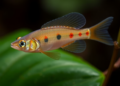
Credit: UTA
Shannon Beston, a third-year Ph.D. student in biology at the University of Texas at Arlington, was selected to receive funds from the National Science Foundation's Doctoral Dissertation Improvement Grants program to further her research into how brains and eyes evolved in response to predation.
The award will fund Beston's dissertation project, titled "The evolution of complexity: tests of the ecological drivers of eye size and brain size evolution in nature", which examines the evolution of complex traits in natural populations. Specifically, the work addresses how eyes and brains among populations of killifish, Rivulus hartii, found in the waters of the Caribbean off the island of Trinidad.
"Understanding how complex traits have evolved is a long-standing goal in evolutionary biology and the complex structure of the eye is frequently presented as an example of evolution that challenges the understanding of evolution by natural selection," Beston said.
While eye size varies extensively across species, there are very few studies that have evaluated how eyes evolve within a single species, she explained. Increases in eye size are associated with improved vision. As a result, shifts in eye size are likely connected, and potentially driven, by a variety of ecological factors, such as foraging, avoiding predators, and identifying mates. Rivulus are found in fish communities on the island that vary in predation intensity, ranging from sites where they are preyed upon by large fish to sites where they are the only species present.
"My most recent work, and the basis of the research I have proposed in the DDIG, has shown that increases in predation are associated with genetically based decreases in eye size," Beston said. "This work provides a clear link between an ecological driver of eye size evolution, but it does not establish causation. We still do not know why predators appear to select for a smaller eye size in Rivulus."
Beston hopes that the research she has proposed in the DDIG will begin to provide answers that establish a causal link between predators and prey eye size, rather than just a correlational relationship. The work she proposed involves a series of mark-recapture experiments where individual Rivulus specimens can be tracked both from populations with predators and without predators to look at how eye size correlates with variables like survival and growth rate.
"I also plan to complete perturbation experiments in the lab and in nature," she said. "These approaches will evaluate how natural selection is operating on eye size and will also allow us to experimentally test the influence of predators on eye size in Rivulus."
Matthew Walsh, UTA assistant professor of biology, said the funding will allow Beston to perform "ambitious, manipulative experiments in nature that have the potential to provide novel insights into how the vertebrate eye evolves."
"Shannon has shown tremendous growth as a Ph.D. student at UTA and is always willing to go the extra mile in the field and lab," Walsh said. "Her selection as a recipient of an NSF grant reflects the success she has achieved to date as well as the strong potential for continued success thereafter."
Beston plans to return to Trinidad to collect more specimens in August and December, as well as making several return trips in 2018, which will be paid for by her DDIG award.
###
About The University of Texas at Arlington
The University of Texas at Arlington is a Carnegie Research-1 "highest research activity" institution. With a projected global enrollment of close to 57,000, UTA is one of the largest institutions in the state of Texas. Guided by its Strategic Plan 2020 Bold Solutions|Global Impact, UTA fosters interdisciplinary research and education within four broad themes: health and the human condition, sustainable urban communities, global environmental impact, and data-driven discovery. UTA was recently cited by U.S. News & World Report as having the second lowest average student debt among U.S. universities. U.S. News & World Report lists UTA as having the fifth highest undergraduate diversity index among national universities. The University is a Hispanic-Serving Institution and is ranked as the top four-year college in Texas for veterans on Military Times' 2017 Best for Vets list.
Media Contact
Louisa Kellie
[email protected]
817-524-8926
@utarlington
http://www.uta.edu
Original Source
http://www.uta.edu/news/releases/2017/04/NSF%20biology%20student%20PhD%20grant.php