A comprehensive comparative evaluation of twenty-five digital wavelet filters across resting-state electroencephalography recordings from one hundred and nine healthy volunteers has demonstrated that wavelet performance depends primarily on the analyzed frequency band rather than on the recording electrode location. Conducted by an engineering research team at Universidad Politécnica Salesiana in Cuenca, Ecuador, the investigation systematically examined candidate functions from the Daubechies, Symlet, and Coiflet families under a unified mathematical framework. By analyzing twenty-seven thousand nine hundred and four distinct subject, channel, and frequency band observations, the authors established that no individual wavelet function operates as a universally optimal tool across the entire human electrophysiological spectrum. However, when evaluating the trade-offs among signal energy preservation, statistical variance, and spectral peak representation, the first-order Daubechies filter emerged as the most recurrently selected function, accounting for more than thirty percent of all highest-ranked computational selections.
Electroencephalography provides a foundational non-invasive clinical and research window into neurological function, capturing dynamic potential fluctuations that reflect coordinated brain activity across established clinical frequency bands. These physiological intervals traditionally comprise Delta oscillations between zero point five and four hertz, Theta rhythms between four and eight hertz, Alpha activity from eight to thirteen hertz, and Beta waves spanning thirteen to thirty hertz. Because raw scalp potentials exhibit inherently low amplitudes that remain exceptionally vulnerable to environmental noise, muscle interference, and baseline physiological fluctuations, robust mathematical decomposition remains vital for accurate diagnostic and research assessments. While classical spectral methods relying on the Fast Fourier Transform have long served the scientific community, their reliance on assumptions of signal quasi-stationarity limits their ability to capture transient physiological phenomena. In response, modern computational neuroscience increasingly depends on the Discrete Wavelet Transform, which simultaneously preserves both temporal and spectral information through localized analysis.
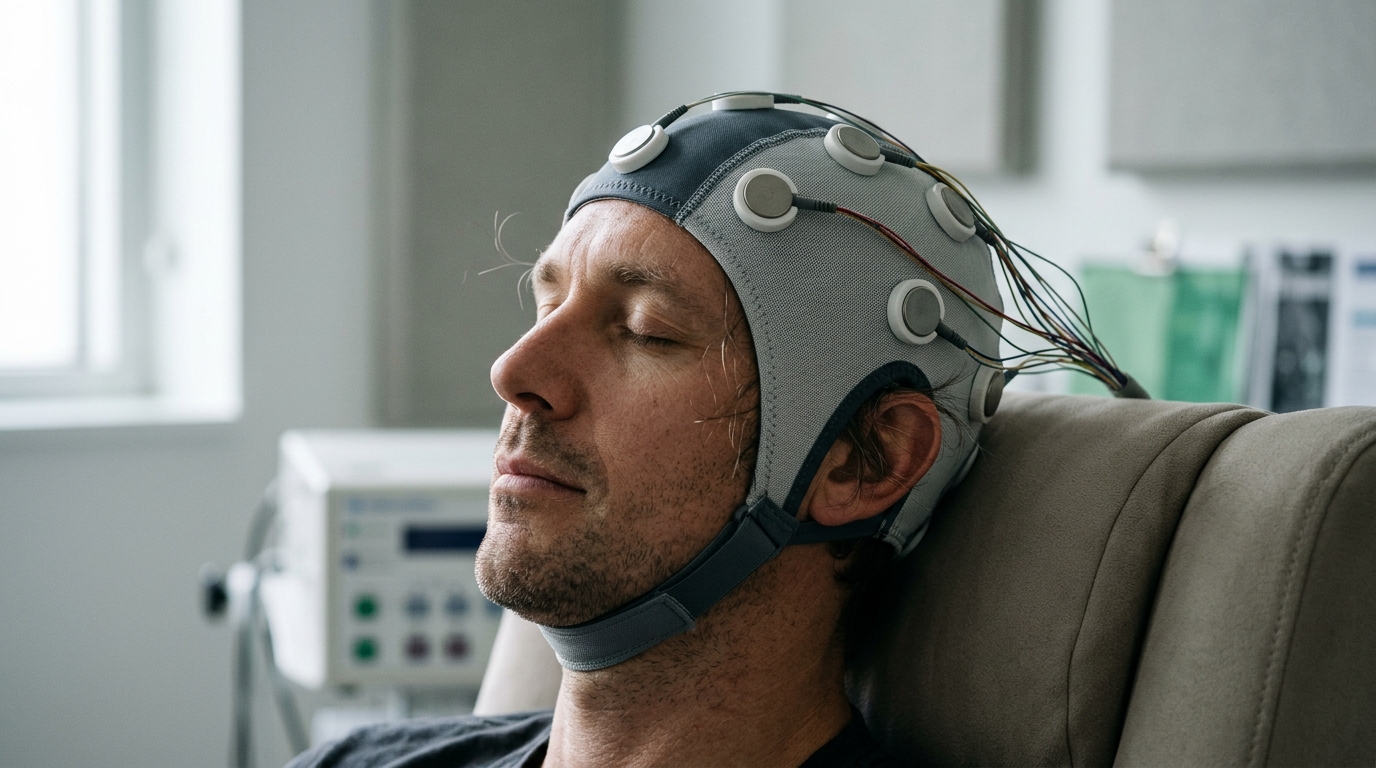
To evaluate wavelet filter behavior without introducing biases from task-related cognitive workloads, the authors examined sixty-one seconds of continuous resting-state electroencephalographic data recorded under standardized eyes-open conditions. The recordings were obtained from the publicly accessible EEG Motor Movement and Imagery Dataset hosted on PhysioNet, which gathered recordings from one hundred and nine participants using the BCI2000 platform. Signals were captured at a sampling frequency of one hundred and sixty samples per second across sixty-four scalp electrodes configured according to the international ten-ten electrode placement standard. Prior to signal decomposition, the researchers applied direct current removal to subtract the temporal mean from each electrode channel. To ensure that every candidate wavelet was assessed strictly against identical baseline physiological inputs, the workflow deliberately omitted secondary preprocessing interventions, such as independent component analysis, ocular or muscular artifact rejection algorithms, channel interpolation, baseline correction, and mathematical re-referencing.
Sub-band decomposition was executed computationally using the Maximal Overlap Discrete Wavelet Transform across seven distinct decomposition levels, implemented on a dedicated workstation using MATLAB R2024b routines. The authors evaluated twenty-five specific wavelet basis functions: ten Daubechies filters spanning orders one through ten, ten Symlet filters spanning orders one through ten, and five Coiflet filters spanning orders one through five. Because the transform utilizes dyadic octave-band frequency mapping, specific reconstruction levels were combined to approximate conventional clinical rhythms, mapping levels two and three to Beta, levels three and four to Alpha, levels four and five to Theta, and levels five through seven to Delta. This dyadic structure avoids temporal downsampling and preserves sample alignment across all reconstructed time series, although adjacent reconstructed physiological sub-bands necessarily share common wavelet decomposition coefficients, introducing partial spectral overlap along intermediate boundaries.
Following sub-band reconstruction, the team extracted key quantitative features across all channel combinations, evaluating instantaneous signal energy, empirical energy variance, dominant peak frequency, and peak frequency magnitude determined via the Discrete Fourier Transform. To address extreme signal fluctuations without distorting underlying physiological patterns, an empirical probability density function was generated for each energy histogram, and statistical outliers beyond lower and upper fences derived from the interquartile range were systematically removed. The cleaned energy distributions were subsequently standardized using min-max normalization onto a uniform zero-to-one interval. This normalization preserved the relative rank ordering of candidate filters within each experimental comparison group without artificially centering distributions around an arbitrary mean, providing a mathematically equitable scale to compare physical metrics possessing disparate numerical ranges and measurement units.
To characterize the mathematical structure of the decomposed brain wave energy, the empirical energy histograms were fitted against six theoretical probability distribution models: the Normal, Rayleigh, Weibull, Exponential, Gamma, and Lognormal distributions. Goodness of fit was systematically assessed using the one-sample Kolmogorov-Smirnov test evaluated at a five percent significance threshold, alongside parameter estimation routines that calculated theoretical distribution variances for each candidate model. Across the complete experimental dataset, the Normal distribution achieved the highest-ranked fit in forty-four point eighty percent of analyzed cases, while the Rayleigh distribution provided the best fit in thirty-four point thirty-seven percent of cases. Together, these two probabilistic models accounted for seventy-nine point seventeen percent of all evaluated energy distributions, whereas the Weibull model represented twelve point fifty-six percent, the Exponential model six point fifty-four percent, the Gamma model one point sixty-eight percent, and the Lognormal model just zero point zero one percent.
Inferential statistical evaluation using linear mixed-effects models demonstrated that individual wavelet filter selection exerts highly significant effects on reconstructed signal energy, peak frequency, and peak magnitude across all four physiological frequency bands. In univariate modeling treating the subject as a random intercept, the strongest wavelet-dependent effects appeared in the Theta and Alpha bands, where F-statistics for peak frequency reached two hundred and thirteen point ninety-three and forty-four point twenty-one, respectively. Conversely, empirical energy variance differed significantly among wavelet filters in the Delta, Theta, and Alpha bands, but showed no statistically significant differences across candidate filters in the Beta band, yielding an F-statistic of zero point nine five three and a p-value of zero point five two seven. These findings confirmed that filter stability and spectral selectivity respond differently depending on the specific frequency band under active investigation.
A broader factorial linear mixed-effects model assessing simultaneous fixed effects and interactions among wavelet choices, electrode channels, and frequency bands revealed that the analyzed frequency band is the dominant statistical driver of signal characteristics. The multivariate analysis revealed significant interaction effects between candidate wavelets and frequency bands for energy, peak frequency, and peak magnitude. In striking contrast, the interaction between individual wavelets and recording channels failed to reach statistical significance across all measured response variables, exhibiting p-values between zero point eight six eight and one point zero zero zero. This crucial statistical dissociation indicates that while wavelet performance shifts substantially as the analytical focus transitions between slow and fast electrophysiological rhythms, the relative ranking of wavelet filters remains broadly consistent regardless of where an electrode is placed across the human scalp.
To translate these multifaceted statistical observations into practical engineering guidance, the authors formulated an equally weighted composite score combining normalized energy preservation, empirical energy variance, and standardized peak frequency. When combined with recurrence frequency analysis across all twenty-seven thousand nine hundred and four subject-channel-band cases, the low-order Daubechies 1 filter achieved top ranking in eight thousand three hundred and ninety selections, representing thirty point zero five percent of the entire dataset. The fifth-order Coiflet filter ranked second globally, securing three thousand seven hundred and ninety-eight selections, or thirteen point sixty percent, followed by Daubechies 2 at eleven point twenty-eight percent and Daubechies 3 at nine point twenty-eight percent. Together, these four low-order wavelets accounted for sixty-four point twenty-one percent of all optimal selections, demonstrating that simpler filter designs consistently outperform complex higher-order alternatives within this processing framework.
The researchers emphasized that high composite scores must always be interpreted alongside global recurrence rates to prevent selecting isolated mathematical artifacts. For example, while the ninth-order Symlet filter achieved an elevated composite score of eight point eight zero four in the Beta band, this outcome represented an isolated maximum supported by a single subject-channel observation out of seven thousand instances. The investigators noted important study constraints, including the deliberate absence of automated artifact removal routines, which left residual ocular and frontal muscle potentials intact, and the partial spectral overlap inherent to dyadic wavelet reconstruction. Consequently, the authors concluded that future neuroengineering protocols should conduct wavelet optimization independently for each targeted frequency band rather than attempting channel-specific tuning or relying on a single supposedly universal wavelet filter across all electroencephalographic analyses.
Subject of Research: Comparative evaluation of wavelet families for resting-state electroencephalography signal decomposition and spectral analysis
Article Title: Analysis of wavelet families for characterizing energy and spectral amplitude in resting state EEG signals
Article References: Siguencia-Cruz, H., Obando-Flores, D. R., Peralta-Orellana, A. M., & Bueno-Palomeque, F. L. (2026). Analysis of wavelet families for characterizing energy and spectral amplitude in resting state EEG signals. Frontiers in Signal Processing, 6, 1878708. https://doi.org/10.3389/frsip.2026.1878708
Image Credits: AI Generated
DOI: 10.3389/frsip.2026.1878708
Keywords: electroencephalography, discrete wavelet transform, maximal overlap discrete wavelet transform, Daubechies wavelets, Symlet wavelets, Coiflet wavelets, biomedical signal processing, resting-state EEG, spectral analysis, probability distribution fitting, linear mixed-effects models, Kolmogorov-Smirnov test, signal energy, peak frequency, neurotechnology, brain rhythms, empirical variance
News Source: Cassandra Pierce. (November 27, 2026). Study Finds Daubechies Wavelets Lead Resting EEG Analysis Across Brain Bands. Scienmag.