• HOME
  • NEWS
  • EXPLORE
    • CAREER
      • Companies
      • Jobs
    • EVENTS
    • iGEM
      • News
      • Team
    • PHOTOS
    • VIDEO
    • WIKI
  • BLOG
  • COMMUNITY
    • FACEBOOK
    • INSTAGRAM
    • TWITTER
Wednesday, April 1, 2026
BIOENGINEER.ORG
No Result
View All Result
  • Login
  • HOME
  • NEWS
  • EXPLORE
    • CAREER
      • Companies
      • Jobs
        • Lecturer
        • PhD Studentship
        • Postdoc
        • Research Assistant
    • EVENTS
    • iGEM
      • News
      • Team
    • PHOTOS
    • VIDEO
    • WIKI
  • BLOG
  • COMMUNITY
    • FACEBOOK
    • INSTAGRAM
    • TWITTER
  • HOME
  • NEWS
  • EXPLORE
    • CAREER
      • Companies
      • Jobs
        • Lecturer
        • PhD Studentship
        • Postdoc
        • Research Assistant
    • EVENTS
    • iGEM
      • News
      • Team
    • PHOTOS
    • VIDEO
    • WIKI
  • BLOG
  • COMMUNITY
    • FACEBOOK
    • INSTAGRAM
    • TWITTER
No Result
View All Result
Bioengineer.org
No Result
View All Result
Home NEWS Science News Biology

Efficient technique discovered for isolating embryonic stem cells in cows

Bioengineer by Bioengineer
February 9, 2018
in Biology
Reading Time: 2 mins read
0
Share on FacebookShare on TwitterShare on LinkedinShare on RedditShare on Telegram
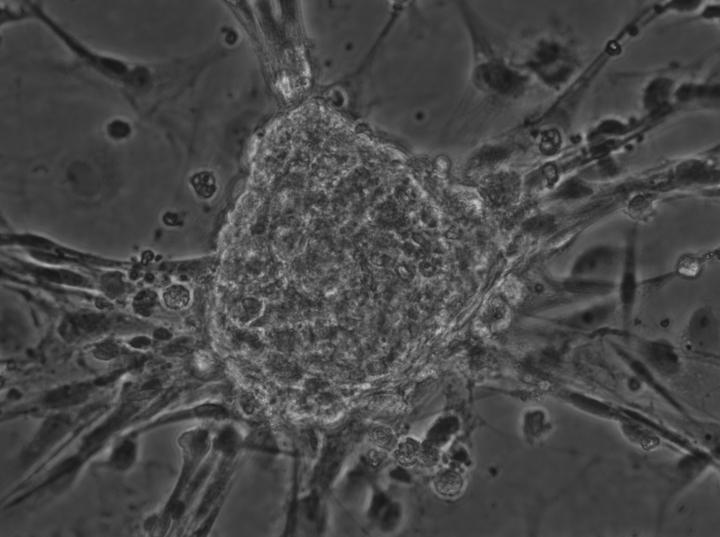
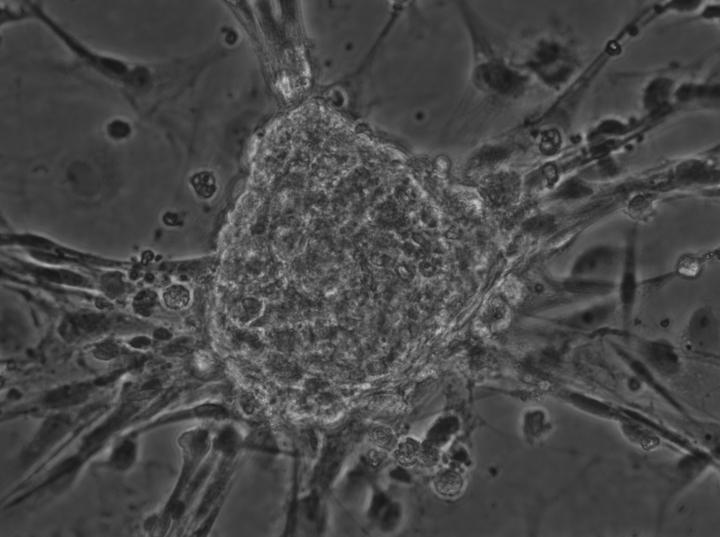
IMAGE

Credit: Pablo Ross / UC Davis

For more than 35 years, scientists have tried to isolate embryonic stem cells in cows without much success. Under the right conditions, embryonic stem cells can grow indefinitely and make any other cell type or tissue, which has huge implications for creating genetically superior cows.

In a study published this week in the journal Proceedings of the National Academy of Sciences, scientists at the University of California, Davis, were able to develop a new culture system that allows them to efficiently derive stem cells on almost every single attempt.

Producing embryonic stem cells from large livestock species like cattle is important for genetic testing, genome engineering and studying human disease. The cells may offer a better model for human stem cell therapies. Mice and rats are sometimes too small to demonstrate whether certain therapies will work on humans.

BREEDING A BETTER COW, FASTER

If researchers can generate gametes, or sperm and eggs cells, from the stem cell lines, the ramifications are profound. Such "in vitro" breeding could decrease the amount of time it takes to produce genetically superior cattle.

"That could revolutionize the way we do genetics by orders of magnitude," said study author Pablo Ross, an associate professor in the Department of Animal Science at UC Davis' College of Agricultural and Environmental Sciences.

In just a few years, scientists could speed up the process of improving generations by decades. "In two and a half years, you could have a cow that would have taken you about 25 years to achieve. It will be like the cow of the future. It's why we're so excited about this," said Ross.

The cow of the future could have more muscle, produce more milk, emit less methane, or more easily adapt to a warmer climate.

Ross envisions the findings helping the cattle industry become more sustainable. "Animals that are more efficient and have improved welfare, that may have more disease resistance is better for everyone," said Ross.

###

Additional co-authors include Yanina Soledada Bogliotti, Marcela Vilarino, Delia Alba Soto, Rafael Vilar Sampaio with the UC Davis Department of Animal Science; Jun Wu, with the University of Texas Southwestern Medical Center; Daiji Okamura with Kindai University; Cuiqing Zhong, Masahiro Sakurai, Keiichiro Suzuki and Juan Carlos Izpisua Belmonte with the Salk Institute for Biological Studies.

The research was supported by the National Institutes of Health and the U.S. Department of Agriculture.

Media Contact

Amy Quinton
[email protected]
530-752-9843
@ucdavisnews

http://www.ucdavis.edu

Original Source

http://www.ucdavis.edu/news/efficient-technique-discovered-isolating-embryonic-stem-cells-cows

Share17Tweet7Share2ShareShareShare1

Related Posts

Do Your Genes Influence How Lifestyle Choices Affect Aging?

Do Your Genes Influence How Lifestyle Choices Affect Aging?

April 1, 2026
Combining Single-Cell Multiomics Unlocks Precise Identification of Rare Cell Types and States

Combining Single-Cell Multiomics Unlocks Precise Identification of Rare Cell Types and States

March 31, 2026

Genetically Engineered Marmosets Pave the Way for Advancements in Human Deafness Research

March 31, 2026

How Great Hammerhead Sharks Outsmart Ocean Temperature Swings: Insights from FIU Researchers

March 31, 2026
Please login to join discussion

POPULAR NEWS

  • blank

    Revolutionary AI Model Enhances Precision in Detecting Food Contamination

    96 shares
    Share 38 Tweet 24
  • Imagine a Social Media Feed That Challenges Your Views Instead of Reinforcing Them

    1006 shares
    Share 398 Tweet 249
  • Promising Outcomes from First Clinical Trials of Gene Regulation in Epilepsy

    51 shares
    Share 20 Tweet 13
  • Popular Anti-Aging Compound Linked to Damage in Corpus Callosum, Study Finds

    43 shares
    Share 17 Tweet 11

About

We bring you the latest biotechnology news from best research centers and universities around the world. Check our website.

Follow us

Recent News

FGFR2b Links to Biomarkers, Tumor Diversity, Survival

Frailty, Malnutrition Link Falls to Daily Functioning

Dactylides D, E: Novel 22-Membered Polyol Macrolides

Subscribe to Blog via Email

Enter your email address to subscribe to this blog and receive notifications of new posts by email.

Join 78 other subscribers
  • Contact Us

Bioengineer.org © Copyright 2023 All Rights Reserved.

Welcome Back!

Login to your account below

Forgotten Password?

Retrieve your password

Please enter your username or email address to reset your password.

Log In
No Result
View All Result
  • Homepages
    • Home Page 1
    • Home Page 2
  • News
  • National
  • Business
  • Health
  • Lifestyle
  • Science

Bioengineer.org © Copyright 2023 All Rights Reserved.