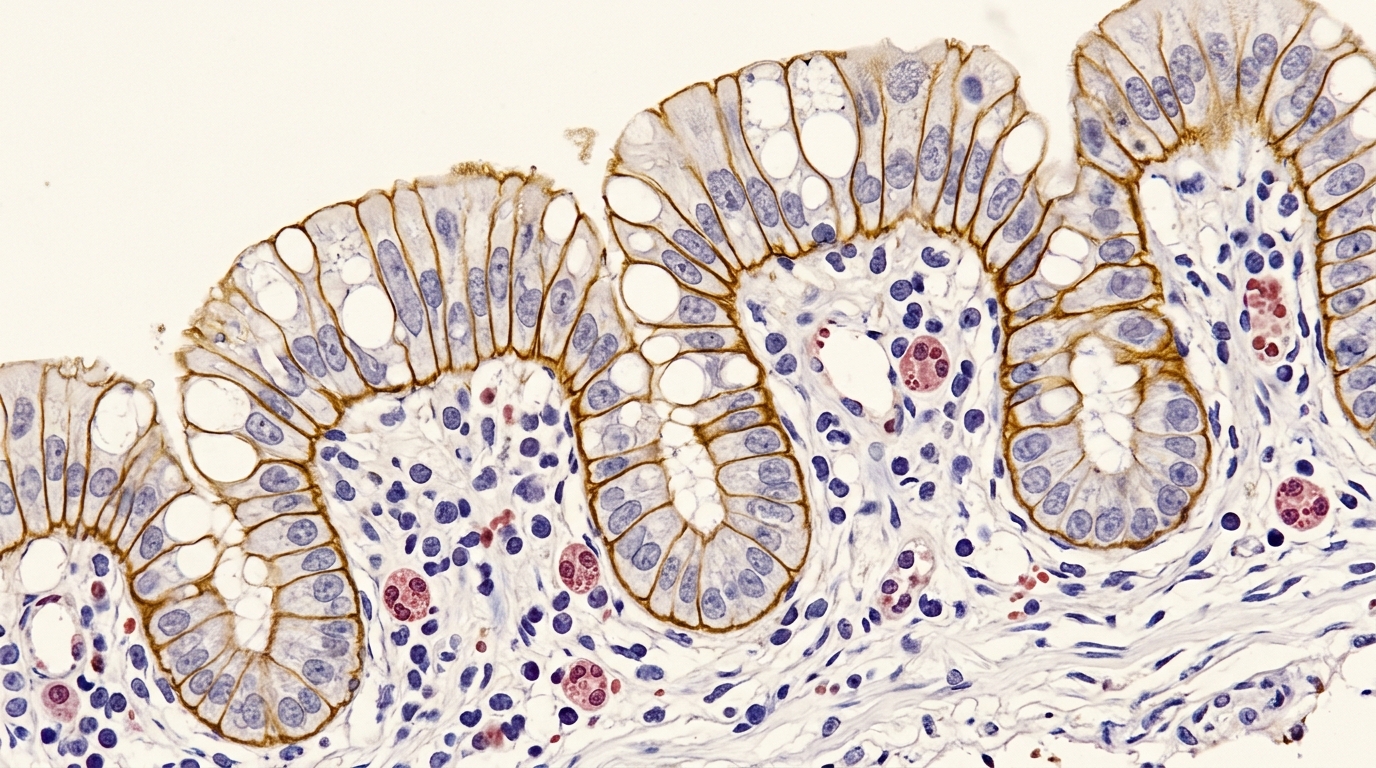
Researchers investigating inflammatory bowel disease have identified an association between reduced mucosal expression of the CDH1 gene, which encodes E-cadherin, and active disease status. In an observational multicohort study integrating public transcriptomic datasets with a clinical validation cohort, scientists evaluated how CDH1 expression relates to mucosal inflammation, the immune microenvironment, and clinical disease activity. Inflammatory bowel disease is characterized by an impaired intestinal epithelial barrier and dysregulated mucosal immunity. Although E-cadherin maintains epithelial integrity, its relationship with mucosal inflammation and disease activity in human inflammatory bowel disease has remained unclear, highlighting a need for reliable biomarkers to identify active disease.
The investigation adhered to STROBE and TRIPOD reporting guidelines to examine these molecular interactions. The research team analyzed transcriptomic data from cohorts GSE75214 and GSE179285 using weighted gene co-expression network analysis, functional enrichment, and immune deconvolution. To validate these computational observations, the investigators evaluated a clinical cohort comprising 115 individuals, including 8 normal controls, 48 patients with inactive inflammatory bowel disease, and 59 with active disease. Tissue specimens from this cohort were examined using quantitative reverse transcription polymerase chain reaction, immunohistochemistry, and multiplex fluorescence immunohistochemistry.
Molecular analyses demonstrated that CDH1 expression was significantly downregulated in active inflammatory bowel disease compared to inactive disease and normal tissue, with statistical significance below 0.001. This downregulation was validated across the public transcriptomic datasets, quantitative reverse transcription polymerase chain reaction, and immunohistochemistry. Furthermore, weighted gene co-expression network analysis linked CDH1-associated gene modules to epithelial barrier integrity, Rap1 signaling pathways, immune activation, inflammatory cascades, and extracellular matrix remodeling, mapping a biological connection between epithelial structural changes and inflammatory pathways.
To characterize the mucosal microenvironment, the authors performed computationally inferred immune deconvolution across the study cohorts. These analyses showed that reduced CDH1 expression correlated with increased proportions of M1 macrophages and activated CD4-positive T cells, alongside decreased resting dendritic cells and regulatory T cells. Direct spatial evaluation using multiplex fluorescence immunohistochemistry demonstrated that focal CDH1 loss co-localized with CD68-positive macrophage accumulation in peri-epithelial regions, confirming a spatial relationship between localized barrier disruption and immune infiltration.
The investigators next evaluated CDH1 as a predictive biomarker for active disease. Assessed alone, CDH1 showed moderate diagnostic accuracy, yielding an area under the receiver operating characteristic curve between 0.729 and 0.771. Using univariable and multivariable logistic regression, the researchers constructed a diagnostic prediction model. A clinical model including C-reactive protein, interleukin-6, fecal calprotectin, and Mayo Endoscopic Score achieved an area under the curve of 0.87. Adding CDH1 significantly enhanced predictive performance, raising the area under the curve to 0.90, with a DeLong test p-value of 0.008, an overall accuracy of 88.8 percent, and a Nagelkerke R-squared value of 0.783.
Internal validation of the prediction model was performed using 10-fold cross-validation and bootstrap resampling, demonstrating a mean cross-validated area under the curve of 0.89 and an optimism-corrected R-squared value of 0.75. Although these internal metrics demonstrated strong statistical performance, the authors stressed that causality between CDH1 loss and mucosal inflammation remains undetermined in this observational study. They emphasized that external validation in independent multicenter cohorts is required before the prediction model can be implemented in clinical practice.
Subject of Research: Association of CDH1 expression with disease activity and immune dysregulation in inflammatory bowel disease
Article Title: Association of reduced CDH1 expression with epithelial–immune dysregulation and disease activity in inflammatory bowel disease: a multicohort observational study with development and internal validation of a diagnostic prediction model
Article References: Chen, M., Zhu, Q., Liu, F., Zhao, Z., & Tao, Y. (2026). Association of reduced CDH1 expression with epithelial–immune dysregulation and disease activity in inflammatory bowel disease: a multicohort observational study with development and internal validation of a diagnostic prediction model. BMC Gastroenterology. https://doi.org/10.1186/s12876-026-05629-0
Image Credits: AI Generated
DOI: 10.1186/s12876-026-05629-0
Keywords: CDH1, E-cadherin, inflammatory bowel disease, epithelial barrier, mucosal immunity, disease activity, diagnostic prediction model, multicohort observational study, immune deconvolution, M1 macrophages, CD4+ T cells, regulatory T cells, multiplex fluorescence immunohistochemistry, fecal calprotectin, Mayo Endoscopic Score, WGCNA, Rap1 signaling, internal validation
News Source: Ophelia Keating. (November 27, 2026). Reduced CDH1 Expression Associates With Active Inflammatory Bowel Disease in Multicohort Study. Scienmag.