In an experimental laboratory investigation evaluating microbial metabolism outside the human body, researchers have demonstrated that dietary prebiotics exert markedly different functional effects on fecal samples derived from patients with active inflammatory bowel disease compared to those in clinical remission. The study, conducted by an interdisciplinary research team from Nanjing First Hospital affiliated with Nanjing Medical University, Jingzhou Central Hospital, and the Zhejiang Academy of Agricultural Sciences, deployed a standardized in vitro fermentation system to directly contrast how five distinct prebiotic substrates modulate bacterial populations and metabolic byproducts. Inflammatory bowel disease, which encompasses both ulcerative colitis and Crohn’s disease, represents a chronic and recurrent inflammatory disorder characterized by profound dysbiosis of the intestinal microbiome and reduced microbial diversity. Because gut microbiota modulation plays a crucial therapeutic role in managing intestinal inflammation and reinforcing epithelial barrier integrity, understanding how specific non-digestible carbohydrates interact with patient microbiomes at different disease stages is vital for developing targeted nutritional and clinical therapies.
The investigative team established their research framework around five chemically distinct prebiotic substrates: lactulose, fructooligosaccharides, isomaltooligosaccharides, mannan oligosaccharides, and xylooligosaccharides. In the gastrointestinal tract of healthy individuals, bacterial communities are typically dominated by the phyla Bacillota, formerly known as Firmicutes, and Bacteroidota, which act as the primary microbial engines generating short-chain fatty acids that maintain mucosal homeostasis. In contrast, patients suffering from inflammatory bowel disease frequently exhibit an elevated ratio of potential pathobionts relative to beneficial commensal microbes, triggering aberrant immune responses and disrupting the intestinal epithelial barrier. While earlier research established that substrates such as fructooligosaccharides could ameliorate colitis severity in murine models using chemical induction with dextran sulfate sodium, comparative evidence examining how various prebiotic classes influence human intestinal microbiota across active and remissive stages remained exceedingly sparse prior to this laboratory evaluation.
To investigate these microbial and biochemical dynamics under rigorous and reproducible experimental conditions, the researchers recruited human participants from the Gastroenterology Department of Nanjing First Hospital between July 2019 and January 2020. The final study cohort comprised 27 diagnosed patients with inflammatory bowel disease alongside 16 healthy normal control participants who were closely matched for age, sex distribution, and body mass index. Among the clinical cohort, 20 individuals had received diagnoses of Crohn’s disease, while seven had ulcerative colitis. Inclusion criteria mandated that all participants were at least 18 years of age, possessed confirmed clinical diagnoses in accordance with established diagnostic consensus opinions, had avoided both probiotic and antibiotic treatments for at least one full month prior to enrollment, and provided formal voluntary written consent approved by the hospital ethics committee. The investigators excluded prospective candidates who experienced acute infectious gastrointestinal diseases within the preceding month, as well as individuals presenting with severe cardiac, pulmonary, hepatic, or renal impairments, or malignant neoplasms.
Clinical characterization of the study population revealed detailed physiological and pharmacological profiles across all participant groups. Within the Crohn’s disease group, which included 16 male and four female participants with a mean age of 40.6 years and an average body mass index of 22.12 kilograms per square meter, the mean disease duration stood at 4.88 months. Clinical activity scoring classified six Crohn’s patients as having active disease, representing 30 percent of the subgroup, while 14 patients, or 70 percent, were in clinical remission. Montreal classification data indicated that 14 individuals were diagnosed between ages 17 and 40, six were diagnosed after age 40, four presented with ileal localization, 12 showed ileocolonic involvement, and four presented with combined upper and ileocolonic disease. Pharmacologically, one Crohn’s patient received 5-aminosalicylic acid, four were treated with immunosuppressants, and all 20 received biologic therapies. Among the seven ulcerative colitis patients, five were male and two female, with a mean age of 43.9 years, a mean disease course of 3.83 months, and two patients exhibiting active clinical disease alongside five in remission. Meanwhile, the healthy control cohort comprised 11 males and five females with a mean age of 43.2 years and an average body mass index of 21.0 kilograms per square meter.
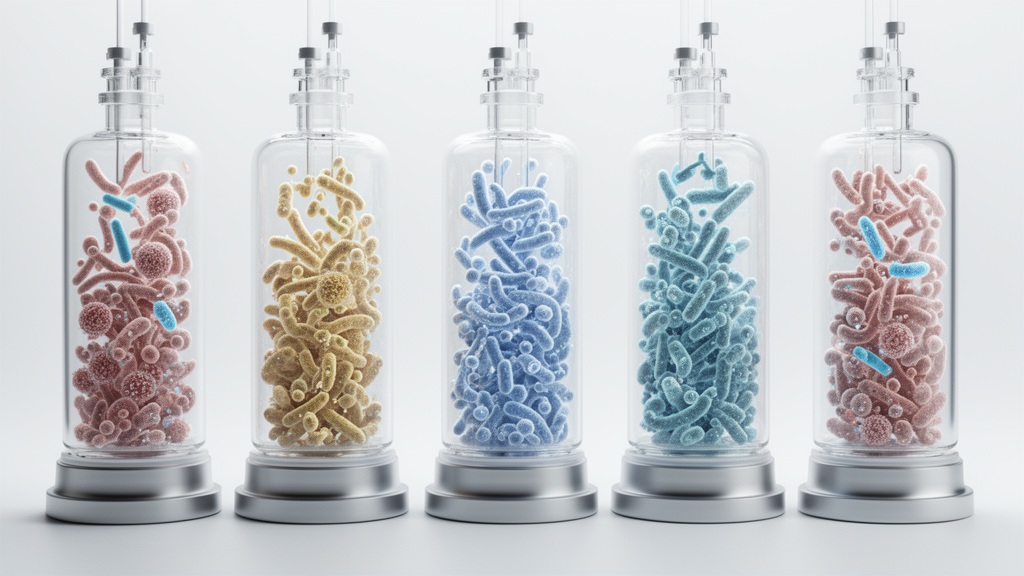
The experimental protocol relied on precise specimen collection, homogenization, and anaerobic culture procedures to simulate intestinal fermentative conditions. Fresh fecal specimens weighing 12 grams were collected in dedicated sterile containers and processed within four hours of defecation to preserve microbial viability. For each test, 0.8 grams of fresh stool was homogenized with eight milliliters of anaerobic phosphate buffer solution at neutral pH, yielding a standardized fecal slurry. The base liquid growth medium, designated YCFA, was protein-based and formulated with three grams per liter peptone, three grams per liter tryptone, 0.8 grams per liter L-cysteine monohydrochloride, 4.5 grams per liter yeast extract, 0.5 grams per liter mucin, 0.4 grams per liter bile salts, 0.05 grams per liter hemin, trace mineral solutions, Tween 80, and specific mineral salts including sodium chloride, potassium chloride, magnesium chloride hexahydrate, and potassium dihydrogen phosphate. Five experimental media variations were generated by supplementing this basal medium with 0.8 percent concentrations of lactulose, fructooligosaccharides, isomaltooligosaccharides, mannan oligosaccharides, or xylooligosaccharides. Serum bottles containing five milliliters of culture medium were flushed with nitrogen gas to establish strict anaerobiosis before autoclaving, after which 0.5 milliliters of fecal suspension was inoculated and incubated at 37 degrees Celsius for 24 hours.
To track microbial dynamics and metabolic outputs, the research team implemented quantitative real-time polymerase chain reaction and gas chromatography across all sample conditions before and after the 24-hour incubation period. Copy numbers per gram of wet feces were logarithmically transformed for statistical evaluation. Parallel metabolic evaluations quantified short-chain fatty acids in fermentation supernatants using a gas chromatograph equipped with a 30-meter DB-FFAP capillary column and a flame ionization detector, using trans-2-butenoic acid, commonly known as crotonic acid, as an internal quantitative standard. Acetic acid, propionic acid, and butyric acid concentrations were calculated based on established calibration curves. In addition, total fermentation gas accumulation was measured using a specialized precision differential manometer connected to the sealed incubation vessels at the conclusion of the 24-hour cycle.
Baseline biochemical profiling before fermentation revealed that total short-chain fatty acid concentrations, as well as individual levels of acetic acid, propionic acid, and butyric acid, were significantly depressed in fecal samples from inflammatory bowel disease patients compared to healthy controls. When fecal inocula from healthy control participants were incubated with the five prebiotics, supplementation with fructooligosaccharides, isomaltooligosaccharides, and xylooligosaccharides produced statistically significant increases in Bifidobacterium abundance compared to basal medium alone. However, healthy control samples showed no statistically significant alterations in overall short-chain fatty acid concentrations or Lactobacillus numbers following prebiotic exposure. Gas accumulation in the healthy group remained statistically comparable to the unsupplemented basal medium across most substrates, with the sole exception of mannan oligosaccharides, which induced a highly significant increase in head-space gas volume, registering a probability value below 0.001.
When analyzing the inflammatory bowel disease cohort as an entire group, the laboratory fermentation experiments demonstrated distinct substrate-dependent responses. While overall levels of total organic acids, propionic acid, and butyric acid did not display statistically significant increases across the full patient cohort, acetic acid levels rose significantly during fermentation supplemented with either isomaltooligosaccharides or xylooligosaccharides. Regarding bacterial community shifts, Lactobacillus populations expanded significantly following exposure to fructooligosaccharides and xylooligosaccharides, whereas Bifidobacterium abundance increased markedly under exposure to fructooligosaccharides, isomaltooligosaccharides, mannan oligosaccharides, and xylooligosaccharides relative to the basal medium. Concurrently, excessive gas accumulation within the inflammatory bowel disease samples was selectively provoked by lactulose and mannan oligosaccharides, while fructooligosaccharides, isomaltooligosaccharides, and xylooligosaccharides did not generate gas volumes exceeding control levels. Correlation analyses revealed that while both fructooligosaccharides and isomaltooligosaccharides drove significant positive associations between Bifidobacterium proliferation and acetic acid production, only isomaltooligosaccharides elevated absolute acetic acid concentrations across the full patient cohort.
The most clinically informative findings emerged from the subgroup analysis that stratified inflammatory bowel disease specimens according to clinical disease activity. At baseline, fecal samples taken from patients in clinical remission contained significantly higher baseline concentrations of total acids and acetic acid than samples harvested during active disease flare-ups, while other baseline microbial metrics trended higher in remission without reaching statistical significance. Following 24 hours of in vitro fermentation, samples from active inflammatory bowel disease patients showed no significant increase in short-chain fatty acid accumulation across any prebiotic condition. In terms of bacterial stimulation in active disease, mannan oligosaccharides and xylooligosaccharides significantly increased Lactobacillus counts, whereas xylooligosaccharides was the sole prebiotic substrate capable of significantly increasing Bifidobacterium abundance during active disease. Conversely, in samples representing clinical remission, acetic acid concentrations increased significantly after fermentation with isomaltooligosaccharides and xylooligosaccharides. Furthermore, remission samples supported significant Lactobacillus growth when challenged with fructooligosaccharides, while all four oligosaccharides—fructooligosaccharides, isomaltooligosaccharides, mannan oligosaccharides, and xylooligosaccharides—successfully boosted Bifidobacterium populations. Excessive gas generation in remission was restricted to lactulose and mannan oligosaccharides, whereas active disease samples generated no excess gas under any substrate.
Interpreting these experimental outcomes, the study authors highlighted that xylooligosaccharides demonstrated the most balanced and promising therapeutic profile among the five tested carbohydrates, successfully promoting beneficial probiotic proliferation in both active and remissive states without aggravating gas generation. In contrast, while lactulose is often studied for its potential antioxidant properties via hydrogen release, it failed to enhance beneficial probiotic abundances or short-chain fatty acid concentrations in this model and significantly stimulated gas production in remission samples, echoing past clinical trials where lactulose failed to improve mucosal endoscopic scores. The researchers acknowledged notable methodological limitations, including the small overall sample size of 27 patients, which could introduce analytical bias, and the inability to conduct separate statistical subgroup analyses contrasting Crohn’s disease against ulcerative colitis due to limited cohort numbers. They concluded that expanded clinical trials and controlled dietary intervention studies will be essential to validate whether targeted prebiotic supplementation can therapeutically modify intestinal dysbiosis in human patients.
Subject of Research: In vitro prebiotic fermentation across active and remissive inflammatory bowel disease
Article Title: Effects of different prebiotics in patients with inflammatory bowel disease: an in vitro fermentation model
Article References: Xu, Y., Ran, D., Zhu, L., Wang, X., & Zhang, Z. (2026). Effects of different prebiotics in patients with inflammatory bowel disease: an in vitro fermentation model. Frontiers in Microbiology, 17, Article 2027955. https://doi.org/10.3389/fmicb.2026.2027955
Image Credits: AI Generated
DOI: 10.3389/fmicb.2026.2027955
Keywords: inflammatory bowel disease, prebiotics, in vitro fermentation, gut microbiota, Bifidobacterium, Lactobacillus, short-chain fatty acids, xylooligosaccharides, fructooligosaccharides, isomaltooligosaccharides, mannan oligosaccharides, lactulose, acetic acid, gas production, Crohn's disease, ulcerative colitis, disease remission, active disease phase
News Source: Drew Townsend. (November 26, 2026). In Vitro Fermentation Model Compares Five Prebiotics Across Active and Remission IBD. Scienmag.