• HOME
  • NEWS
  • EXPLORE
    • CAREER
      • Companies
      • Jobs
    • EVENTS
    • iGEM
      • News
      • Team
    • PHOTOS
    • VIDEO
    • WIKI
  • BLOG
  • COMMUNITY
    • FACEBOOK
    • INSTAGRAM
    • TWITTER
Saturday, February 7, 2026
BIOENGINEER.ORG
No Result
View All Result
  • Login
  • HOME
  • NEWS
  • EXPLORE
    • CAREER
      • Companies
      • Jobs
        • Lecturer
        • PhD Studentship
        • Postdoc
        • Research Assistant
    • EVENTS
    • iGEM
      • News
      • Team
    • PHOTOS
    • VIDEO
    • WIKI
  • BLOG
  • COMMUNITY
    • FACEBOOK
    • INSTAGRAM
    • TWITTER
  • HOME
  • NEWS
  • EXPLORE
    • CAREER
      • Companies
      • Jobs
        • Lecturer
        • PhD Studentship
        • Postdoc
        • Research Assistant
    • EVENTS
    • iGEM
      • News
      • Team
    • PHOTOS
    • VIDEO
    • WIKI
  • BLOG
  • COMMUNITY
    • FACEBOOK
    • INSTAGRAM
    • TWITTER
No Result
View All Result
Bioengineer.org
No Result
View All Result
Home NEWS Science News Biology

Cells in standby mode

Bioengineer by Bioengineer
February 9, 2018
in Biology
Reading Time: 2 mins read
0
Share on FacebookShare on TwitterShare on LinkedinShare on RedditShare on Telegram
IMAGE

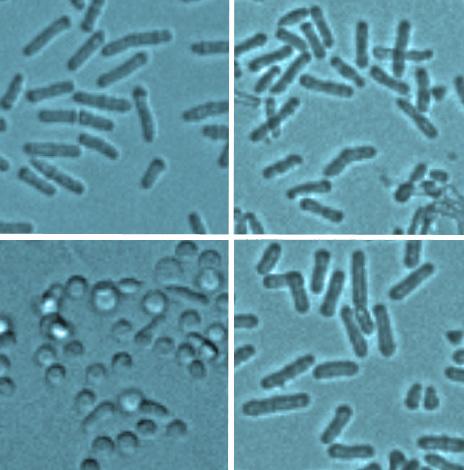
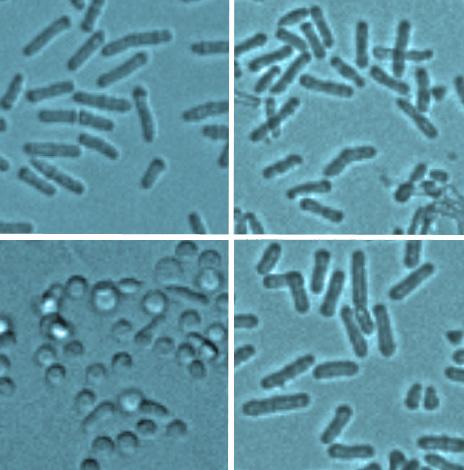
Normally, cells are highly active and dynamic: in their liquid interior, called the cytoplasm, countless metabolic processes occur in parallel, proteins and particles jiggle around wildly. If, however, those cells do not get enough nutrients, their energy level drops. This leads to a marked decrease of the cytoplasmic pH – the cells acidify. In response, cells enter into a kind of standby mode, which enables them to survive. A team of researchers from Dresden, Germany, have found out that the cytoplasm of these seemingly dead cells changes its consistency from liquid to solid. Thereby, they protect the sensitive structures in the cellular interior.

Cells can enter into a kind of standby mode – called dormancy – when confronted with unfavorable conditions such as nutrient deprivation. In this state, cells drastically reduce their metabolism and shut down growth and cell division. In extreme cases, such cells are hardly or not at all distinguishable from dead cells – and yet they can re-emerge from this state unharmed and continue to grow and divide when conditions in their environment improve.

Munder and colleagues from Dresden (Germany) under supervision of Simon Alberti wanted to understand how cells switch on and off the standby mode. They focused their efforts on yeast cells, which they observed during starvation. Their observation: The cytoplasm loses its dynamics, cell organelles and particles slow down and many proteins form large, microscopically visible structures. It seems as if the cytoplasm changes its consistency in response to nutrient deprivation. And indeed: a closer look with highly sensitive biophysical methods shows that the material state of the cytoplasm changes from liquid to solid – the cell enters into a kind of rigor mortis. As it turns out, the cytoplasmic pH, which decreases markedly under starvation conditions, plays a crucial role in this process.

Remarkably, the sleeping cells – in contrast to dead cells – can also reverse this process. When nutrients are added back, the pH rises again, the cytoplasm fluidizes and cells continue to grow and divide. The studies of Munder and colleagues show that the state of the cytoplasm is crucial for switching on and off the standby mode: ''Cells seem to have a control mechanism in place, which they use for the regulation of their material properties in response to certain environmental cues, thereby ensuring their survival''. Thus, it seems to be possible to trick death by shutting down all processes of life in a controlled manner. Whether this trick can be taught to human cells will become clear in the next couple of years.

###

Original publication

Matthias Munder, Daniel Midtvedt, Titus Franzmann, Elisabeth Nüske, Oliver Otto, Maik Herbig, Elke Ulbricht, Paul Müller, Anna Taubenberger, Shovamayee Maharana, Doris Richter, Jochen Guck, Vasily Zaburdaev and Simon Alberti
A pH-driven transition of the cytoplasm from a fluid- to a solid-like state promotes entry into dormancy
eLIFE, 22 March 2016
DOI: http://dx.doi.org/10.7554/eLife.09347
Published March 22, 2016

Media Contact

Dr. Matthias Munder
[email protected]
49-351-210-2830
@maxplanckpress

http://www.mpg.de
Share14Tweet8Share2ShareShareShare2

Related Posts

Florida Cane Toad: Complex Spread and Selective Evolution

Florida Cane Toad: Complex Spread and Selective Evolution

February 7, 2026
New Study Uncovers Mechanism Behind Burn Pit Particulate Matter–Induced Lung Inflammation

New Study Uncovers Mechanism Behind Burn Pit Particulate Matter–Induced Lung Inflammation

February 6, 2026

DeepBlastoid: Advancing Automated and Efficient Evaluation of Human Blastoids with Deep Learning

February 6, 2026

Navigating the Gut: The Role of Formic Acid in the Microbiome

February 6, 2026
Please login to join discussion

POPULAR NEWS

  • Robotic Ureteral Reconstruction: A Novel Approach

    Robotic Ureteral Reconstruction: A Novel Approach

    82 shares
    Share 33 Tweet 21
  • Digital Privacy: Health Data Control in Incarceration

    63 shares
    Share 25 Tweet 16
  • Study Reveals Lipid Accumulation in ME/CFS Cells

    57 shares
    Share 23 Tweet 14
  • Breakthrough in RNA Research Accelerates Medical Innovations Timeline

    53 shares
    Share 21 Tweet 13

About

We bring you the latest biotechnology news from best research centers and universities around the world. Check our website.

Follow us

Recent News

Inflammasome Protein ASC Drives Pancreatic Cancer Metabolism

Phage-Antibiotic Combo Beats Resistant Peritoneal Infection

Boosting Remote Healthcare: Stepped-Wedge Trial Insights

Subscribe to Blog via Email

Enter your email address to subscribe to this blog and receive notifications of new posts by email.

Join 73 other subscribers
  • Contact Us

Bioengineer.org © Copyright 2023 All Rights Reserved.

Welcome Back!

Login to your account below

Forgotten Password?

Retrieve your password

Please enter your username or email address to reset your password.

Log In
No Result
View All Result
  • Homepages
    • Home Page 1
    • Home Page 2
  • News
  • National
  • Business
  • Health
  • Lifestyle
  • Science

Bioengineer.org © Copyright 2023 All Rights Reserved.