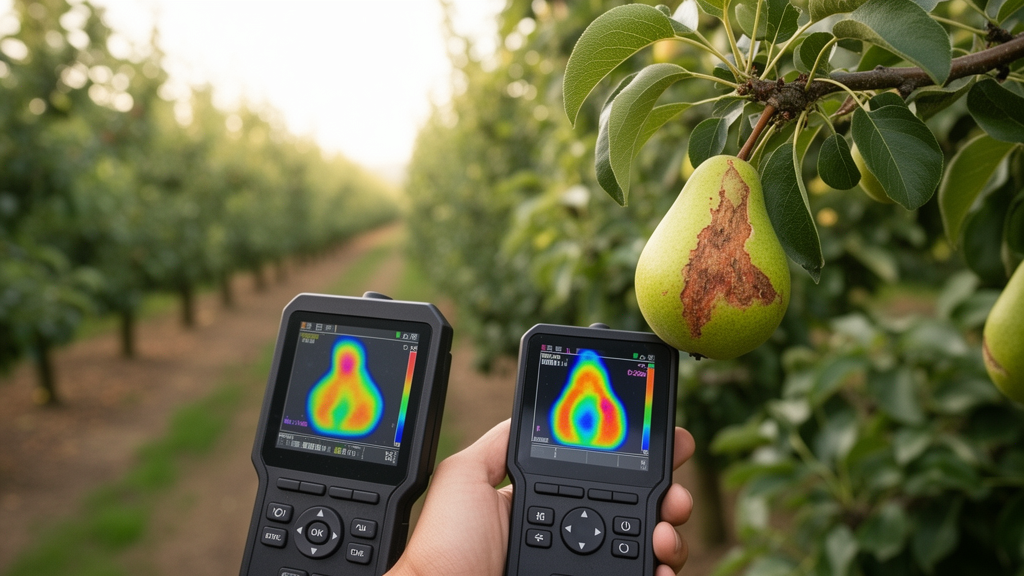
Agricultural researchers have developed FB-YOLO, a lightweight deep learning object detection framework engineered to identify early visible symptoms of fire blight directly in orchards. Fire blight, caused by the quarantine bacterium Erwinia amylovora, poses an enduring threat to global pome fruit cultivation, particularly commercial apples and pears. Disseminated by wind, insects, agricultural activities, and infected plant material, the pathogen infects hosts across the Rosaceae family in over sixty countries. Because early visible symptoms lack sufficient contrast with healthy foliage, manual inspection frequently fails to detect incipient disease foci before bacterial populations proliferate, leading to shoot dieback, tree mortality, and catastrophic orchard losses. Effective field management hinges on breaking pathogen transmission cycles through timely symptom detection and targeted pruning of infected shoots. FB-YOLO provides an automated computer vision mechanism designed to localize suspected symptom regions along infected shoots, offering an auxiliary screening tool to guide timely inspection by field personnel.
Manual orchard scouting is labor-intensive and unreliable for detecting subtle early symptoms, prompting exploration into automated monitoring through spectral remote sensing and computer vision. Prior spectral studies utilizing hyperspectral and multispectral sensors explored leaf-level diagnosis and canopy-level disease identification, including research by Skoneczny, Jarolmasjed, Xiao, Bagheri, and Mahmud. However, these spectral approaches focus on broad leaf- or canopy-level evaluations rather than bounding-box localization of shoot-associated symptoms. Moreover, high equipment costs, complex data processing, and limited spatial coverage constrain the practical deployment of hyperspectral systems. Conversely, deep learning computer vision architectures such as Faster R-CNN and Mask R-CNN provide symptom detection but remain computationally heavy for edge devices. While generic one-stage YOLO detectors offer favorable speed-accuracy trade-offs, their direct application to fire blight is impeded by three technical bottlenecks: an acute accuracy-lightweight trade-off in complex backgrounds, inadequate spatial feature modeling along directional leaf veins and shoots, and a lack of specialized knowledge distillation schemes.
To establish an effective detection model, the researchers constructed FireBlightSynth, a specialized dataset supervised by senior agricultural pathology experts to ensure rigorous annotation standards. The dataset integrates two distinct components: a curated subset of 1,526 expert-verified positive images from the public ERWIAM apple dataset and 1,350 raw field photographs collected in spring 2024. Field imagery was captured at an experimental fragrant pear orchard in Korla, Xinjiang, China, using a Canon EOS-70D DSLR camera across diverse shooting angles, distances, and illumination conditions. To unify annotation granularity, the authors excluded ambiguous suspected infections and broad shoot-level annotations from the public repository, while tightening bounding boxes and merging overlapping instances. Using TrexLabel in YOLO format, four symptom categories were standardized: flower infection showing browning and drying, necrotic anthers, milky-white viscous exudate diagnostic of Erwinia amylovora, and leaf infection characterized by wilting, curling, and vein necrosis, yielding 2,876 valid real orchard images.
Because biosafety constraints and seasonal pathogen lifecycles restrict real-image acquisition for quarantine diseases, the authors implemented an instance-level synthetic data augmentation strategy based on the extract-paste paradigm. Prior to synthesis, an independent evaluation set of 300 real images containing 1,432 annotated instances was frozen and strictly isolated from all synthesis canvases and training pools. From the remaining 2,576 real source images, an instance pool was constructed across the four symptom classes. An exponentially weighted sampling scheme calculated category weights to prioritize scarce anther and exudate instances, placing two to six targets per synthetic canvas. Sizing operations clamped bounding dimensions between 3 and 580 pixels on 640-pixel canvases while enforcing a 30-pixel border margin to prevent truncation. Horizontal flipping, brightness adjustments, and contrast scaling were selectively applied to rare categories, followed by a two-stage placement search restricting overlap to under five percent, generating 3,349 synthetic images to yield 6,225 total images with 28,813 annotated instances.
To overcome the representational limits of YOLOv8n in complex orchard environments, the researchers embedded the Coordinate Attention mechanism into the network backbone. Standard convolutional backbones with two-dimensional global pooling discard precise spatial coordinates, impairing the localization of subtle lesions that spread directionally along petioles, veins, and shoots. Coordinate Attention resolves this limitation by factorizing global pooling into two parallel one-dimensional feature encoding processes that aggregate spatial features separately along the horizontal and vertical coordinate axes. The resulting direction-aware feature maps are concatenated and processed through a shared one-by-one convolution with a channel reduction ratio, non-linear activation, and spatial splitting into orthogonal tensors. Independent convolutional transforms and sigmoid functions then generate coordinate attention weights that multiply the input feature maps element-wise. By embedding Coordinate Attention modules after the P3, P4, and P5 stages—corresponding to 64, 128, and 256 channels—FB-YOLO enhances multi-scale spatial discriminability and directional context with minimal parameter overhead.
To bridge the representational capacity gap between lightweight student networks and high-capacity architectures without increasing inference latency, the authors formulated a Hierarchical Knowledge Distillation framework. During student training, a high-capacity Coordinate Attention-enhanced YOLOv8x teacher model remains frozen, transferring dark knowledge through three integrated components: logit-level supervision, feature alignment, and class weighting. Logit distillation applies temperature scaling with a parameter of 5.0 to soften class probability distributions across prediction slots, using Kullback-Leibler divergence scaled by temperature squared to guide the student in learning inter-class structural similarities. For feature alignment, adaptive average pooling aligns the spatial dimensions of the teacher’s SPPF layer with the student, while a learnable bias-free one-by-one convolution projects the student’s channels to match the teacher, minimizing mean squared error. Additionally, class weighting applies inverse instance-frequency ratios to the classification loss branch, increasing gradient contributions from rare anther and exudate categories to reduce missed detections caused by training imbalance.
Experimental implementation was conducted in Python using PyTorch with CUDA 11.4 on a computing server equipped with an 80 GB NVIDIA A800 GPU. Models were trained for 100 epochs using 640 by 640 input resolution, batch size 16, and the SGD optimizer initialized with a learning rate of 0.005, momentum of 0.937, and weight decay of 0.0005. Training employed cosine learning rate annealing and disabled mosaic augmentation during the final five epochs to facilitate convergence on real background distributions. Total training loss combined the detection loss with logit distillation weighted at 0.7 and feature alignment weighted at 0.05. Performance was evaluated on the independent real test set using standard detection metrics: Precision, Recall, F1-score, and mean Average Precision at 0.5 IoU and across 0.50 to 0.95 thresholds. Computational efficiency was quantified through trainable parameter counts and theoretical GFLOPs, while practical physical performance was measured through end-to-end latency and frames per second.
Ablation experiments demonstrated the cumulative benefits of synthetic augmentation and structural optimizations. On the 300-image real test set, adding 2,679 synthetic images to 2,061 real training images increased YOLOv8n precision from 75.30 to 88.06 percent, recall from 66.43 to 68.23 percent, and mAP@0.5 from 73.42 to 80.12 percent. Sequential structural ablation confirmed that integrating Coordinate Attention into YOLOv8n raised recall from 68.23 to 72.84 percent and mAP@0.5 from 80.12 to 80.63 percent, with parameters rising only from 3.011 M to 3.023 M and GFLOPs from 8.1 to 8.2. Replacing intermediate channel-wise distillation with the full Hierarchical Knowledge Distillation framework further elevated recall to 80.50 percent, mAP@0.5 to 85.30 percent, and mAP@0.5:0.95 to 53.30 percent. Component testing verified that logit distillation, SPPF alignment, and class weighting contributed individual recall gains of 3.05, 2.39, and 2.03 percentage points. Compared to the massive YOLOv8x teacher, the FB-YOLO student retained 91.4 percent of teacher mAP@0.5 with approximately 22.6 times fewer parameters.
In benchmark comparisons against existing lightweight detectors, FB-YOLO achieved superior accuracy and recall. On the real test set, YOLOv5n achieved 85.00 percent precision and 69.00 percent recall, YOLOv9t reached 86.00 percent precision and 67.20 percent recall, and YOLOv10n recorded 86.00 percent precision and 68.00 percent recall. FB-YOLO achieved 88.20 percent precision and 80.50 percent recall, providing a 12.27 percentage point recall advantage over baseline YOLOv8n. Physical edge deployment was evaluated on an NVIDIA Jetson Orin Nano with 8 GB memory in 15 W power mode with jetson_clocks enabled, drawing approximately 12 W. Running FP16 TensorRT inference at 640 by 640 resolution, FB-YOLO recorded 42.9 ms mean latency, 45.1 ms P95 latency, and 23.3 FPS throughput. Compared to YOLOv8n, FB-YOLO added only 0.3 ms of mean latency, satisfying the 50 ms frame budget required for 20 FPS orchard screening, though falling short of the 40 ms budget needed for 25 FPS.
Grad-CAM visual heatmaps confirmed that FB-YOLO generated focused activations around subtle lesions in complex field scenes where YOLOv8n missed targets, including occluded leaves and early infections. Nevertheless, the authors outlined important operational constraints and limitations regarding the deployment of FB-YOLO. The model is specifically designed as an auxiliary screening tool to alert field personnel to suspected symptom locations for subsequent manual shoot inspection, rather than an autonomous replacement for professional agricultural pathology diagnosis or definitive pruning decisions. Detection failures still occur in scenarios with severe foliage occlusion and extreme low-contrast phenotypes. Furthermore, deployment testing was restricted to static images, indicating that continuous video streaming, temporal consistency, and higher frame rates require further optimization. Finally, because training datasets originated from specific orchard environments in Xinjiang, China, and Germany, extensive multi-region validation across diverse seasons, microclimates, and diverse pome fruit cultivars will be necessary before the technology is scaled for broader agricultural adoption.
Subject of Research: Lightweight deep learning object detection for early orchard fire blight symptoms
Article Title: FB-YOLO: Lightweight detection of early visible fire blight symptoms in orchards
Article References: Dai, X., & Jiang, Y. (2026). FB-YOLO: Lightweight detection of early visible fire blight symptoms in orchards. Smart Agricultural Technology, 15, Article 102787. https://doi.org/10.1016/j.atech.2026.102787
Image Credits: AI Generated
DOI: 10.1016/j.atech.2026.102787
Keywords: FB-YOLO, fire blight, Erwinia amylovora, YOLOv8n, Coordinate Attention, Hierarchical Knowledge Distillation, SPPF feature alignment, orchard monitoring, Jetson Orin Nano, edge computing, object detection, precision agriculture, pome fruit, FireBlightSynth, instance-level augmentation, plant pathology
News Source: Alan Morgan. (November 26, 2026). Lightweight Deep Learning Detector Identifies Early Fire Blight Symptoms in Orchards. Scienmag.