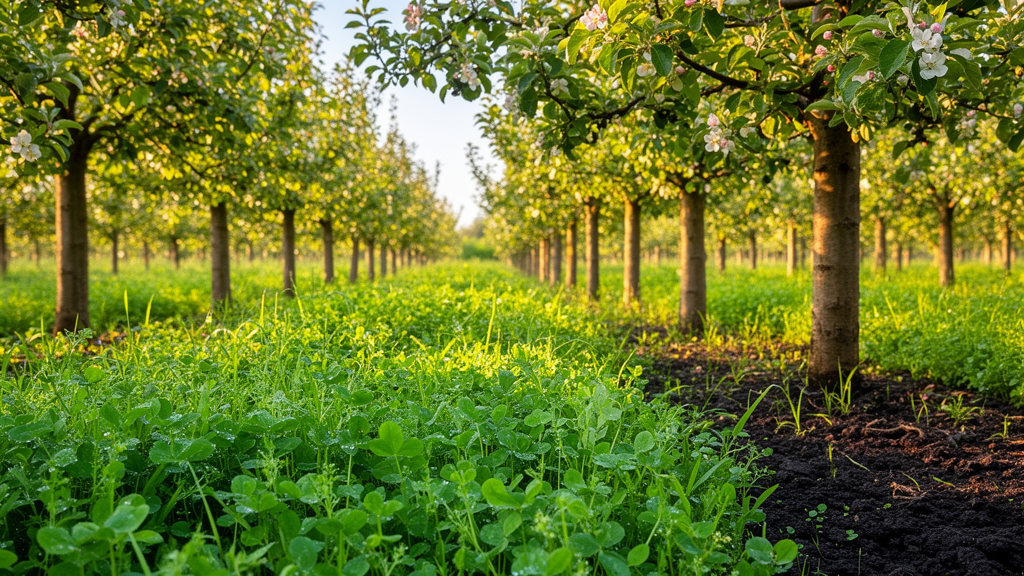
A comprehensive systematic review synthesizing research on orchard floor management demonstrates that integrating living mulch into fruit and olive orchards substantially enhances critical agroecosystem services, even as its direct effects on fruit yields display considerable context-dependent variability. Across an evaluated dataset of 394 orchard-specific studies drawn from an initial pool of 897 unique peer-reviewed publications, investigators examined the multifaceted outcomes of establishing herbaceous ground covers alongside woody perennial crops. The synthesised evidence indicates that living mulch consistently improves soil quality, bolsters biological activity, suppresses troublesome weed communities, and mitigates surface erosion, addressing several core vulnerabilities associated with conventional intensive monoculture and repeated mechanical or chemical weeding. Nevertheless, the systematic analysis reveals that tree yield responses do not follow a uniform trajectory across production environments: documented harvest outcomes spanned positive gains in 27 percent of evaluated references, completely neutral differences in 30 percent, and measurable yield declines in 34 percent, alongside five percent reporting mixed or variable performance. These divergent outcomes underscore that the practical success of vegetative soil cover relies on strategic plant selection and adaptive management rather than universal implementation routines.
Conventional soil management across commercial fruit and olive groves has long relied on intensive interventions, including continuous herbicide applications and mechanical tillage, designed to maintain completely bare ground along tree rows to eliminate vegetative competition for scarce water and mineral resources. While growers widely operate under the premise that any co-occurring ground vegetation will compromise tree development and harvest volume, persistent soil exposure causes severe agroecosystem degradation over extended production cycles. Bare orchard soil accelerates the loss of organic matter, compromises natural structural aggregates, diminishes microbial biodiversity, and increases susceptibility to extreme surface runoff, erosion, and soil sickness driven by the accumulation of single-crop residues and toxic metabolites. To evaluate agroecological alternatives, researchers analyzed living mulch, defined as one or more herbaceous species deliberately seeded or cultivated to coexist alongside the primary tree crop either throughout alleyway inter-rows or directly along tree rows. While cover cropping between tree tracks represents an established conservation approach, extending vegetative cover directly under the tree canopy targets the primary rooting zone, demanding a thorough synthesis of ecological processes and production trade-offs across diverse perennial systems.
The underlying evidence base synthesized within the systematic review comprises 394 targeted investigations distributed across seven distinct functional categories, capturing a wide spectrum of orchard types and geographic regions. Monospecific research efforts focused heavily on apple orchards, which accounted for 84 records, followed by olive groves with 62 records, citrus plantations with 46 records, pear plantings with 15 records, almond orchards with 13 records, peach blocks with 11 records, and vineyards with 10 records, while 112 multi-species studies and 43 publications covering 18 additional woody crops provided broader comparative depth. An UpSet intersection analysis of category distributions revealed that soil chemical properties formed the most extensively investigated domain, appearing in 120 publications and representing the most frequent standalone research subject with 49 dedicated articles. Biodiversity represented the second largest functional category with 109 records, followed closely by tree agronomic performance across 97 records, weed suppression across 82 records, soil physical properties across 66 records, pest regulation across 49 records, and root system dynamics across five specialized investigations. Notably, the most frequent inter-category intersections linked agronomic crop performance with soil chemical dynamics and biodiversity with weed management, with each paired topic appearing together across 18 specialized publications.
Suppression of undesired weed species represents the primary management motivation for orchardists considering living mulch systems, and the synthesized evidence reveals that controlled plant diversification substantially curtails spontaneous weed density and competitive biomass. High weed biomass under conventional management typically results from the dominance of a few highly competitive, specialized weed species that share resource acquisition traits with fruit trees. In contrast, introducing functional herbaceous covers composed of Poaceae and Fabaceae, whether grown as single species or integrated mixtures, suppresses weed establishment through both physical competition and specialized biochemical interference known as allelopathy. Members of the grass family release allelochemicals classified into phenolic acids, hydroxamic acids, alkaloids, and quinones from roots, grains, and pollen, directly inhibiting weed germination rates, radicle extension, and shoot development. Among leguminous species, hairy vetch synthesizes cyanamide, which disrupts root cell division in emerging competing plants, while red clover discharges phytotoxic isoflavonoids into the surrounding soil profile. Furthermore, fine fescue grasses discharge root leachates enriched with meta-tyrosine, a non-protein amino acid functioning as a natural post-emergence bioherbicide that arrests the early development of neighboring seedlings.
Beyond suppressive biochemical interactions, living mulches drive substantial biological rejuvenation throughout the orchard floor by increasing the polygenicity of decomposing plant residues, counteracting the microbial homogenization typical of monoculture soils. The introduction of diverse organic tissues provides heterogeneous substrates for soil microbiota, accelerating organic matter humification while keeping phytotoxic metabolite levels low and curtailing the incidence of soil sickness. Documented field trials demonstrate that soils managed under living mulches sustain greater microbial biomass, taxonomic richness, and functional enzyme activity compared with continuously bare ground. This biological stimulation directly supports long-term nutrient cycles, driving significant increases in total soil organic carbon, accessible nitrogen, and potassium concentrations, especially when leguminous covers are integrated. Although microbial biomass nitrogen acts as an active biological sink that later mobilizes plant-available nitrogen, researchers observed that permanent grass covers may induce temporary reductions in phosphorus availability through competitive uptake by dense herbaceous root networks during initial establishment years. Nevertheless, long-term meta-analyses confirm that such temporary phosphorus reductions in alleyways rarely impair harvest yields when vegetative growth is balanced by minimal tillage or periodic mechanical mowing.
The structural characteristics of orchard soils also undergo marked physical amelioration under established living covers, fostering increased resistance against climatic extremes and heavy precipitation events. Across multiple long-term field trials, soil bulk density decreased while total porosity, capillary networks, and macro-aggregate structural stability increased substantially relative to herbicide-treated or bare tilled surfaces. In a thirteen-year experiment in south-west Poland involving sheep fescue and common bentgrass mulches in apple orchards, researchers recorded a 1.38-fold increase in the ratio of stable-to-unstable soil aggregates alongside enhanced infiltration capacity. Similarly, a fifteen-year citrus experiment in southern China demonstrated that continuous grass covers reduced annual runoff by 83.57 percent and restricted soil erosion to merely 0.57 percent of the soil loss documented under clean tillage. In sloped tropical olive groves, living covers drastically reduced surface water loss where runoff on bare ground absorbed nearly half of total rainfall. Moreover, continuous vegetation provides an essential thermal buffer, dampening daily surface soil temperature swings and preventing excessive summer heat absorption within the top twenty to thirty centimeters of topsoil, thereby protecting vulnerable tree roots from severe heat stress.
Biological pest regulation represents another major functional dimension influenced by vegetative ground cover, as diversified plant architecture supplies critical microclimates and supplementary floral resources for beneficial organisms. Ground covers elevate relative humidity, moderate canopy temperatures, and reduce wind turbulence, creating favorable ecological niches that support diverse communities of natural enemies, including predatory mites, parasitoids, and active pollinators. In olive and apple orchards, researchers documented enhanced arthropod predator densities and canopy biocontrol efficacy when mixed grass covers were maintained continuously rather than subjected to intensive, uninterrupted mowing cycles, especially where covers were permitted to flower. Controlled studies in citrus groves similarly confirmed increased biological suppression of pest populations under specific living mulch species. However, evidence shows that the spatial configuration and longevity of the ground cover dictate practical pest suppression outcomes; narrow vegetative strips restricted solely to inter-row midpoints or short-cycle monospecific covers interrupted by subsequent herbicide treatments failed to alter insect communities or suppress canopy pests, confirming that ecological benefits require spatial and temporal continuity across the grove floor.
Direct assessments of tree root architecture demonstrate that introducing living mulch modifies subsurface spatial distribution, as tree roots must share the subterranean profile with competing herbaceous root systems. In unmanaged bare soil, fruit tree roots typically colonize the entirety of available topsoil; however, the presence of vigorous living mulch roots frequently induces morphological shifts, encouraging deeper root colonization and stimulating mycorrhizal associations and root hair proliferation. Controlled field investigations in citrus, grapevine, and apple plantings indicate that living mulch established along tree rows generally shifts tree root density away from upper layers toward deeper, more stable soil horizons. While this downward displacement can reduce shallow root biomass and restrict vegetative shoot expansion, it simultaneously builds systemic environmental resilience by anchoring roots into moist, temperature-buffered horizons that remain insulated against surface heat and brief droughts. In mature vineyards and high-density orchards, controlled competition from living mulches successfully curtailed excessive vine and canopy vigor, enhancing grape phenolic composition and anthocyanin concentrations without inducing physiological tree exhaustion.
Despite clear ecological and environmental contributions, living mulch systems introduce notable agronomic and operational challenges that explain grower hesitation and yield reductions under unmanaged conditions. Fruit trees compete poorly against aggressive herbaceous covers, particularly during young establishment phases, within coarse soils, or across rainfed environments receiving less than 700 millimeters of annual precipitation. In such moisture-limited settings, excessive transpiration by unmanaged cover plants can deplete critical moisture reserves within upper soil layers, diminishing tree vigor and commercial fruit yields unless mowing frequencies are carefully elevated. Furthermore, dense vegetative mats along tree rows establish protective habitats for destructive rodent populations, specifically voles from the genus Microtus, which feed on bark and structural tree roots. Researchers have demonstrated that rodent damage can be suppressed by integrating rodent-repellent plant species containing specialized secondary metabolites, such as coumarin-rich sweet woodruff or aromatic terpenoids, or by employing shallow horizontal blade weeders that sever weed taproots and disrupt underground rodent galleries without destabilizing aggregate topsoil structure.
Successfully integrating living mulch into commercial fruit and olive orchards requires shifting from rigid weed eradication toward adaptive agroecological management tailored to specific pedoclimatic and socio-economic contexts. Authors of the review emphasize structured multicriteria selection frameworks, such as three-step evaluation grids that systematically filter candidate cover species based on vegetative architecture, commercial seed availability, farm machinery constraints, and specific ecosystem service requirements. To maximize functional diversity while limiting competition, multi-species mixtures can be strategically deployed, combining understory nitrogen-fixing legumes beneath trees with erosion-controlling grasses across alleyways, or intercropping commercial aromatics such as capers and winter thyme to generate secondary farm income. Furthermore, long-term sixteen-year trial data indicate that initial competitive yield depressions during orchard establishment dissipate as trees adapt their root profiles, ultimately matching the yields of bare-ground orchards while safeguarding fragile topsoils from irreversible structural and biological degradation. Expanding living mulch adoption across global orchards will ultimately depend on farmer participation, species diversification, and recognizing the durable economic value of long-term ecosystem stability over short-term monoculture yields.
Subject of Research: Systematic review of living mulch impacts on fruit and olive orchard agroecosystems
Article Title: Living mulch in fruit and olive orchards. A review
Article References: Giorgi, V., Monaci, E., Lodolini, E. M., & Neri, D. (2026). Living mulch in fruit and olive orchards. A review. Agronomy for Sustainable Development, 46(4), Article 47. https://doi.org/10.1007/s13593-026-01120-y
Image Credits: AI Generated
DOI: 10.1007/s13593-026-01120-y
Keywords: living mulch, orchard floor management, agroecology, weed suppression, soil fertility, soil physical properties, soil erosion control, fruit tree yield, olive orchards, apple orchards, allelopathy, soil microbial biomass, soil organic carbon, cover crops, root system dynamics, biological pest control, water infiltration
News Source: Alan Morgan. (November 26, 2026). Orchard Living Mulch Enhances Soil Ecosystem Services Despite Variable Yield Impacts. Scienmag.