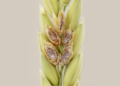
A deterministic and stochastic modeling investigation published in the Bulletin of Mathematical Biology by Bernard Asamoah Afful and Luis F. Gordillo reveals that Black Sigatoka disease, caused by the airborne fungus Pseudocercospora fijiensis (formerly Mycosphaerella fijiensis), exhibits a backward bifurcation that permits stable endemic persistence even when the basic reproduction number falls below unity. Black Sigatoka represents one of the most destructive threats to global banana and plantain production, causing extensive leaf necrosis and premature defoliation before fruit bunches reach maturity, resulting in commercial yield losses that frequently exceed 50 percent in the absence of intensive control measures. While classical epidemiological theory suggests that driving the basic reproduction number below one guarantees eradication, the researchers demonstrate that the pathogen’s reproductive biology creates a bistable regime where a stable endemic equilibrium coexists with the disease-free state. This dynamic theoretical framework directly explains the historic resilience of the disease and clarifies why conventional control measures relying solely on standard reproduction thresholds repeatedly fail in commercial plantations.
The persistence of Pseudocercospora fijiensis is heavily anchored in its polycyclic life cycle and dual spore dispersal pathways, which combine rapid local infection with broad geographical distribution across banana plantations. The infection cycle progresses across four defined phases on the host plant: exposure, incubation, latency, and spore production, with spore germination typically occurring within two to three hours under favorable conditions of high relative humidity and free water. In susceptible host cultivars, leaf susceptibility decreases with age, concentrating spore deposition and initial germination on young leaves. Once established, the fungus spreads via two distinct spore forms: asexual conidia and sexual ascospores. Conidia, generated in young to intermediate lesions, disperse locally through rain splash, water runoff, or localized wind, driving rapid polycyclic progression within fields. Conversely, sexual ascospores mature within pseudothecia on necrotic leaf tissue and forcibly discharge under wet conditions, enabling long-distance windborne travel spanning tens to hundreds of kilometers and serving as primary inoculum to re-infect sanitized groves.
The central driver of the backward bifurcation identified by the authors is the heterothallic reproductive biology of Pseudocercospora fijiensis, which requires physical proximity between two compatible mating types, MAT1-1 and MAT1-2, for sexual fertilization. On necrotic tissues, receptive hyphae must be fertilized by spermatia of the opposite mating type to generate viable pseudothecia and ascospores. At low densities of infected leaf biomass—such as during initial pathogen invasion or following aggressive sanitation—compatible mating encounters are rare, inducing an Allee effect through density-dependent mate limitation that suppresses per-capita sexual reproduction. The authors mathematically formulated this encounter limitation using the saturation function g(I) = lambda * I / (1 + lambda * I), where infected leaf biomass is denoted by I and lambda represents a positive encounter rate parameter. At low pathogen densities where I is much smaller than 1 / lambda, ascospore production scales quadratically as alpha * lambda * I squared, reflecting pairwise mating constraints, whereas high densities allow ascospore production to reach its maximum rate as mating opportunities saturate.
To formalize these interrelated host and pathogen mechanisms, the authors formulated a deterministic system of differential equations tracking four host leaf biomass compartments alongside asexual and sexual spore densities. Total leaf biomass density N is partitioned into susceptible leaves H, resistant leaves R, exposed latent leaves E, and infected leaves I. Fresh host biomass enters the plantation at recruitment rate Lambda, with a fraction kappa entering as susceptible tissue and the remaining fraction 1 minus kappa exhibiting resistance efficacy delta, which quantifies the suppression of spore penetration and germination. Natural leaf senescence occurs at constant rate mu, while cultural sanitation practices remove infected foliage and both spore populations at per-unit rate rho. Pathogen transmission incorporates relative humidity h and temperature T through a response function beta(h, T) that combines humidity saturation with half-saturation constant K_h and a Gaussian thermal response centered at optimal temperature T_hat. The infection force blends mass-action incidence for windborne ascospores with frequency-dependent standard incidence for rain-splashed conidia.
By setting system time derivatives to zero, the authors established both the disease-free equilibrium and the endemic steady state, deriving the basic reproduction number through the next-generation matrix method developed by Diekmann, van den Driessche, and Watmough. In the disease-free state, exposed, infected, and spore biomasses equal zero, yielding baseline susceptible biomass kappa * Lambda / mu and resistant biomass (1 – kappa) * Lambda / mu, giving a total disease-free leaf density of Lambda / mu. In calculating the basic reproduction number R0, the authors rigorously demonstrated that sexual ascospores must be excluded from the linear transmission Jacobian because ascospore production vanishes quadratically near zero infected biomass. Consequently, early invasion dynamics are governed entirely by asexual conidial transmission, yielding the analytical threshold R0 = [beta(h, T) * psi * eta * gamma * (delta * kappa + 1 – delta)] / [(gamma + mu) * (mu_P + rho) * (mu + rho)], where eta represents conidial production rate, gamma denotes progression from latency, and mu_P is natural spore decay.
The analytical investigation confirms that the system undergoes a backward bifurcation at R0 = 1, rigorously established using Theorem 4.1 from Castillo-Chavez and Song. Evaluating the Jacobian matrix and computing left and right eigenvectors associated with the zero eigenvalue at the critical transmission parameter beta_0_star revealed positive bifurcation coefficients a and b when the mate limitation parameter lambda exceeds a critical threshold, lambda_crit. Using baseline parameter values, the researchers calculated a bifurcation coefficient a equal to 1.4700 times 10 to the seventh power and determined that lambda substantially exceeded the critical value of 0.0011, confirming that sexual reproduction operates well above the backward bifurcation threshold. Under these subcritical conditions, an unstable equilibrium branch bends backward from R0 = 1, coexisting with a stable endemic branch at exceptionally low values of R0. When infected leaf biomass exceeds a critical threshold I_c = D / [lambda * (1 – D)], nonlinear ascospore production overcomes mate limitation, enabling an outbreak to establish even when the linear reproduction number remains strictly below unity.
To identify the biological and environmental parameters exercising the greatest influence over endemic infection severity, the authors carried out local and global sensitivity analyses on the endemic-infected leaf biomass I_star. Local sensitivity using normalized forward sensitivity indices revealed that the fraction of newly recruited susceptible leaves kappa was overwhelmingly dominant, exhibiting an index of 1.47, which indicates that a 1 percent increase in susceptible recruitment produces a 1.47 percent surge in endemic infected biomass. Other baseline parameters, including transmission scaling, recruitment rate, and decay rates, registered local indices close to zero. Global sensitivity analysis combining Latin Hypercube Sampling with Partial Rank Correlation Coefficients reinforced these findings, showing that total host recruitment Lambda and susceptible fraction kappa exerted the strongest positive correlations with endemic infection, while cultural sanitation rate rho and natural leaf decay mu showed significant negative correlations. Violin plot distributions confirmed that host recruitment parameters and cultural removal mechanisms consistently govern disease burden across broad parameter spaces.
Recognizing that deterministic differential equations fail to capture demographic fluctuations in small or heavily managed populations, the authors formulated a discrete-event stochastic model implemented via the Gillespie Stochastic Simulation Algorithm. By converting continuous leaf biomass into discrete effective leaf units and defining transition propensities across twelve discrete events, the authors simulated 400 stochastic trajectories over a 50-day period. While deterministic trajectories predicted continuous disease persistence whenever R0 exceeded one, stochastic realizations revealed marked fluctuations in susceptible and infected leaf biomass during transient phases. Most strikingly, pathogen compartments demonstrated distinct behaviors: asexual conidia displayed moderate continuous fluctuations, whereas sexual ascospores exhibited highly intermittent, burst-like dynamics caused by density-dependent mating constraints at low infection levels. These discrete episodic bursts generated substantial variability during early invasion phases, demonstrating that averaging stochastic realizations fails to reproduce smooth deterministic trajectories and exposing demographic stochasticity as a primary driver of disease variability.
To evaluate the operational feasibility of disease elimination, the researchers generated 500 independent stochastic realizations across varied initial host biomass levels ranging from 5 to 10,000 leaves per hectare over a 100-day simulation window. The findings revealed that disease eradication probabilities are exceptionally high when total initial susceptible and resistant host biomass remains small, particularly below approximately 1,000 leaves per hectare, but drop precipitously as host density increases, eventually stabilizing at negligible levels. Similarly, the mean time required to achieve complete pathogen eradication lengthened progressively as host biomass increased, rapidly approaching the 100-day ceiling. These stochastic outcomes illustrate that intensive sanitation capable of depressing host biomass below critical density thresholds can induce stochastic fade-out, offering an empirical mathematical foundation for the rare historic eradication achieved in Tully, Queensland between 2001 and 2005, where an aggressive multi-year campaign destroyed approximately 95 percent of banana plantations alongside strict quarantine and replanting bans.
Global variance decomposition conducted using Sobol’s method confirmed that the susceptible recruitment fraction kappa accounts for over 60 percent of first-order variance and nearly 70 percent of total-order variance in endemic-infected biomass, with additional contributions from recruitment Lambda, sanitation rho, and distributed nonlinear interactions. The authors conclude that effective management cannot rely on simply suppressing R0 below unity, but must instead push pathogen populations below the critical biomass threshold required to overcome mate limitation. Practical strategies must prioritize cultural interventions that restrict susceptible leaf emergence during high-risk humid periods, aggressively deploy genetically resistant cultivars to suppress dual transmission pathways, and implement rigorous post-sanitation monitoring of pathogen density and mating type distribution. By integrating reproductive ecology, Allee effects, and demographic stochasticity into surveillance programs, agricultural managers can better anticipate epidemic tipping points and implement coordinated interventions to prevent the persistent colonization of commercial banana plantations.
Subject of Research: Mathematical epidemiology of Black Sigatoka disease dynamics and backward bifurcation
Article Title: The Curse of Black Sigatoka: A Backward Bifurcation Perspective
Article References: Afful, B. A., & Gordillo, L. F. (2026). The Curse of Black Sigatoka: A Backward Bifurcation Perspective. Bulletin of Mathematical Biology, 88(11), Article 202. https://doi.org/10.1007/s11538-026-01769-2
Image Credits: AI Generated
DOI: 10.1007/s11538-026-01769-2
Keywords: Pseudocercospora fijiensis, Black Sigatoka disease, backward bifurcation, basic reproduction number, ascospores, conidia, mate limitation, Allee effect, Gillespie algorithm, Sobol sensitivity analysis, partial rank correlation coefficient, Latin hypercube sampling, bistability, plant epidemiology, banana plantations, demographic stochasticity, host recruitment, disease eradication
News Source: Reid Dalton. (November 26, 2026). Mathematical Model Explains Why Black Sigatoka Persists Below Unit Reproduction Threshold. Scienmag.