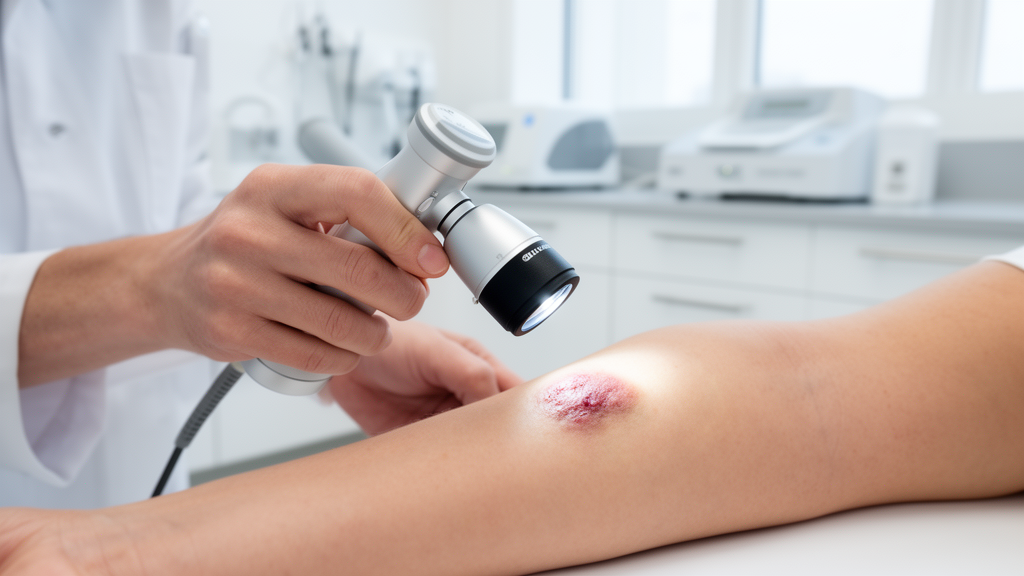
A research team has introduced an artificial intelligence architecture named zero attention and complete perception, designed to improve the automated classification of skin lesions while maintaining computational efficiency. Published in Visual Computing for Industry, Biomedicine, and Art, the study addresses significant diagnostic pressures facing dermatology clinics where increasing patient numbers, driven by environmental pollution and lifestyle factors, often lead to delayed clinical evaluations. Conventional dermatological assessment relies heavily on visual examination, which remains subjective and susceptible to diagnostic variation among clinicians due to the pronounced heterogeneity of skin conditions across different patients. When visual inspection is insufficient, physicians frequently resort to invasive tissue biopsies, a process that achieves high diagnostic accuracy but typically requires patients to endure hospital registration queues and wait between three and fourteen days for laboratory results. To establish an automated, non-invasive alternative, the investigators engineered a deep learning framework that modifies the foundational EfficientNet architecture to capture subtle morphological patterns without requiring impractical computational resources.
Developing automated systems for dermatological diagnosis involves several technical hurdles inherent to medical image processing. Dermoscopic image collections frequently exhibit considerable variation in image quality due to differing shooting conditions, camera hardware, and patient skin tones, which can impede standard computer vision algorithms. Furthermore, clinical datasets suffer from severe class imbalance, where common benign conditions vastly outnumber critical or rare malignancies. In the widely used HAM10000 dataset, for example, melanocytic nevi account for 6,705 images while vascular lesions represent only 142 samples. Such uneven distributions tend to bias neural network training toward majority classes, diminishing diagnostic sensitivity for less frequent skin diseases. To mitigate these discrepancies, the researchers implemented a dual-stage data augmentation strategy prior to network training, pairing traditional intraclass image transformations with an innovative multisource image region replacement technique adapted from remote sensing methodologies.
The team’s data preprocessing protocol employed intraclass geometric and photometric transformations executed with a fifty percent probability to expand minority category representations. These procedures included rotating dermatological images around their geometric centers to simulate varied lesion orientations, scaling the central region to represent different observation magnifications, and adjusting luminance and contrast levels to enhance algorithmic robustness against lighting variations. The researchers also converted selected color images to grayscale, removing chromatic interference to force the model to prioritize structural contours and textural indicators. In parallel, the multisource image region replacement method identified masked lesion regions in an image and randomly inserted one or two marked lesion patches into the non-masked background of an image from another diagnostic class. This synthesis generated composite training samples exhibiting multi-disease characteristics, compelling the network to process varied diagnostic features simultaneously and mitigating class imbalance without compromising the structural integrity of the lesions.
At the structural core of the classification system is the zero attention and complete perception network, constructed upon an EfficientNet backbone spanning nine distinct operational stages. EfficientNet relies on compound scaling across network depth, width, and image resolution alongside depthwise separable convolutions, which decompose standard convolution into separate depthwise and pointwise operations to minimize parameter counts. The baseline EfficientNet incorporates stacked mobile inverted bottleneck convolution blocks containing squeeze and excitation modules that apply cross-channel attention. However, the study authors identified a critical architectural limitation in standard squeeze and excitation designs: while they calculate weighting parameters across channels, they neglect spatial semantic correlations within individual channels. To overcome this shortcoming, the researchers developed the complete perception mobile inverted bottleneck convolution, replacing standard blocks with an integrated subsystem that evaluates channel weights while simultaneously extracting localized spatial features across lesion boundaries.
The complete perception squeeze and excitation module couples standard channel weighting with a newly formulated zero attention mechanism to process fine-grained spatial information. In this configuration, convolutional feature maps are segmented into discrete spatial patches, converted into vectors through linear mapping, and assigned positional encodings to preserve spatial coordinates. Hyperparameters governing patch granularity and encoding dimensionality directly determine the model’s capacity to resolve local visual details. The primary innovation within the zero attention layer involves inserting a column or row of zero vectors into the key and value matrices of the multihead attention structure. In conventional dot-product attention, query vectors multiplied by key vectors yield relative numerical scores that are normalized through a softmax function into a probability distribution. When an image region contains only non-informative background texture, raw dot products remain uniformly low; nevertheless, standard softmax normalizes these small values, allocating disproportionate attention weights to irrelevant pixels. By establishing an explicit zero-vector benchmark, the modified mechanism forces attention weights of irrelevant non-semantic regions toward zero, suppressing background noise such as normal skin texture or hair follicles.
To support model training across its expanded architectural modules, the researchers replaced the baseline EfficientNet network activation function, previously configured with the SiLU function, with the Mish activation function. This mathematical substitution stabilized gradient backpropagation during optimization, counteracting potential training oscillations and preventing the network from overfitting to non-clinical noise as it learned subtle visual structures. The full computational workflow was executed within the PaddlePaddle version 3.0 beta framework on a Windows 11 workstation equipped with an NVIDIA Tesla V100 graphics processing unit, a four-core Intel central processing unit, and 32 gigabytes of system memory. Network weights were initialized using ImageNet pre-trained representations, and optimization ran for sixty iterations over approximately eight hours, applying a batch size of sixteen for HAM10000 and eight for ISIC2017 alongside a decaying learning rate schedule designed to accelerate initial convergence while enabling fine parameter adjustments in final stages.
Comprehensive performance assessments on the HAM10000 dataset, comprising 10,015 clinical images spanning seven disease categories, demonstrated that the proposed model surpassed several established deep learning architectures, including VGG16, ResNet-50, MobileNet, DenseNet-121, SENet, EfficientNet-B4, and Vision Transformer. Evaluated across overall accuracy, precision, weighted-average F1-score, and macro-average area under the receiver operating characteristic curve, the zero attention model recorded top-tier outcomes. Relative to the secondary benchmark Vision Transformer, the architecture exhibited improvements of 0.3 percent in precision, 1.2 percent in classification accuracy, 0.2 percent in weighted F1-score, and 1.3 percent in macro-average area under the curve. Confusion matrix analysis revealed classification accuracies of 98.09 percent for basal cell carcinoma and 98.04 percent for vascular lesions. Accuracies for actinic keratoses and intraepithelial carcinoma, dermatofibroma, and melanocytic nevi ranged between 91.30 percent and 92.66 percent, while benign keratosis lesions and melanoma yielded lower accuracies of 89.79 percent and 86.35 percent, respectively, reflecting boundary overlaps and shared visual characteristics.
Validation on the three-class ISIC2017 benchmark dataset confirmed consistent improvements across model generations compared to standard EfficientNet implementations. Across versions B0 through B7, the modified models achieved superior accuracy over their baseline counterparts, with the B7 iteration improving from 90.04 percent in baseline EfficientNet to 91.91 percent in the enhanced model, and the B0 version advancing from 84.31 percent to 85.02 percent. In comparative benchmarks against other published networks on ISIC2017, the proposed framework achieved an overall accuracy of 91.9 percent, approaching SkinLesNet at 92.0 percent while significantly outperforming VGG16 at 70.0 percent and ResNet-50 at 75.0 percent. Furthermore, the architecture achieved a precision of 90.8 percent, a sensitivity of 86.8 percent, and a specificity of 93.9 percent, outperforming SkinLesNet’s 80.0 percent precision and 82.0 percent sensitivity. The high specificity confirmed the system’s capacity to discriminate benign samples from malignant lesions, an essential attribute for automated screening workflows aimed at minimizing false-positive referrals.
Ablation investigations isolated the specific contributions of each structural innovation and data enhancement technique on the ISIC2017 dataset. In baseline tests without data enhancement, the model achieved a precision of 0.909, an accuracy of 0.935, and an average area under the curve of 0.964. Implementing intraclass enhancement alone increased precision to 0.930, accuracy to 0.954, and average area under the curve to 0.985, while applying multisource region replacement alone yielded 0.930 precision, 0.957 accuracy, and 0.986 area under the curve. Combining both enhancement protocols maximized outcomes, achieving 0.931 precision, 0.959 accuracy, and 0.987 average area under the curve. Architectural ablations demonstrated that integrating the complete perception module with zero attention raised baseline precision from 0.886 to 0.907, accuracy from 0.895 to 0.914, and average area under the curve from 0.934 to 0.955. Gradient-weighted class activation mapping confirmed that zero attention redirected focal weights away from uniform skin textures toward lesion margins, reducing misdiagnoses between melanoma and benign nevi by approximately 3.2 percent and between vascular lesions and benign keratoses by roughly 1.8 percent.
Analysis of computational resource demands showed that the model’s structural enhancements did not impose excessive operational burdens. Although substituting the complete perception module into EfficientNet increased overall parameter counts—reaching 87.4 million parameters in the enhanced B7 variant compared to 66.0 million in the standard B7 architecture, representing a 32.4 percent increase—computational operations grew moderately. Floating point operations across lower variants increased by 0.3 to 0.8 billion operations, constituting less than twenty percent of baseline operational loads, while upper tiers expanded by three to five billion operations, representing a five to seven percent overhead. The authors noted that this balanced profile supports potential deployment in primary medical facilities using low-power hardware for real-time diagnostic triage. Nevertheless, the study highlighted important constraints, including training datasets limited in dermatoscope hardware variety and skewed toward fair skin phototypes, leaving real-world generalization across varied ethnic demographics and low-cost imaging equipment subject to future verification across broader multi-center cohorts.
Subject of Research: Deep learning system for dermatological lesion classification using zero attention and complete perception mechanisms
Article Title: ZACP: enhancing skin lesion classification ability using zero attention and complete perception
Article References: Zuo, H., Weng, Z., Fu, Z., Ding, F., Chai, J., Chen, L., Gong, C., & Zheng, Z. (2026). ZACP: enhancing skin lesion classification ability using zero attention and complete perception. Visual Computing for Industry, Biomedicine, and Art, 9(1), Article 12. https://doi.org/10.1186/s42492-026-00223-3
Image Credits: AI Generated
DOI: 10.1186/s42492-026-00223-3
Keywords: artificial intelligence, dermatology, skin lesion classification, deep learning, EfficientNet, zero attention, complete perception, HAM10000, ISIC2017, melanoma, computer vision, medical image analysis, convolutional neural networks, attention mechanism, Mish activation, image augmentation, biomedical imaging
News Source: Blake Davidson. (November 26, 2026). Zero Attention System Enhances Skin Lesion Classification Accuracy Across Benchmark Datasets. Scienmag.