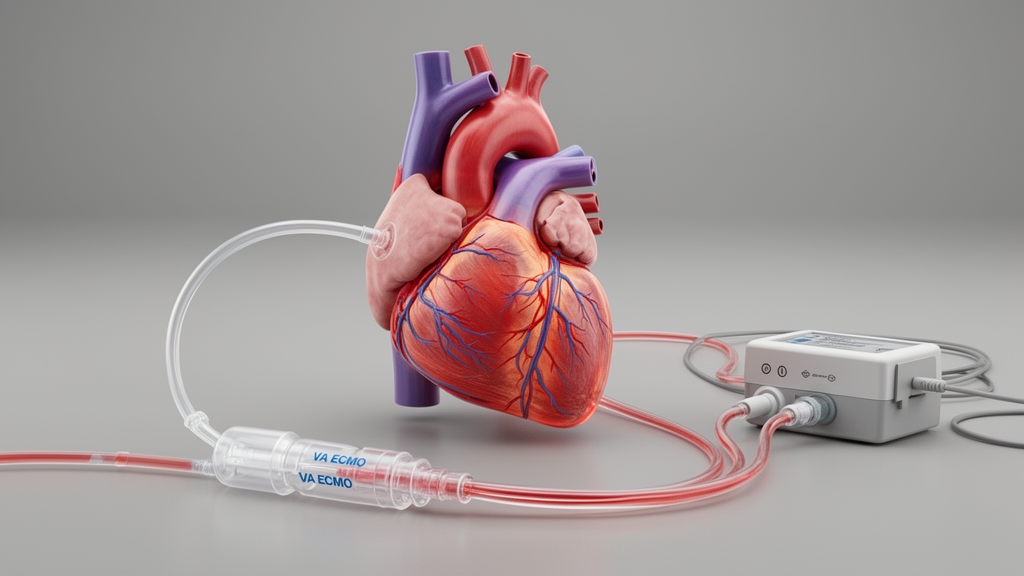
Peripheral venoarterial extracorporeal membrane oxygenation delivers essential circulatory support by restoring systemic perfusion and oxygen delivery in critically ill patients, typically utilizing a peripheral femoro-femoral cannulation configuration that directs retrograde arterial return into the descending aorta. Under long-standing clinical convention, this anatomical configuration gave rise to the widespread assumption that the retrograde stream intrinsically increases left ventricular afterload simply because the returning extracorporeal flow physically opposes native antegrade ejection from the heart. Writing in Critical Care, Alexander Dietl, Matthieu Schmidt, Demetri Yannopoulos, Dawid Staudacher, and Tobias Wengenmayer challenge this entrenched hemodynamic paradigm, presenting a quantitative hydrodynamic appraisal demonstrating that the directional path of extracorporeal blood flow does not itself constitute mechanical afterload. Instead, the authors clarify that afterload is governed by pressure and wall stress rather than flow direction, establishing that routine clinical decisions regarding left ventricular unloading must be re-evaluated through the physiological relationship between delivered volume, vascular tone, and measured systemic pressures.
The foundational argument against the traditional assumption rests on fluid dynamics, specifically the physical distinction between kinetic dynamic pressure and the static opening pressure of the arterial tree. Moving fluid exerts a dynamic pressure that can be mathematically approximated using the equation q equals one-half rho v squared, in which rho represents blood density and v corresponds to flow velocity. While clinicians often visualize retrograde perfusion as a high-momentum jet actively colliding with native cardiac output and obstructing aortic valve opening, calculating the actual kinetic pressure of this opposing stream reveals a scale that is clinically negligible. When assuming standard physiological parameters including a blood density of 1060 kilograms per cubic meter, a normal aortic diameter of 2.5 centimeters, and an extracorporeal flow rate of 5 liters per minute, the resultant mean aortic flow velocity is merely 0.17 meters per second, which generates a dynamic pressure of only 0.11 millimeters of mercury.
Even though this hydrodynamic calculation reflects a simplified, non-pulsatile approximation, it establishes the fundamental order of magnitude governing aortic kinematics during mechanical life support. An opposing dynamic pressure of 0.11 millimeters of mercury is remarkably trivial when contrasted with the substantial systemic arterial pressure required to overcome intra-aortic resistance and force open the aortic valve. Although dynamic pressure reaches higher magnitudes in the immediate vicinity of the arterial cannula tip, the kinetic energy of this localized high-velocity jet rapidly dissipates into turbulence within the lower descending aorta well before reaching the aortic root. Consequently, while cannula-tip turbulence and localized fluid velocity remain clinically important factors regarding red blood cell shear stress and hemolysis, they do not exert meaningful mechanical opposition to left ventricular ejection, proving that cannulation geometry and flow direction alone do not define ventricular afterload.
The true determinant of whether supplemental extracorporeal perfusion increases left ventricular afterload is the systemic arterial pressure generated in response to added blood volume, rather than the velocity or direction of the flow. Extracorporeal circuits introduce an additional source of aortic inflow, but the degree to which this additional volume translates into left ventricular afterload depends predominantly on systemic vascular resistance and the underlying tone of the arterial vasculature. This physiological interaction can be conceptualized at the bedside through Ohm’s law, which states that pressure equals flow multiplied by resistance, although clinicians must recognize that this formulation represents an idealized simplification. In clinical practice, venous drainage through the extracorporeal circuit reduces cardiac preload, native cardiac output and pump flow interact in a non-linear manner, systemic vascular resistance fluctuates continuously, and centrifugal pump output varies alongside changes in pressure even at fixed rotational speeds.
Applying this pressure-flow relationship clarifies that augmenting extracorporeal flow raises systemic arterial pressure only when vascular resistance remains static, producing even steeper pressure increases if systemic vasoconstriction intensifies. Conversely, when systemic vascular tone decreases appropriately or is therapeutically modulated, the introduction of substantial extracorporeal aortic inflow can effectively restore tissue perfusion without provoking an unwanted rise in central aortic pressure. Furthermore, mean arterial pressure provides only an incomplete representation of the true burden experienced by the myocardium, because the aortic valve opens against diastolic pressure rather than mean pressure. Under conditions where mean arterial pressure remains identical, a narrower pulse pressure inevitably demands a higher diastolic threshold for valve opening, underscoring that ventricular loading cannot be characterized by single pressure metrics alone.
The physiological distinction between surrogate indices and direct ventricular strain is further reflected in effective arterial elastance, defined as the ratio of end-systolic pressure to stroke volume. When native left ventricular stroke volume diminishes during peripheral circulatory support, effective arterial elastance mathematically rises, yet this numerical elevation does not necessarily indicate a proportional expansion in myocardial workload. Elastance functions primarily as a vascular-ventricular coupling index, whereas the actual physical burden sustained by the myocardium is myocardial wall stress, a parameter determined by intracavitary pressure, left ventricular radius, and ventricular wall thickness. Treating pump flow and arterial pressure as interchangeable variables conflates distinct hemodynamic targets, obscuring the clinical reality that the primary function of extracorporeal volume delivery is oxygen transport and systemic perfusion, while pressure management requires independent pharmacological control.
Recognizing the separation between flow delivery and pressure load carries immediate therapeutic implications for critical care practitioners managing patients on peripheral extracorporeal circuits. The authors propose that extracorporeal blood flow titration and arterial pressure maintenance should be addressed as separate clinical objectives, using pump flow to satisfy metabolic oxygen demands while adjusting vasoactive medications to attain individualized hemodynamic targets. In cases where systemic perfusion pressure remains deficient despite adequate circuit flow, such as during profound vasoplegic shock, vasopressor administration remains indispensable to restore perfusion. In contrast, when systemic perfusion is fully preserved but arterial pressure reaches excessive levels, carefully weaning vasopressors or introducing vasodilator therapy can mitigate left ventricular wall stress, thereby achieving conservative ventricular unloading through hemodynamic optimization without immediate recourse to invasive mechanical devices.
This pharmacological approach to afterload reduction demands heightened vigilance in patients presenting with concomitant pulmonary failure, because aggressive reductions in mean arterial pressure can aggravate differential hypoxaemia. Consequently, while pharmacological pressure optimization offers a non-invasive pathway to lessen myocardial wall stress, it must be balanced against systemic oxygenation dynamics. The fundamental guiding principle remains that clinicians should methodically evaluate and optimize vascular load before automatically proceeding to invasive left ventricular unloading interventions, ensuring that therapeutic decisions address specific pathophysiological drivers rather than empirical routine.
Reframing afterload as a pressure-dependent phenomenon directly challenges the established practice of deploying routine mechanical left ventricular unloading across all peripheral extracorporeal circuits. This conceptual shift does not imply that ventricular unloading is redundant, as severely impaired hearts frequently lose the capacity to open the aortic valve entirely, presenting clinicians with an urgent binary threshold. Established clinical indications for mechanical unloading include marked left ventricular distension, hydrostatic pulmonary congestion, failure of aortic valve opening, intracardiac blood stasis, and the complete loss of arterial pulsatility. In these high-risk scenarios, mechanical devices can preserve myocardial integrity by curtailing myocardial oxygen consumption and attenuating deleterious ventricular remodeling, but the authors emphasize that these interventions should be triggered by explicit signs of overload rather than initiated purely because peripheral cannulation is present.
Historical experimental models and computational simulations frequently concluded that escalating peripheral circuit flow universally worsened left ventricular afterload and filling pressures, but many of those early protocols permitted mean arterial pressure to rise unconstrained as flow expanded, failing to isolate the independent effect of flow at fixed pressure targets. Recent experimental investigations, numerical simulations, and invasive clinical evaluations reveal a far more nuanced interaction, showing that the net ventricular response is governed by baseline ventricular contractility, vascular compliance, circulating preload, and the complex fluid interaction between native cardiac output and extracorporeal inflow. Under well-regulated conditions where vascular tone is appropriately managed to maintain an individualized target pressure, higher extracorporeal flow rates are not uniformly harmful and can substantially enhance hemodynamic stability in selected cohorts.
Ultimately, a comprehensive evaluation of ventricular workload must extend beyond afterload alone, acknowledging that extracorporeal support simultaneously alters venous preload, myocardial contractility, and heart rate. Because peripheral drainage decompresses the right heart while modifying venous return, isolated clinical measurements such as left ventricular end-diastolic pressure, pulmonary capillary wedge pressure, and pressure-volume loop areas reflect composite loading states rather than pure afterload metrics. Clinical management must therefore integrate filling pressures, pulmonary venous return, chamber dimensions, valve kinetics, and arterial tone into a coherent diagnostic framework. By shifting clinical practice from reflexive, circuit-based mechanical unloading toward individualized, phenotype-driven hemodynamics, clinicians can ensure that vascular load is thoroughly optimized before invasive unloading is deployed.
Subject of Research: Hydrodynamic and hemodynamic mechanisms of left ventricular afterload during peripheral venoarterial extracorporeal membrane oxygenation
Article Title: Venoarterial extracorporeal membrane oxygenation provides flow, not afterload: reframing left ventricular afterload during peripheral VA ECMO
Article References: Dietl, A., Schmidt, M., Yannopoulos, D., Staudacher, D., & Wengenmayer, T. (2026). Venoarterial extracorporeal membrane oxygenation provides flow, not afterload: reframing left ventricular afterload during peripheral VA ECMO. Critical Care, 30(1), Article 615. https://doi.org/10.1186/s13054-026-06475-y
Image Credits: AI Generated
DOI: 10.1186/s13054-026-06475-y
Keywords: Venoarterial Extracorporeal Membrane Oxygenation, Left Ventricular Afterload, Peripheral Cannulation, Retrograde Arterial Flow, Dynamic Pressure, Mean Arterial Pressure, Systemic Vascular Resistance, Effective Arterial Elastance, Myocardial Wall Stress, Ventricular Unloading, Aortic Valve Opening, Femoro-Femoral Cannulation, Vascular Tone, Vasopressor Weaning, Differential Hypoxaemia, Hemodynamics, Aortic Root Flow
News Source: Ophelia Keating. (November 26, 2026). Peripheral VA ECMO Generates Negligible Kinetic Afterload Against Left Ventricular Ejection. Scienmag.