A comprehensive year-round ecological investigation conducted in the Swiss Alps demonstrates that environmental DNA water sampling can reliably detect the occurrence of benthic macroinvertebrate communities across extreme seasonal transitions, though its capacity to estimate quantitative relative abundances remains constrained and taxon-dependent. Researchers evaluated the methodological performance of molecular environmental DNA metabarcoding against traditional physical kick-net collections across twelve sampling stations situated in the glacier-fed Val Roseg floodplain. Located in the canton of Graubünden at an elevation of approximately two thousand meters above sea level, the pristine alpine river system experiences intense hydrological shifts governed by glacial dynamics. The empirical findings indicate that the relative abundance of arthropod taxa documented through physical kick-net sampling significantly predicted the statistical likelihood of their detection via environmental DNA presence-and-absence models across most survey periods. However, when evaluating quantitative read proportions, the alignment between methods weakened considerably, underscoring fundamental differences in how spatial transport and molecular amplification capture alpine river biodiversity.
Standard biomonitoring in flowing freshwater systems has long relied on physical benthic collection devices, tracing back to the rigid mechanical frames developed by Eugene Surber in the nineteen-thirties and subsequent standardized kick-net protocols. While manual kick-netting remains effective for acquiring benthic organisms from shallow gravel riffles, the procedure presents persistent operational drawbacks that become especially pronounced within harsh alpine environments. Physical sampling requires field personnel to wade directly into active river channels, which creates substantial safety hazards during periods of high discharge and rapid glacial melting. Furthermore, sorting and identifying thousands of collected specimens under stereoscopic microscopy requires extensive taxonomic expertise, demands considerable labor, and frequently encounters limitations in morphological resolution at the genus or species level. In contrast, environmental DNA metabarcoding offers a non-invasive alternative by filtering river water to capture cellular debris, shed tissue, and extracellular genetic material directly from the stream before amplifying diagnostic marker fragments through polymerases.
To rigorously test whether molecular monitoring can complement or substitute for mechanical benthic collection across an entire annual cycle, researchers sampled the braided Val Roseg network every two months between October 2021 and August 2022. The Roseg river originates from Lake Roseg at the Bernina massif, draining meltwater from proglacial sources across a catchment characterized by extreme seasonal contrasts. Field sites were strategically distributed across the complex glacial floodplain, encompassing junction points between the main glacial stem and three major tributaries, as well as distinct reference reaches situated in proglacial lake outflows and downstream braided channels. Environmental conditions shifted dramatically between seasons, characterized by low baseflows fed by groundwater and constant lake outflows in freezing winter months, followed by turbulent, sediment-laden meltwater flows during peak summer ablation. The two sampling methodologies were conducted side by side during each survey window to directly compare biological recovery across matching temporal and spatial coordinates.
Physical kick-net collections followed standardized protocol using a square twenty-five centimeter net equipped with a five-hundred-micrometer mesh, positioned immediately downstream of disturbed gravel substrates in shallow riffles under fifty centimeters of depth. At each station, operators reworked an upstream bed area of approximately zero point thirty-five square meters with their boots for thirty seconds, allowing dislodged macroinvertebrates to sweep naturally into the net mesh via stream currents. Reworked material was cleaned of large rocks and macro-debris, preserved in ethanol solutions adjusted from seventy percent in temperate months to ninety-five percent in sub-zero winter temperatures, and transferred to the laboratory for counting and morphological identification to the family level. Across the entire sampling campaign, sixty-eight kick-net samples yielded a total of one hundred forty-nine thousand two hundred seventy-six individual macroinvertebrates representing twenty-four families, comprising dominant aquatic arthropods alongside secondary representations of mollusks, aquatic annelids, and flatworms.
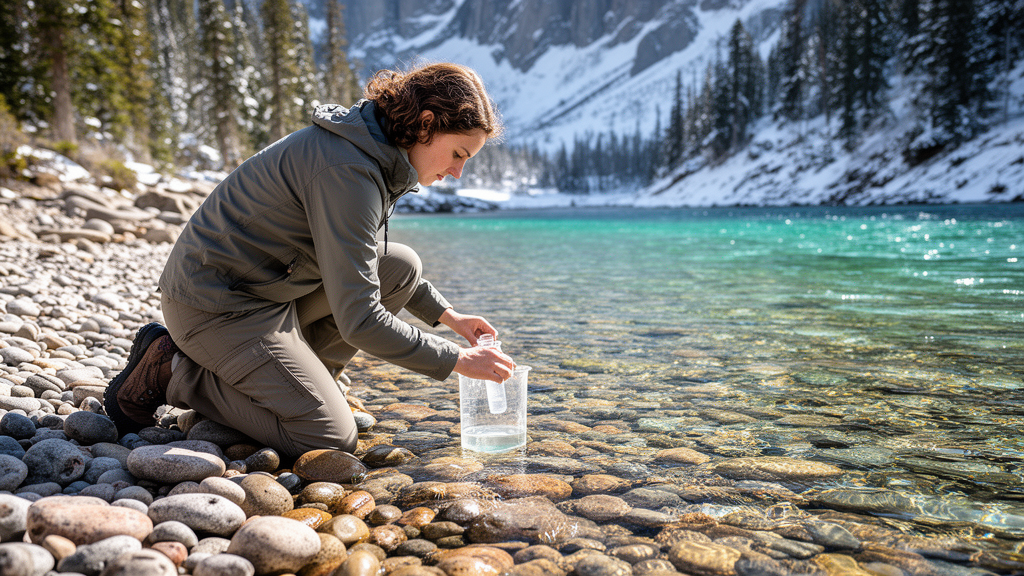
Parallel environmental DNA sampling involved pumping large volumes of river water through specialized zero point forty-five micrometer filtering capsules across biological triplicates, collecting thirty liters per replicate to reach a cumulative total of ninety liters per station. Capsules were immediately preserved using forty milliliters of nucleic acid preservation buffer and held at ambient temperature until extraction. Within a dedicated pre-amplification laboratory facility, filters were agitated, digested with lysis buffers and proteinase enzymes, and extracted through soil-matrix purification columns. Extracts were tested for chemical inhibitors using quantitative amplification and subsequently diluted ten-fold to mitigate reaction suppression. Researchers amplified target mitochondrial DNA across nine analytical replicates per site using the generalist arthropod primer set Arth02, which targets a variable segment of the sixteen-S ribosomal RNA gene. Amplicons were indexed following protocols designed to minimize spurious chimeric tagging, pooled into indexed sequencing libraries, and analyzed on a high-throughput sequencing platform.
Bioinformatic curation implemented through specialized packages filtered raw sequence libraries against strict quality thresholds, assembling paired-end reads, removing sequences with low library counts, and clustering molecular operational taxonomic units at a ninety-seven percent similarity threshold. After eliminating contaminants and bioinformatic artifacts detected across control blanks, researchers retained eleven million four hundred nine thousand one hundred forty-seven high-quality sequencing reads representing two hundred fifty-seven operational taxonomic units from sixty-one successfully amplified water samples. Statistical modeling revealed that the proportion of individuals enumerated in physical kick-net collections correlated positively with both environmental DNA presence-absence detection and relative read abundance.
When evaluating the primary insect orders utilized globally as biological indicators of aquatic ecological health, the degree of correspondence between methodologies diverged substantially among taxonomic lineages. Among the sensitive Ephemeroptera, Plecoptera, and Trichoptera assemblages commonly referred to as EPT groups, only Ephemeroptera demonstrated a statistically significant positive relationship between kick-net community proportions and environmental DNA relative abundance. Plecoptera exhibited a positive but statistically non-significant association, whereas Trichoptera yielded broad confidence intervals and no significant correlation, driven by pronounced divergences in winter detection. Overall, physical kick-netting recovered a broader diversity of localized EPT families, while environmental DNA analyses captured approximately one-third of the specific benthic families recorded by physical nets.
Conversely, environmental DNA metabarcoding generated substantial detections of non-benthic organisms categorized outside traditional bioindicator orders, capturing widespread signals from springtails, terrestrial spiders, and other soil-dwelling arthropods entirely absent from kick-net samples. This divergence reflects fundamental spatial differences between the sampling techniques. Kick-net collections isolate resident organisms inhabiting coarse sedimentary benthos within a restricted riffle patch, providing an explicit measure of localized community structure. In contrast, environmental DNA water filtration integrates genetic material shed throughout the upstream catchment, encompassing organisms transported from upstream tributaries, floodplain margins, and adjacent riparian soils. While this broad hydrological integration enhances regional biodiversity surveys and rapidly catalogs species across wide river basins, downstream transport of persistent genetic fragments complicates the detection of fine-scale microhabitat degradation and introduces potential false-positive detections for strictly local reach assessments.
Concurrently monitored physicochemical parameters, including stream water temperature, electrical conductivity, and suspended sediment concentration, aligned along a single shared axis of seasonal variation that confounded simple single-variable explanations of macroinvertebrate ecology. Total kick-net organism counts exhibited an unexpected seasonal trajectory, escalating down the river continuum and peaking during the coldest winter months of December, February, and April rather than during warm summer runoff. Statistical models showed negative associations between organism abundance and water temperature, alongside positive associations with electrical conductivity and a marginal negative relationship with suspended sediment load. The researchers caution that these statistical associations reflect a unified seasonal climatic gradient rather than independent causal mechanisms operating in isolation.
Field operations also highlighted distinct physical challenges imposed by alpine seasonality, where sub-zero winter temperatures caused sampling hoses and water filtration apparatus to freeze, requiring the use of wider pipes, heated flushing water, and higher preservation alcohol concentrations. During summer, elevated discharge and extreme sediment turbidity frequently clogged molecular filter capsules before the targeted volume could pass through, while turbulent flows restricted wading access. Five environmental DNA samples failed to amplify, likely attributable to low starting concentrations of arthropod template DNA in cold meltwater. The authors conclude that environmental DNA metabarcoding provides an effective, time-efficient tool for characterizing overarching arthropod biodiversity and detecting regional community shifts. Nevertheless, mechanical kick-netting remains essential for accurate local abundance quantification and microhabitat-specific monitoring, demonstrating that molecular and physical methods currently serve complementary rather than mutually exclusive roles in high-altitude freshwater management.
Subject of Research: Methodological comparison of kick-net sampling and environmental DNA metabarcoding in an alpine river
Article Title: Kick‐Net Versus eDNA: Year‐Round Methodological Comparison of Benthic Macroinvertebrate Community in an Alpine River
Article References: Mas‐Carrió, E., Barchi, N., Guenat, J. M., Lane, S. N., & Fumagalli, L. (2026). Kick‐Net Versus eDNA: Year‐Round Methodological Comparison of Benthic Macroinvertebrate Community in an Alpine River. Ecology and Evolution, 16(11), Article e74625. https://doi.org/10.1002/ece3.74625
Image Credits: AI Generated
DOI: 10.1002/ece3.74625
Keywords: environmental DNA, eDNA metabarcoding, benthic macroinvertebrates, alpine river ecology, kick-net sampling, Val Roseg, Arth02 primers, Ephemeroptera, Plecoptera, Trichoptera, Diptera, aquatic biomonitoring, sediment load, electrical conductivity, glacial meltwater, OBITools, metabaR, taxonomic resolution
News Source: Drew Townsend. (November 26, 2026). Year-Round Alpine River Study Shows eDNA Reliably Detects Benthic Invertebrate Occurrence. Scienmag.