• HOME
  • NEWS
  • EXPLORE
    • CAREER
      • Companies
      • Jobs
    • EVENTS
    • iGEM
      • News
      • Team
    • PHOTOS
    • VIDEO
    • WIKI
  • BLOG
  • COMMUNITY
    • FACEBOOK
    • INSTAGRAM
    • TWITTER
Saturday, February 7, 2026
BIOENGINEER.ORG
No Result
View All Result
  • Login
  • HOME
  • NEWS
  • EXPLORE
    • CAREER
      • Companies
      • Jobs
        • Lecturer
        • PhD Studentship
        • Postdoc
        • Research Assistant
    • EVENTS
    • iGEM
      • News
      • Team
    • PHOTOS
    • VIDEO
    • WIKI
  • BLOG
  • COMMUNITY
    • FACEBOOK
    • INSTAGRAM
    • TWITTER
  • HOME
  • NEWS
  • EXPLORE
    • CAREER
      • Companies
      • Jobs
        • Lecturer
        • PhD Studentship
        • Postdoc
        • Research Assistant
    • EVENTS
    • iGEM
      • News
      • Team
    • PHOTOS
    • VIDEO
    • WIKI
  • BLOG
  • COMMUNITY
    • FACEBOOK
    • INSTAGRAM
    • TWITTER
No Result
View All Result
Bioengineer.org
No Result
View All Result
Home BIOENGINEERING

Growing organs a few ink drops at a time

Bioengineer by Bioengineer
February 9, 2018
in BIOENGINEERING
Reading Time: 2 mins read
0
Share on FacebookShare on TwitterShare on LinkedinShare on RedditShare on Telegram
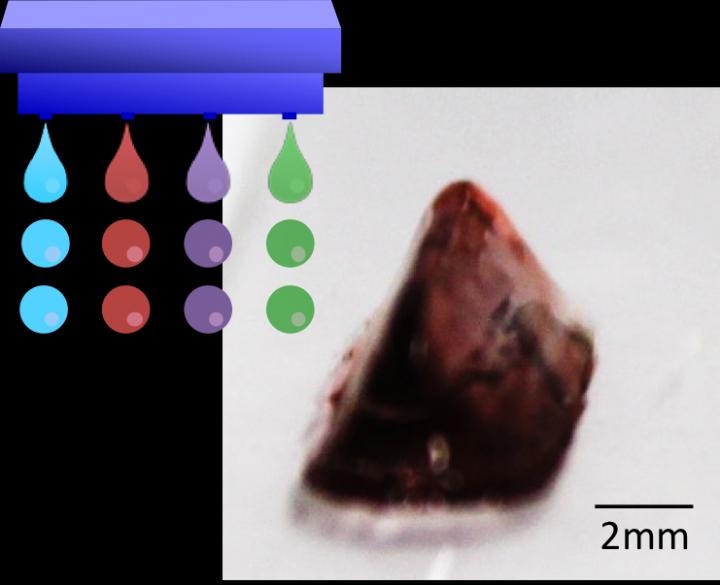
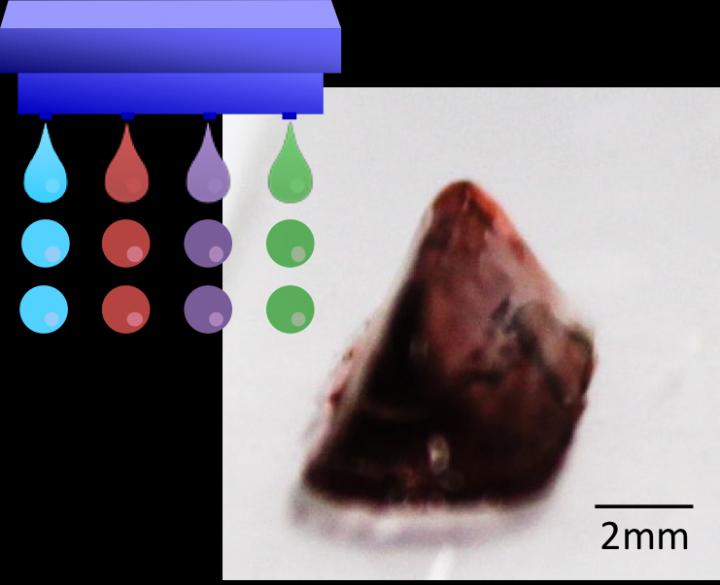
IMAGE

Credit: Osaka University

Osaka – Printed replacement human body parts might seem like science fiction, but this technology is rapidly becoming a reality with the potential to greatly contribute to regenerative medicine. Before any real applications, "bioprinting" still faces many technical challenges. Processing the bio-ink and making it stick to itself and hold the desired printed gel structure have been proving particularly difficult especially in inkjet printing. Few methods currently exist for gluing bio-ink droplets together and these do not work for every kind of cell, motivating new alternative approaches.

Building on their previous work, researchers at Osaka University have now refined an enzyme-driven approach to sticking biological ink droplets together, enabling complex biological structures to be printed. They recently published their findings in Macromolecular Rapid Communications.

Lead author, Shinji Sakai says, "Printing any kind of tissue structure is a complex process. The bio-ink must have low enough viscosity to flow through the inkjet printer, but also needs to rapidly form a highly viscose gel-like structure when printed. Our new approach meets these requirements while avoiding sodium alginate. In fact, the polymer we used offers excellent potential for tailoring the scaffold material for specific purposes."

Currently, sodium alginate is the main gelling agent used for inkjet bioprinting, but has some compatibility problems with certain cell types. The researchers' new approach is based on hydrogelation mediated by an enzyme, horseradish peroxidase, which can create cross-links between phenyl groups of an added polymer in the presence of the oxidant hydrogen peroxide.

Although hydrogen peroxide itself can also damage cells, the researchers carefully tuned the delivery of cells and hydrogen peroxide in separate droplets to limit their contact and keep the cells alive. More than 90% of the cells were viable in biological test gels prepared in this way. A number of complex test structures could also be grown from different types of cells.

"Advances in induced pluripotent stem cell technologies have made it possible for us to induce stem cells to differentiate in many different ways," co-author Makoto Nakamura says. "Now we need new scaffolds so we can print and support these cells to move closer to achieving full 3D printing of functional tissues. Our new approach is highly versatile and should help all groups working to this goal."

###

Media Contact

Saori Obayashi
[email protected]
81-661-055-886
@osaka_univ_e

http://www.osaka-u.ac.jp/en

Original Source

https://www.ncbi.nlm.nih.gov/pubmed/29226501 http://dx.doi.org/10.1002/marc.201700534
Share12Tweet8Share2ShareShareShare2

Related Posts

IMAGE

Ferrets, cats and civets most susceptible to coronavirus infection after humans

December 10, 2020
IMAGE

Deep Longevity publishes an epigenetic aging clock of unprecedented accuracy

December 8, 2020

How poor oral hygiene may result in metabolic syndrome

December 8, 2020

New findings shed light on the repair of UV-induced DNA damage

December 8, 2020
Please login to join discussion

POPULAR NEWS

  • Robotic Ureteral Reconstruction: A Novel Approach

    Robotic Ureteral Reconstruction: A Novel Approach

    82 shares
    Share 33 Tweet 21
  • Digital Privacy: Health Data Control in Incarceration

    63 shares
    Share 25 Tweet 16
  • Study Reveals Lipid Accumulation in ME/CFS Cells

    57 shares
    Share 23 Tweet 14
  • Breakthrough in RNA Research Accelerates Medical Innovations Timeline

    53 shares
    Share 21 Tweet 13

About

We bring you the latest biotechnology news from best research centers and universities around the world. Check our website.

Follow us

Recent News

Boosting Remote Healthcare: Stepped-Wedge Trial Insights

Barriers and Boosters of Seniors’ Physical Activity in Karachi

Evaluating Pediatric Emergency Care Quality in Ethiopia

Subscribe to Blog via Email

Enter your email address to subscribe to this blog and receive notifications of new posts by email.

Join 73 other subscribers
  • Contact Us

Bioengineer.org © Copyright 2023 All Rights Reserved.

Welcome Back!

Login to your account below

Forgotten Password?

Retrieve your password

Please enter your username or email address to reset your password.

Log In
No Result
View All Result
  • Homepages
    • Home Page 1
    • Home Page 2
  • News
  • National
  • Business
  • Health
  • Lifestyle
  • Science

Bioengineer.org © Copyright 2023 All Rights Reserved.