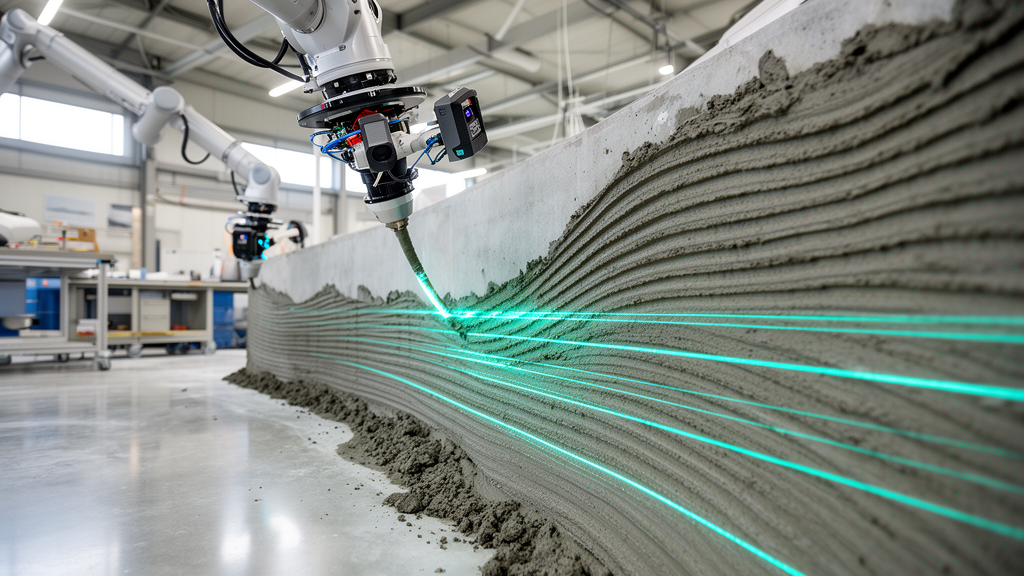
A comprehensive geometric error measuring and modeling framework has demonstrated the ability to track, predict, and mitigate dimensional deviations across all construction phases of a large-scale, 3D-printed concrete shell structure. Large-scale 3D concrete printing is inherently continuous and dynamic, marked by evolving material properties that can quickly transform subtle path misalignments or settlement into severe geometric defects such as plastic collapse or elastic buckling. By addressing error formation across the design, printing, and post-curing evaluation phases rather than relying on isolated single-stage checks, the multi-stage system successfully guided the automated fabrication and subsequent high-precision manual assembly of an expansive double-shell structure known as Yuehu Zun.
The engineering challenge of geometric accuracy in 3D concrete printing stems from the complex interplay of time-dependent material behavior, process parameters, and robotic toolpaths. In conventional construction, structural design and physical execution operate through disconnected workflows, but in additive manufacturing, fresh material properties evolve rapidly while enduring progressively accumulated self-weight from newly deposited upper layers. Early attempts to model these behaviors frequently treated concrete as a time-independent material with constant properties, failing to capture early-age settlement, lateral deformation, or layer-wise error amplification over extended printing durations. Similarly, real-time sensing setups on active construction sites have typically relied on single data sources such as lone cameras or isolated distance sensors, which identify only localized surface defects or narrow profile deviations while missing the broader accumulation and propagation of structural discrepancies across complex geometries.
To overcome these structural and sensing constraints, the research team developed a three-module architecture operating across the entire construction lifecycle. In the design phase prior to printing, the framework employs a numerical module utilizing the VoxelPrint plugin in Grasshopper alongside Abaqus finite element analysis to perform dynamic, process-oriented simulations. This module divides the sliced toolpaths into discrete voxel groupings that replicate the physical deposition sequence. Crucially, the numerical model incorporates a time-dependent elastic modulus and cohesion governed by the Mohr-Coulomb yield criterion, capturing how the fresh concrete progressively stiffens and gains shear resistance over time. By calculating the evolving displacement and principal stress fields at each incremental step relative to the undeformed nominal computer-aided design geometry, the module identifies sensitive zones prone to eccentric loading, over-extrusion, or excessive deformation before physical fabrication begins.
During the active printing phase, the framework transitions to real-time physical-to-virtual mapping to monitor cross-sectional deviations, overall height settlement, and bottom lateral spreading. Global scene geometry is continuously captured using a surrounding array of eighteen high-resolution digital cameras mounted at an elevation of 2.2 meters, oriented to ensure more than 60 percent image overlap between adjacent views. Multi-view stereo algorithms and Structure-from-Motion workflows reconstruct initial point clouds, which undergo Bundle Adjustment optimization by minimizing reprojection error with robust kernel functions to mitigate outliers. Concurrently, a handheld RigelScan laser scanner operating at a capture rate of seven million measurements per second and a resolution of 0.05 millimeters records local point cloud data from the highly stressed lower layers. These local scans are processed via real-time pose estimation and the Truncated Signed Distance Function, feeding updated 3D virtual representations into the virtual control platform at ten-minute intervals with transmission delays held below 50 milliseconds.
The third interconnected component of the framework addresses post-printing evaluation using a multi-source coarse-to-fine fusion reconstruction strategy. Evaluating geometric accuracy after curing is vital because concrete undergoes non-negligible creep, shrinkage, and plastic deformation between deposition and final hardening, which analytical calculations cannot reliably capture. The researchers gathered global point clouds of the cured components using twenty-four cameras positioned at elevations of 3.0 meters and 5.4 meters, alongside a terrestrial Leica RTC360 laser scanner operating across four scan stations placed six meters from the structure’s center. After downsampling both datasets to equivalent orders of magnitude, a coarse registration step utilizes geometric features including covariance matrices, eigenvalue differences, and local curvature to align coordinate systems. A refined point-to-plane Iterative Closest Point algorithm then optimizes spatial alignment against target surface normal vectors, followed by Poisson surface reconstruction to produce a watertight, high-fidelity mesh of the physical as-built geometry.
Physical validation of this integrated methodology was conducted on the Yuehu Zun shell structure, a double-layer ribbed configuration inspired by double-shell lunar habitat designs. Measuring 4.1 meters in total height with a base diameter of 3.9 meters, the structure connects inner and outer walls through continuous sinusoidal rib infills that enhance structural connectivity and material efficiency while avoiding abrupt toolpath interruptions. The printable concrete formulation incorporated ordinary Portland cement blended with sulphoaluminate cement, quartz sand, polypropylene microfibers, and chemical admixtures at a water-to-binder ratio of 0.37. Rheological characterization showed an average flow table spread diameter of 185 millimeters, an initial setting time of approximately 60 minutes, an early-age strength of 0.6 MPa, an internal friction angle of 20 degrees, and a density of 2500 kilograms per cubic meter. Due to the reach envelope of the robotic mobile printing arm, which possessed a maximum reach radius of 5.2 meters and a height capacity of 1.9 meters, the shell was segmented into eight components comprising a base segment, intermediate vertical and horizontal tiers, and an upper catenary dome.
Pre-printing predictive simulation of the eight components involved approximately 1.25 million voxels with a uniform edge length of 20 millimeters, resolving across 100 analysis increments in a total computation time of approximately 13 minutes. Analysis of component P3, which featured the structure’s most pronounced inclination angle, revealed significant non-uniform deformation concentrated around turning boundaries and outer edges. At the 40th minute of simulated printing, displacement reached 7.8 millimeters in corner regions where inner and outer layers met, driven by robotic kinematic deceleration causing localized over-extrusion and fresh concrete inertia continuing along tangent trajectories. By the 98th minute, predicted displacement at the top edge reached 44.5 millimeters as early settlement amplified across successive layers, while maximum principal stress reached 0.06 MPa between the 39th and 40th layers without triggering material yielding. In response, operators modified the path planning by reducing travel speeds at sharp corners and raising speeds along gentle transitions, reducing subsequent measured corner deviations from predicted values of 23, 18, and 14 millimeters down to 12, 12, and 10 millimeters.
During active construction, the in-process digital mapping module successfully captured evolving profile errors and triggered corrective actions based on standardized quality indicator thresholds. Cross-sectional measurements showed the extruded bead approximated a trapezoid with an average area of 2042 square millimeters, revealing an area error of 442 square millimeters against theoretical design values, while height settlement reached 10 millimeters. These deviations prompted operators to recalibrate robotic end-effector coordinates and adjust nozzle travel velocities. In the local bottom region measuring 600 millimeters across five printed layers, laser scanning revealed lateral width deformation exceeding 5 millimeters after 40 minutes and stabilizing at approximately 14.5 millimeters around the 50th minute. This stabilization coincided closely with the material’s 60-minute initial setting time, confirming that progressive cohesion development and internal shear resistance eventually balanced lateral spreading stresses driven by accumulated self-weight without external intervention.
In the post-printing evaluation phase, multi-source progressive registration demonstrated clear statistical superiority over conventional point-to-point techniques. Aligning the 1,220,864-point photogrammetry dataset with the 2,904,834-point terrestrial laser scanning dataset yielded an initial coarse root mean square error of 0.27708 millimeters. Following twenty iterations of the point-to-plane Iterative Closest Point algorithm, the final root mean square error dropped to 0.01756 millimeters with a 98 percent overlap ratio and a fitness metric of 0.95526. Compared directly to point-to-point registration, which achieved a 90 percent overlap and a root mean square error of 0.03436 millimeters, the point-to-plane approach delivered a 48.9 percent error reduction and a 3.4 percent improvement in registration fitness. The resulting global as-built model revealed a maximum positive deformation of 37.55 millimeters at the top of catenary dome component P4, while component P1 exhibited the greatest error dispersion with a standard deviation of 9.052 millimeters due to coexisting outward base spread and inward recession.
Despite these successful outcomes, the authors noted several operational limitations. The current framework relies on a ten-minute model update interval, which suits large shell elements but is less adaptable to small components or complex cellular infills that require higher refresh rates. Furthermore, the intervention workflow remains rule-based and dependent on human machine operators. Future research will focus on integrating Internet of Things telemetry, Building Information Modeling standards, and deep learning architectures to achieve fully autonomous, closed-loop defect classification and real-time robotic toolpath compensation.
Subject of Research: Geometric error measuring and modeling across the design, printing, and evaluation phases of large-scale 3D concrete printing
Article Title: Geometric error measuring and modeling in 3D concrete printing of large-scale shell structure
Article References: Wang, Y., Sun, J., Wang, Z., Zhou, C., Wen, S., & Zhou, Y. (2026). Geometric error measuring and modeling in 3D concrete printing of large-scale shell structure. Case Studies in Construction Materials, 25, Article e06746. https://doi.org/10.1016/j.cscm.2026.e06746
Image Credits: AI Generated
DOI: 10.1016/j.cscm.2026.e06746
Keywords: 3D concrete printing, additive manufacturing, geometric error modeling, structural shell, finite element analysis, VoxelPrint, digital twin, photogrammetry, laser scanning, Iterative Closest Point, construction automation, deformation monitoring, Mohr-Coulomb criterion, robotic construction, CSCEC Technology Center, Abaqus simulation
News Source: Denise Maddox. (November 26, 2026). Full-Process Digital Mapping Framework Mitigates Geometric Errors in 3D Concrete Printing. Scienmag.