Credit: Image credit: Environmental Protection Agency
The varied sex lives of a type of green algae have enabled a University of Adelaide researcher to test a theory of why there are males and females.
The question of why different types of sex cells evolved, such as sperm and eggs (collectively known as gametes), remains uncertain.
"Why should there be males and females? Why would a situation evolve where some individuals produce small gametes that are motile or capable of motion (the males) and others produce large, non-motile gametes (the females)?" says Dr Jack da Silva, Senior Lecturer in the University of Adelaide's School of Biological Sciences.
"Sexual reproduction does not require males and females, all it requires is the fusion of sex cells from two different mating types."
The classic theory to explain the evolution of different size sex cells and therefore different sexes is the Disruptive Selection Theory and was proposed in the 1970s. It describes how a population evolves from different mating types producing same-sized sex cells (or gametes) to mating types producing different-sized gametes, such as where there are distinct males and females.
Dr da Silva has provided the first test specific to this theory – using the reproductive strategies of green algae.
"The theory is that as organisms evolve to be larger, the single-celled embryo (or zygote) is selected to be larger as well. This necessitates larger gametes to store more nutrients to give the embryo a head start in development," says Dr da Silva.
"Organisms have a limited budget for producing gametes. So if there are more they will be smaller, if there are less they will be larger. Because greater numbers of gametes gives one mating type a selective advantage – more chance of successful fertilisation – the other mating type will be forced to produce larger, and therefore fewer, gametes to enable the production of the larger zygote."
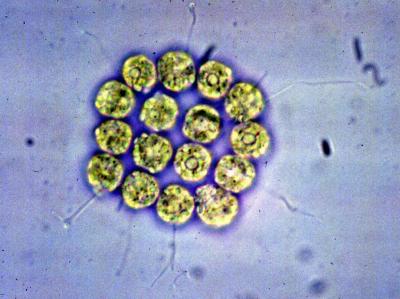
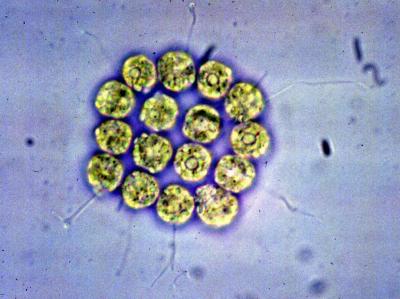
Published in the journal Ecology and Evolution, Dr da Silva tested this theory using data from studies of Volvocine algae, in which species vary considerably in their reproductive patterns: some in which two mating types produce gametes of the same size that can move (motile); others that produce motile gametes of different sizes; and others in which one mating type produces small, motile gametes and the other mating type produces large non-motile gametes (males and females).
He derived a prediction from an existing mathematical model of the Disruptive Selection Theory that states that for the evolution of males and females to remain stable, the ratio of the size of the larger gamete to the smaller gamete has to be greater than three. The maths says that if the ratio is any less, they always evolve back to being the same size.
"The algae were perfect for testing this theory: they showed the whole range of variation of gamete size differences. And the theory held. Wherever there were gametes of different sizes, the larger ones were always at least three times bigger.
"This provides the first test that is specific to this theory – previous tests have been about predictions that are common to this and similar theories. To date there hasn't been a lot of strong evidence in support of any of the competing theories, but here we have confirmed that the classic theory is probably on the right track.
Dr da Silva says it's important to understand this evolution because it helps us understand differences between males and females, such as their morphology and behaviour. "These differences between males and females stem from this original evolution of the size and motility of the sex cells," he says.
###
Media Contact:
Dr Jack da Silva, Senior Lecturer, School of Biological Sciences, University of Adelaide. Phone: +61 (0)8 8313 8083, Mobile: +61 0435 034 188, [email protected]
Robyn Mills, Media Officer, Phone: +61 (0)8 8313 6341, Mobile: +61 (0)410 689 084, [email protected]
Media Contact
Jack da Silva
[email protected]
61-435-034-188
@UniofAdelaide
http://www.adelaide.edu.au
Related Journal Article
http://dx.doi.org/10.1002/ece3.3656