Credit: OIST
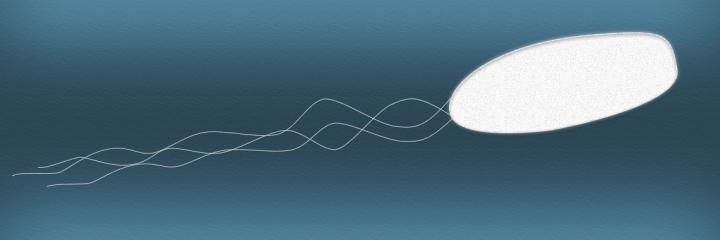
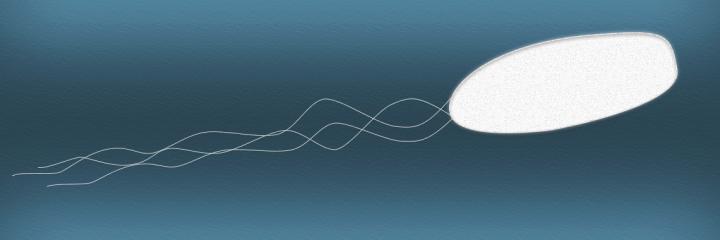
When looking at bacteria, you typically see also flagella: long hairs that protrudes from the bacteria's body. The key function of the flagella is movement – what scientists call 'motility'. The flagella give the bacteria the ability to swim in their environment by rotating like propellers. Bacteria can have a different number of flagella, and flagella are important because there is a clear correlation between motility and infection. Dr Hideyuki Matsunami of the Trans-Membrane Trafficking Unit at the Okinawa Institute of Science and Technology Graduate University (OIST), together with a team of scientists, explored some aspects of the formation of flagella in research that may have implications for contrasting bacterial infections. They published their findings in Scientific Reports.
"When you have a bacterial infection, the first action is to take antibiotics," said Prof Fadel Samatey, leader of the Trans-Membrane Trafficking Unit and one of the authors of the study. "The goal of antibiotics is to kill any bacterium. But this goal has side effects, because not all the bacteria that live in our body are harmful. So, what we are thinking about is how we can disrupt infections, but without just killing any bacterium. One way to do that would be to disrupt the bacteria's motility, which means to disrupt the flagella."
A way to disrupt the flagella is to dwarf their development. Flagella grow out of the bacterium body – much like body hair – thanks to multiple proteins. Some proteins are responsible for the rotation of the flagella, some proteins are responsible for the growth of the flagella, and some proteins are responsible for allowing the flagella to pass through the membranes of the bacterium and thus be outside the bacterium's body. All the proteins that make up the visible part of flagella are synthetized inside the bacterium, and are then secreted through a channel that goes through the bacterium's membranes and inside the flagella, allowing the flagella to grow from the tip, not from the bottom.
"We worked on a protein that is key in the early stage of the flagella's development. This protein allows the flagella to grow outside the bacteria body," Samatey said. "We have discovered that this protein exists in two different forms, in which the basic chemistry of the protein is the same, but there is a different geometrical arrangement of the protein's components. If the protein is forced in its 'narrower' geometrical structure, it is impossible for the flagella to grow outside the bacterium's body, as the channels that would allow the flagella in exit the bacterium's body do not form. The flagella are trapped inside and do not grow."
At this stage, the protein has been artificially modified outside the bacterium's body, and then inserted back in the bacterium. It is possible that in the future, the researchers will find another way to achieve the same result. For example, a small molecule that can modify the geometry of the protein, and that can be incorporated in a pill. Such a solution might be an effective way to disrupt bacteria motility.
While the proteins that make up the flagella are very similar among different bacteria, they are not identical. The overall structure is mostly conserved, but there are some differences from one species to another. These differences could make it possible to target only specific bacteria, thus providing a much needed alternative to the use of antibiotics.
###
Media Contact
Kaoru Natori
[email protected]
81-989-662-389
@oistedu
http://www.oist.jp/