• HOME
  • NEWS
  • EXPLORE
    • CAREER
      • Companies
      • Jobs
    • EVENTS
    • iGEM
      • News
      • Team
    • PHOTOS
    • VIDEO
    • WIKI
  • BLOG
  • COMMUNITY
    • FACEBOOK
    • INSTAGRAM
    • TWITTER
Wednesday, April 1, 2026
BIOENGINEER.ORG
No Result
View All Result
  • Login
  • HOME
  • NEWS
  • EXPLORE
    • CAREER
      • Companies
      • Jobs
        • Lecturer
        • PhD Studentship
        • Postdoc
        • Research Assistant
    • EVENTS
    • iGEM
      • News
      • Team
    • PHOTOS
    • VIDEO
    • WIKI
  • BLOG
  • COMMUNITY
    • FACEBOOK
    • INSTAGRAM
    • TWITTER
  • HOME
  • NEWS
  • EXPLORE
    • CAREER
      • Companies
      • Jobs
        • Lecturer
        • PhD Studentship
        • Postdoc
        • Research Assistant
    • EVENTS
    • iGEM
      • News
      • Team
    • PHOTOS
    • VIDEO
    • WIKI
  • BLOG
  • COMMUNITY
    • FACEBOOK
    • INSTAGRAM
    • TWITTER
No Result
View All Result
Bioengineer.org
No Result
View All Result
Home NEWS Science News Biology

DNA evidence shows that salmon hatcheries cause substantial, rapid genetic changes

Bioengineer by Bioengineer
February 9, 2018
in Biology
Reading Time: 2 mins read
1
Share on FacebookShare on TwitterShare on LinkedinShare on RedditShare on Telegram
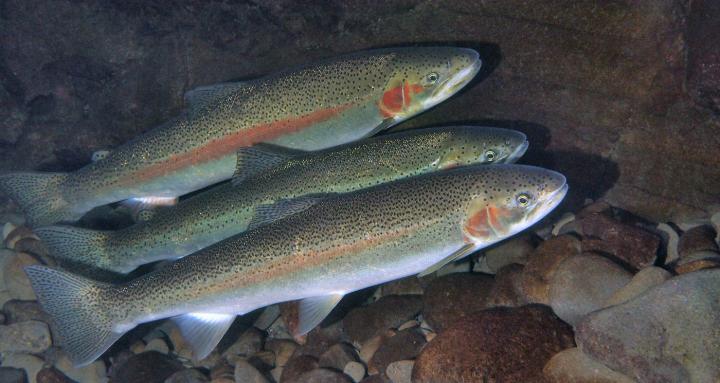
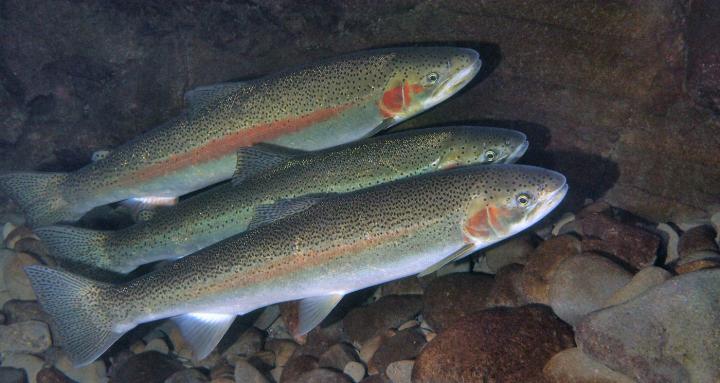
IMAGE

CORVALLIS, Ore. – A new study on steelhead trout in Oregon offers genetic evidence that wild and hatchery fish are different at the DNA level, and that they can become different with surprising speed.

The research, published today in Nature Communications, found that after one generation of hatchery culture, the offspring of wild fish and first-generation hatchery fish differed in the activity of more than 700 genes.

A single generation of adaptation to the hatchery resulted in observable changes at the DNA level that were passed on to offspring, scientists reported.

This research was conducted at Oregon State University in collaboration with the Oregon Department of Fisheries and Wildlife. Scientists say the findings essentially close the case on whether or not wild and hatchery fish can be genetically different.

Differences in survival and reproductive success between hatchery and wild fish have long offered evidence of rapid adaptation to the hatchery environment. This new DNA evidence directly measured the activity of all genes in the offspring of hatchery and wild fish. It conclusively demonstrates that the genetic differences between hatchery and wild fish are large in scale and fully heritable.

"A fish hatchery is a very artificial environment that causes strong natural selection pressures," said Michael Blouin, a professor of integrative biology in the OSU College of Science. "A concrete box with 50,000 other fish all crowded together and fed pellet food is clearly a lot different than an open stream."

It's not clear exactly what traits are being selected for, but the study was able to identify some genetic changes that may explain how the fish are responding to the novel environment in the hatchery.

"We observed that a large number of genes were involved in pathways related to wound healing, immunity, and metabolism, and this is consistent with the idea that the earliest stages of domestication may involve adapting to highly crowded conditions," said Mark Christie, lead author of the study.

Aside from crowding, which is common in the hatchery, injuries also happen more often and disease can be more prevalent.

The genetic changes are substantial and rapid, the study found. It's literally a process of evolution at work, but in this case it does not take multiple generations or long periods of time.

"We expected hatcheries to have a genetic impact," Blouin said. "However, the large amount of change we observed at the DNA level was really amazing. This was a surprising result."

With the question put to rest of whether hatchery fish are different, Blouin said, it may now be possible to determine exactly how they are different, and work to address that problem. When the genetic changes that occur in a hatchery environment are better understood, it could be possible to change the way fish are raised in order to produce hatchery fish that are more like wild fish. This research is a first step in that direction.

###

This work was performed using steelhead trout from the Hood River in Oregon. It was supported by the Bonneville Power Administration and the Oregon Department of Fish and Wildlife.

Media Contact

Michael Blouin
[email protected]
541-737-2362
@oregonstatenews

http://www.orst.edu

Share12Tweet7Share2ShareShareShare1

Related Posts

Do Your Genes Influence How Lifestyle Choices Affect Aging?

Do Your Genes Influence How Lifestyle Choices Affect Aging?

April 1, 2026
Combining Single-Cell Multiomics Unlocks Precise Identification of Rare Cell Types and States

Combining Single-Cell Multiomics Unlocks Precise Identification of Rare Cell Types and States

March 31, 2026

Genetically Engineered Marmosets Pave the Way for Advancements in Human Deafness Research

March 31, 2026

How Great Hammerhead Sharks Outsmart Ocean Temperature Swings: Insights from FIU Researchers

March 31, 2026
Please login to join discussion

POPULAR NEWS

  • blank

    Revolutionary AI Model Enhances Precision in Detecting Food Contamination

    96 shares
    Share 38 Tweet 24
  • Imagine a Social Media Feed That Challenges Your Views Instead of Reinforcing Them

    1006 shares
    Share 398 Tweet 249
  • Promising Outcomes from First Clinical Trials of Gene Regulation in Epilepsy

    51 shares
    Share 20 Tweet 13
  • Popular Anti-Aging Compound Linked to Damage in Corpus Callosum, Study Finds

    43 shares
    Share 17 Tweet 11

About

We bring you the latest biotechnology news from best research centers and universities around the world. Check our website.

Follow us

Recent News

Linking Health Quality and Life Meaning in Elders

Household Solid Fuel Raises Frailty Risk in Chinese Adults

FSHR and LHR Compensation Unveils Ovarian Hyperstimulation Mechanisms

Subscribe to Blog via Email

Enter your email address to subscribe to this blog and receive notifications of new posts by email.

Join 78 other subscribers
  • Contact Us

Bioengineer.org © Copyright 2023 All Rights Reserved.

Welcome Back!

Login to your account below

Forgotten Password?

Retrieve your password

Please enter your username or email address to reset your password.

Log In
No Result
View All Result
  • Homepages
    • Home Page 1
    • Home Page 2
  • News
  • National
  • Business
  • Health
  • Lifestyle
  • Science

Bioengineer.org © Copyright 2023 All Rights Reserved.