Every year, backyard songbirds across the United States make an arduous journey to warmer winter climes. They migrate hundreds of miles, occasionally braving tough terrain and nasty weather. Sometimes, they have no place to stop and refuel along the way.
Birds actually weigh these risks using a combination of factors–fat, weather and date–to make a migration risk assessment, according to new research funded by the National Science Foundation (NSF). The findings can serve as the basis for building better conservation strategies, researchers say.
The work focused on three species of songbirds, red-eyed vireos, Swainson's thrushes and wood thrushes, as they crossed the Gulf of Mexico, from coastal Alabama to the Yucatan Peninsula. The researchers published their findings today in the Proceedings of the National Academy of Sciences (PNAS).
"There are a lot of studies looking at bird's departure behavior or arrival behavior," said Jill Deppe, a biologist at Eastern Illinois University and principal investigator on the NSF award. "This is the first time we've been able to take a subset of birds and gather data on both."
The team used radio telemetry to track the birds as they migrated from one side of the gulf to the other, a distance of some 600 miles. Radio telemetry relies on miniature transmitters, smaller than the average watch battery, to record birds' locations. The researchers attached transmitters to birds' backs without harming them or interfering with their ability to fly. Each transmitter emits a radio signal at a specific frequency, picked up by antennas on the team's radio towers, which line part of the coast in Alabama and Mexico.
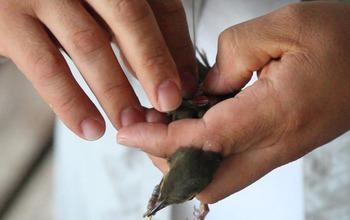
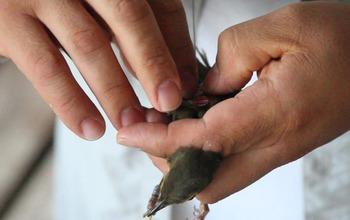
The researchers found birds generally used two cues–weather and their body fat levels–to make migration risk assessments. If humidity was too high, birds wouldn't depart. Birds that didn't carry large amounts of fat changed their routes, going farther inland and sometimes entirely around the gulf to avoid an open-water crossing. Researchers measured the fat content by looking at the birds' subcutaneous fat deposits, visible just underneath the skin.
Departure time also influenced the birds' success. Those that left at the end of September through mid-October, when gulf weather is more favorable, were more successful.
Surprisingly, however, age didn't seem to matter; young birds were just as successful in migration as older birds, an "interesting and unexpected" outcome that merits further study, Deppe said.
There are still many unanswered questions about bird migration, especially for small birds. "It's not that they're unanswerable," Deppe said. "They've simply been challenging to study given current technological limitations. But that's changing."
Her team for this research involved not only biologists, but also engineers and atmospheric scientists. One of the co-authors on the PNAS paper, Gil Bohrer of Ohio State University, received funding from NASA to develop new tools for understanding relationships between climate and animal migration. His work helped the team's biologists understand how weather played into the songbird's migration decisions.
Research can help protect migrating birds
Migration carries costs–among them, the tribulations of navigating unfamiliar territory and crossing ecological features like the Gulf of Mexico. But for birds, the benefits outweigh those costs.
"These birds have evolved to make this flight," Deppe said. "It probably gives them some time and energy savings on a direct route. They're not exposed to predators as much over the open water, they're less exposed to parasites, too."
Songbirds spend a significant chunk of their lives–about 30 percent–migrating. Red-eyed Vireos, for example, can spend the spring and summer breeding season in deciduous forests of the eastern United States, and winter in the South American tropics. The five-inch songbird can travel upwards of 3,000 miles, twice a year.
"They are quite successful at negotiating the barriers, at assessing the risk that's involved," said Frank Moore, another author on the PNAS paper and a biologist at the University of Southern Mississippi. "And if you think about it, some of the factors that are important in this risk, they can control. Other factors are outside their control."
Now that we know what criteria birds use to migrate, that information can be used to build more effective conservation strategies, Deppe said. Those include protecting high-quality habitats along the birds' migration routes. In those areas, the birds can eat and gain the fat necessary for them to survive migration.
Songbirds play an important role in the ecosystem, both as food for larger predators and as consumers of fruits and seeds that shape plant distributions.
"Survival of migrating songbirds, like migrating butterflies, has been declining for some time," said Michelle Elekonich, a program director in NSF's Directorate for Biological Sciences, which funded the research. "This work will help us understand migration better and may allow us to better protect migrants."
###
-NSF-