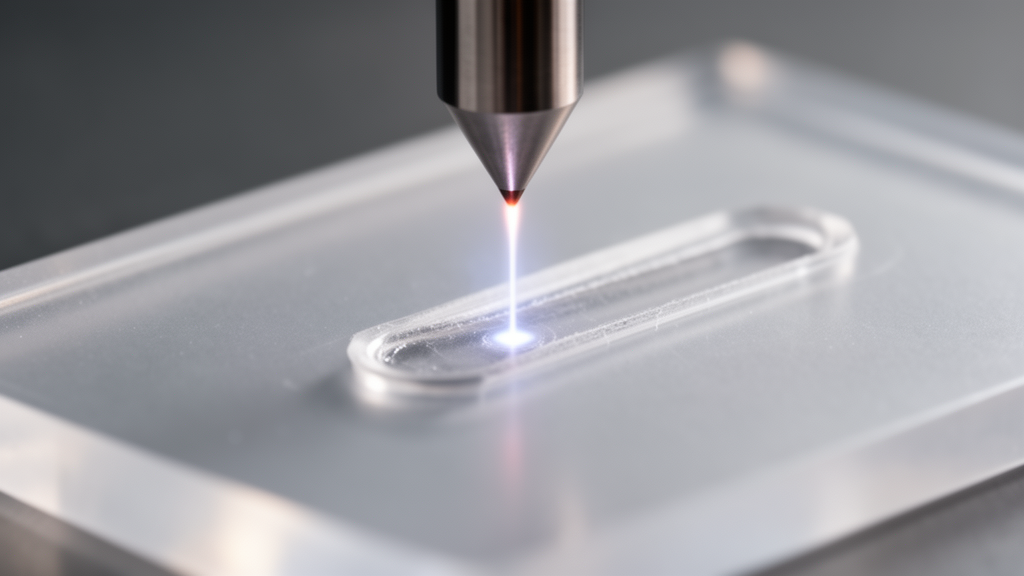
A research investigation published in Applied Physics A has demonstrated that efficient material removal during ultrafast laser processing can actively suppress heat-affected thermal modifications in polymer targets at repetition rates far below the gigahertz regime. Conducted by an international team of researchers including Andrés P. Bernabeu, Pol Sopeña, Nicolas Bottin, Daniel Puerto, Sergi Gallego, David Grojo, and Augusto Beléndez, the experimental study analyzed the direct interplay between cumulative heat generation and ablative mass ejection in poly(vinyl chloride) foils. Ultrafast laser micromachining of polymers has historically presented significant engineering obstacles because organic macromolecules typically exhibit very low thermal diffusivity values alongside comparatively low transition and decomposition temperatures. When energy deposited by consecutive laser pulses fails to diffuse away before subsequent pulses arrive, thermal accumulation rapidly builds up within the treated zone. Under typical processing conditions, this thermal buildup promotes undesirable structural consequences such as localized swelling, softening, melting, and polymer degradation around the irradiated perimeter, severely compromising manufacturing precision.
To investigate the governing physics behind these structural transitions, the experimental team systematically examined how laser pulse duration, focusing beam radius, and pulse repetition rate dictate the physical response of poly(vinyl chloride) foils under near-infrared irradiation at a central wavelength of 1030 nanometers. The experimental apparatus utilized an industrial-grade Carbide ultrafast laser source manufactured by Light Conversion, which delivered tunable pulse durations spanning continuously from 220 femtoseconds up to 32 picoseconds. Throughout the primary experimental sequences, the individual laser pulse energy was maintained at a constant value of 88 microjoules, while the repetition rate was adjusted across a broad experimental operating window ranging from 100 hertz to 60 kilohertz. The beam delivery system incorporated two distinct optical focusing lenses to generate two separate interaction configurations: a 500-millimeter focal length lens producing an effective beam radius of 118 micrometers at the one-over-e-squared intensity contour, and a 150-millimeter focal length lens yielding a tighter effective beam radius of 40 micrometers.
The optical beam geometry was directed onto the 300-micrometer-thick poly(vinyl chloride) foil samples at an oblique incidence angle of approximately thirty degrees relative to the surface normal, a spatial orientation chosen to accommodate an integrated in situ optical inspection system. This diagnostic arrangement featured a 680-nanometer light-emitting diode illuminator, a beam splitter, a tube lens, a five-times magnification microscope objective with a numerical aperture of 0.14, and a digital complementary metal-oxide-semiconductor camera for continuous target alignment. Accurate measurements of the effective focal spot sizes on the target plane were established using the standardized Liu analytical method calibrated on monocrystalline silicon reference samples. In the loose focusing configuration with a focal length of 500 millimeters, the 88-microjoule pulse energy produced a peak irradiation fluence of 0.40 joules per square centimeter, whereas the tighter 150-millimeter lens produced a concentrated peak fluence of 3.50 joules per square centimeter at the polymer target surface.
Comprehensive physical characterization of the irradiated polymer targets combined advanced digital optical microscopy using a Keyence VHX-7000 instrument with high-resolution confocal laser scanning microscopy using a Keyence VK-X3050 system. The confocal topographic inspections were conducted with a twenty-times objective having a numerical aperture of 0.46, delivering a lateral scanning pitch of 0.75 micrometers, an exceptional vertical height resolution of one nanometer, and a nominal height repeatability of forty nanometers. Quantitative analysis evaluated three distinct volumetric parameters defined relative to the unmodified planar surface: the positive volume representing swollen or resolidified polymer material elevated above the original surface baseline, the negative volume reflecting actual ablated void space excavated below the baseline, and the net topographic volume determined mathematically by subtracting the negative removed volume from the positive swollen volume. This volumetric differentiation provided an unambiguous metric for distinguishing between pure heat-affected surface deformation and true ablative removal across varying operational parameters.
The poly(vinyl chloride) material selected for the investigation presented unique physical properties that made it an ideal model polymer for studying competitive heat dynamics. Earlier calorimetric and thermogravimetric characterizations revealed that poly(vinyl chloride) possesses a glass transition temperature of approximately 345 kelvin (around 72 degrees Celsius) and a thermal decomposition threshold of roughly 498 kelvin (around 225 degrees Celsius). Combined with an estimated optical electronic bandgap of 3.95 electron volts, the incident 1030-nanometer photons, each carrying approximately 1.2 electron volts of energy, drove light-matter coupling primarily through non-linear four-photon absorption phenomena. Furthermore, poly(vinyl chloride) exhibits a low thermal diffusivity of 1.4 times ten to the power of minus seven square meters per second, accompanied by low thermal conductivity.
Initial pulse-duration trials conducted under the low-fluence regime of 0.40 joules per square centimeter at a fixed repetition rate of 60 kilohertz isolated the temporal influence of energy deposition on morphological evolution. At this peak fluence level, single laser pulses caused no observable physical alteration on the target surface, confirming that the applied energy remained strictly below the single-pulse ablation threshold, which was determined to be 1.74 joules per square centimeter for 220-femtosecond pulses in the tightly focused configuration. When long 32-picosecond pulses were applied for 800 shots, the distributed temporal delivery produced purely positive topographic structures characterized by local softening, material swelling, and subsequent resolidification without material excavation. Conversely, when the pulse duration was reduced to two picoseconds and 220 femtoseconds under identical total energy, energy confinement dramatically increased peak optical intensity, triggering genuine ablative cratering and producing net negative volumes despite operating below the single-pulse ablation threshold.
The transition between swelling and ablation under multipulse exposure showed a distinct dependence on pulse accumulation numbers across different temporal regimes. In the low-fluence configuration, the critical transition point where negative ablated volume overtook positive swollen volume occurred after approximately 50 pulses for 220-femtosecond irradiation, roughly 550 pulses for two-picosecond irradiation, and required nearly 1400 pulses for 32-picosecond irradiation. Remarkably, comparative measurements between the two optical focusing conditions revealed that the low-fluence regime operating at 0.40 joules per square centimeter generated substantially larger total removed net volumes than the high-fluence configuration at 3.50 joules per square centimeter. While counterintuitive under standard cold-ablation models where smaller spot sizes often yield higher local efficiency, the authors explained that the larger 118-micrometer beam radius heated a significantly greater spatial volume of polymer material, allowing cumulative pulse-to-pulse thermal deposition to build a larger softened reservoir that accelerated macroscopic material removal over extended pulse sequences.
A critical revelation of the study emerged when the researchers systematically varied the laser repetition rate from 100 hertz to 60 kilohertz using 220-femtosecond pulses at a fixed dosage of 1000 pulses. Optical microscopy identified three concentric morphological zones: a central excavated crater, an intermediate annular rim of positive swelling and resolidified polymer, and an outer peripheral zone marked by altered optical reflectivity. This extended outer boundary corresponded to regions where transient local temperatures exceeded the material glass transition point of 72 degrees Celsius. When increasing the repetition rate from 100 hertz up to one kilohertz, all three zones expanded substantially, reflecting conventional thermal accumulation driven by shortened inter-pulse cooling intervals. However, as the repetition rate advanced beyond five kilohertz up to 60 kilohertz, the positive swollen volume and the extended thermal diameter contracted significantly, while the volume of ablated material continued to climb, plateauing near maximum efficiency between 15 and 20 kilohertz.
Normalized volumetric evaluations confirmed that this non-monotonic thermal trend occurred both below and above the single-pulse ablation threshold, demonstrating that thermal accumulation remains a decisive factor even during intense direct ablation. The experimental data matched theoretical predictions derived from the characteristic heat accumulation rate formula, where the threshold accumulation frequency scales proportionally with four times the thermal diffusivity divided by the square of the beam radius. For the experimental diffusivity of poly(vinyl chloride), this scaling yielded characteristic onset frequencies of roughly 40 hertz for the 118-micrometer beam radius and approximately 350 hertz for the 40-micrometer radius. This mathematical relationship explained why the maximum positive volume shifted toward higher repetition rates for the smaller beam spot, reinforcing the principle that thermal accumulation kinetics in polymers are fundamentally governed by the interplay between laser beam geometry and thermal diffusion time constants.
To verify the underlying chemical integrity across these structural regimes, micro-Raman spectroscopy was performed on samples irradiated at one kilohertz. Raman spectra tracking characteristic carbon-chlorine stretching vibrations between 580 and 730 reciprocal centimeters demonstrated that the polymer molecular structure was largely preserved within the extended reflectivity zone, whereas vibrational peaks broadened and decreased along the positive swollen rim and disappeared entirely within the deep crater base. The findings substantiate that rapid material removal physically ejects substantial thermal energy before it can diffuse laterally into adjacent substrate walls.
Subject of Research: Ultrafast laser processing and heat accumulation dynamics in poly(vinyl chloride)
Article Title: Interplay between heat accumulation and material removal in ultrafast laser processing of PVC
Article References: Bernabeu, A. P., Sopeña, P., Bottin, N., Puerto, D., Gallego, S., Grojo, D., & Beléndez, A. (2026). Interplay between heat accumulation and material removal in ultrafast laser processing of PVC. Applied Physics A, 132(10), Article 984. https://doi.org/10.1007/s00339-026-10125-z
Image Credits: AI Generated
DOI: 10.1007/s00339-026-10125-z
Keywords: ultrafast laser processing, poly(vinyl chloride), laser ablation, heat accumulation, material removal, ablation cooling, repetition rate, pulse duration, beam radius, thermal diffusivity, glass transition temperature, four-photon absorption, confocal microscopy, Raman spectroscopy, surface morphology, polymer micromachining, fluence threshold, polyethylene terephthalate
News Source: Denise Maddox. (November 26, 2026). Ultrafast Laser Processing Reveals Material Removal Mitigates Thermal Damage in Polymers. Scienmag.