• HOME
  • NEWS
  • EXPLORE
    • CAREER
      • Companies
      • Jobs
    • EVENTS
    • iGEM
      • News
      • Team
    • PHOTOS
    • VIDEO
    • WIKI
  • BLOG
  • COMMUNITY
    • FACEBOOK
    • INSTAGRAM
    • TWITTER
Sunday, February 8, 2026
BIOENGINEER.ORG
No Result
View All Result
  • Login
  • HOME
  • NEWS
  • EXPLORE
    • CAREER
      • Companies
      • Jobs
        • Lecturer
        • PhD Studentship
        • Postdoc
        • Research Assistant
    • EVENTS
    • iGEM
      • News
      • Team
    • PHOTOS
    • VIDEO
    • WIKI
  • BLOG
  • COMMUNITY
    • FACEBOOK
    • INSTAGRAM
    • TWITTER
  • HOME
  • NEWS
  • EXPLORE
    • CAREER
      • Companies
      • Jobs
        • Lecturer
        • PhD Studentship
        • Postdoc
        • Research Assistant
    • EVENTS
    • iGEM
      • News
      • Team
    • PHOTOS
    • VIDEO
    • WIKI
  • BLOG
  • COMMUNITY
    • FACEBOOK
    • INSTAGRAM
    • TWITTER
No Result
View All Result
Bioengineer.org
No Result
View All Result
Home NEWS Science News Biology

New species discovered in Antarctica

Bioengineer by Bioengineer
February 9, 2018
in Biology
Reading Time: 2 mins read
0
Share on FacebookShare on TwitterShare on LinkedinShare on RedditShare on Telegram
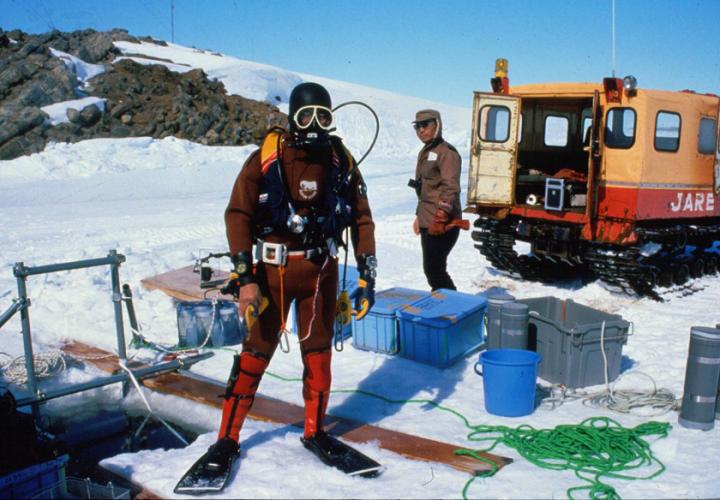
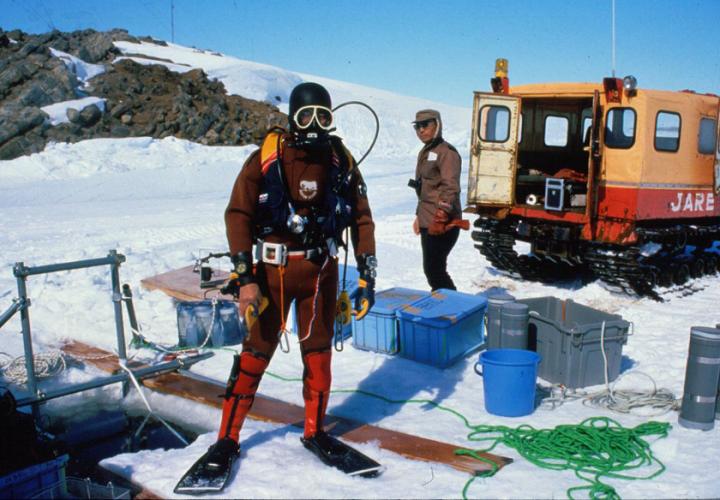
IMAGE

Credit: Photo provided by the National Institute of Polar Research

A team of Japanese scientists has discovered a new species of polychaete, a type of marine annelid worm, 9-meters deep underwater near Japan's Syowa Station in Antarctica, providing a good opportunity to study how animals adapt to extreme environments.

International efforts are currently underway in Antarctica to build long-term monitoring systems for land and coastal organisms from an ecological conservation standpoint. To this end, the accumulation of continent-wide fauna information is essential, but Japan is lagging behind in gathering and analyzing such data around Syowa Station, particularly in regard to coastal marine life.

To address this problem, in 2015 a team of researchers, including Keiichi Kakui, a lecturer at Hokkaido University, and Megumu Tsujimoto, a postdoctoral researcher at Japan's National Institute of Polar Research, started researching marine specimens stored at the institute, as well as newly collected specimens. As a part of this process, they conducted microscopic analyses to examine two annelid worms that scuba divers collected 8-9 meters deep on January 16th, 1981, at Nishinoura near Syowa Station.

The worm found 9 meters deep turned out to be a new, unnamed polychaete — a variety with a thick, gel-like coat and conspicuous, long notochaeta. The team named the new species Flabegraviera fujiae, taking after the icebreaker ship "Fuji" used in the expedition in 1981. The specimen collected 8 meters deep was recognized as Flabegraviera mundata, and was deemed to have been collected at the shallowest depth ever recorded for the Flabegraviera genus.

"This study is a major step forward in understanding marine life in the coastal region near Syowa Station," says Dr. Keiichi Kakui, "The Flabegraviera genus, to which the three species belong, is unique to the Antarctic and considered a good example for studying how polychaetes adapt to extreme environments."

Now that it has become clear that polychaetes inhabit depths reachable by scuba divers, the researchers hope to conduct experiments using living specimens to gain a deeper understanding of marine life in the area, helping to create an information infrastructure vis-à-vis local biodiversity.

###

The present study forms a part of research carried out on polychaetes by Naoto Jimi, a first-year doctoral candidate at Hokkaido University.

This press release is jointly issued by Hokkaido University and the National Institute of Polar Research.

Media Contact

Naoki Namba
81-117-068-034
@hokkaido_uni

http://www.oia.hokudai.ac.jp/

Share13Tweet8Share2ShareShareShare2

Related Posts

Florida Cane Toad: Complex Spread and Selective Evolution

Florida Cane Toad: Complex Spread and Selective Evolution

February 7, 2026
New Study Uncovers Mechanism Behind Burn Pit Particulate Matter–Induced Lung Inflammation

New Study Uncovers Mechanism Behind Burn Pit Particulate Matter–Induced Lung Inflammation

February 6, 2026

DeepBlastoid: Advancing Automated and Efficient Evaluation of Human Blastoids with Deep Learning

February 6, 2026

Navigating the Gut: The Role of Formic Acid in the Microbiome

February 6, 2026
Please login to join discussion

POPULAR NEWS

  • Robotic Ureteral Reconstruction: A Novel Approach

    Robotic Ureteral Reconstruction: A Novel Approach

    82 shares
    Share 33 Tweet 21
  • Digital Privacy: Health Data Control in Incarceration

    63 shares
    Share 25 Tweet 16
  • Breakthrough in RNA Research Accelerates Medical Innovations Timeline

    53 shares
    Share 21 Tweet 13
  • Mapping Tertiary Lymphoid Structures for Kidney Cancer Biomarkers

    50 shares
    Share 20 Tweet 13

About

We bring you the latest biotechnology news from best research centers and universities around the world. Check our website.

Follow us

Recent News

Decoding Phantom Limb Movements via Intraneural Signals

Attitudes Toward Aging Impact Early Nursing Home Quality

Transforming Healthcare: Just Culture and Restorative Practices

Subscribe to Blog via Email

Enter your email address to subscribe to this blog and receive notifications of new posts by email.

Join 73 other subscribers
  • Contact Us

Bioengineer.org © Copyright 2023 All Rights Reserved.

Welcome Back!

Login to your account below

Forgotten Password?

Retrieve your password

Please enter your username or email address to reset your password.

Log In
No Result
View All Result
  • Homepages
    • Home Page 1
    • Home Page 2
  • News
  • National
  • Business
  • Health
  • Lifestyle
  • Science

Bioengineer.org © Copyright 2023 All Rights Reserved.