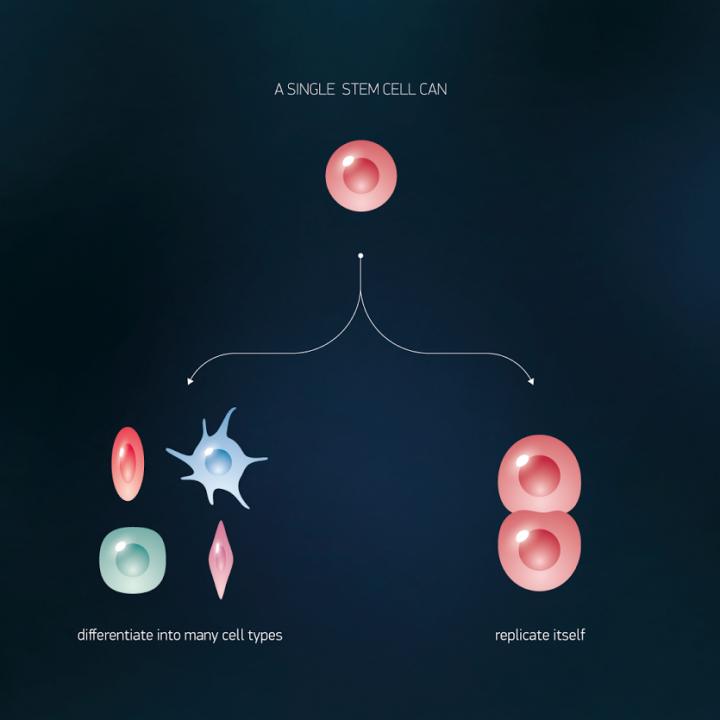
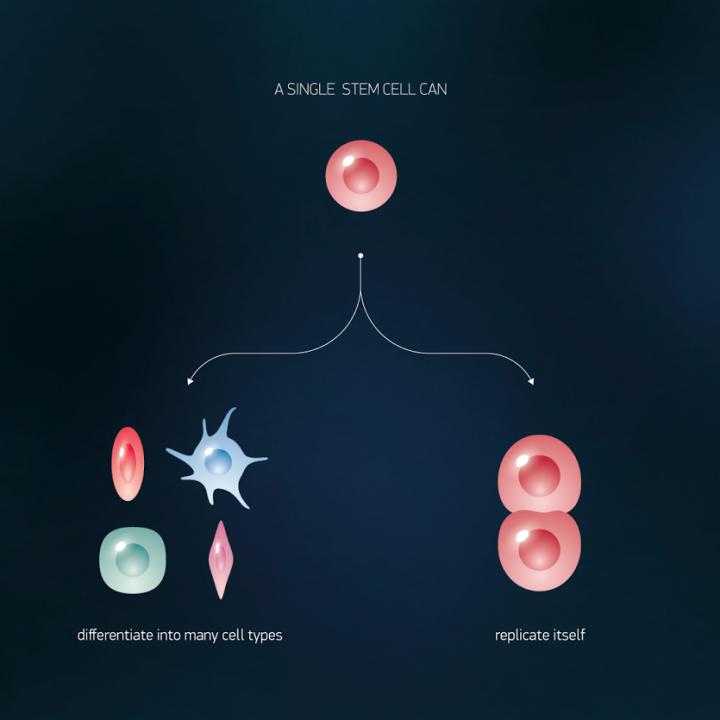
Stem cells are specialized undifferentiated cells that can divide and have the remarkable potential to develop into many different cell types in the body during early life and growth. In addition, they serve as a sort of internal repair system in many tissues, dividing essentially without limit to replenish other cells. When a stem cell divides, each new cell has the potential either to remain a stem cell or become another type of cell with a more specialized function, such as a muscle cell, a red blood cell, or a brain cell. Scientists distinguish several types of stem cells. Stem cells that can potentially produce any cell in the body are called pluripotent stem cells. There are no pluripotent stem cells in an adult body; they are found naturally in early embryos.
There are two ways to get pluripotent stem cells. The first is to extract them from the excess embryos produced during the in vitro fertilization procedure. But this practice is still controversial technically and ethically because it does destroy an embryo which could have been implanted. This is why researchers came up with the second way to get pluripotent stem cells — reprogramming adult cells.
The process of "turning on" genes that are active in a stem cell and "turning off" genes that are responsible for cell specialization is called reprogramming. This technology was pioneered by Shinya Yamanaka, who showed that the introduction of four specific proteins that are essential during early embryonic development could be used to convert adult cells into pluripotent cells. He was awarded the 2012 Nobel Prize along with Sir John Gurdon "for the discovery that mature cells can be reprogrammed to become pluripotent."
Thanks to their unique regenerative abilities, stem cells offer a new potential for treating any disease. For example, there have been cases of transplanting retinal pigment epithelium and spine cells from stem cells. Another experiment showed that stem cells were able to regenerate teeth in mice. Reprogramming holds great potential for new medical applications, because reprogrammed pluripotent stem cells (or induced pluripotent stem cells) can be made from a patient's own cells and embryos will not be needed.
However, the extent of the similarity between induced pluripotent stem cells and the "gold standard" of pluripotency, human embryonic stem cells, is still unclear. Recent studies highlighted significant differences between these two types of stem cells, although only a limited number of cell lines of different origins were analyzed.
Researchers compared induced pluripotent stem cells lines reprogrammed from different adult cell types that have been previously differentiated from embryonic stem cells. All these cells were isogenic, which means they all had the same gene set.
Transcription is the first step of gene expression, in which a particular segment of DNA is copied into RNA. Methylation is a chemical reaction – the addition of a methyl group (CH3) to a molecule. Epithelial tissue is a sheet of cells that covers a body surface or lines a body cavity. DNA stores the instructions for protein synthesis.
Scientists analyzed the transcriptome – the set of all products encoded, synthesized and used in a cell. Moreover, they elicited methylated DNA areas, because methylation plays a critical role in cell specialization. Thorough study of changes in the gene activity regulation mechanism showed that reprogrammed and embryonic stem cells are similar. In addition, researchers came up with a list of the activity of 275 key genes that can present reprogramming results.
Researchers analyzed three types of adult cells — fibroblasts, retinal pigment epithelium and neural cells. All of them consist of the same gene set, but a chemical modification (e.g. methylation) combined with other changes determines which part of DNA will be used for product synthesis.
The type of adult cells which were reprogrammed and the process of reprogramming itself did not leave any marks, concluded scientists. Differences between cells that did occur were thought to be the impact of random factors. "We defined the best induced pluripotent stem cells line concept. The minimum number of iPSC clones that would be enough for at least one to be similar to "gold standard" with 95% confidence is five." – says Dmitry Ischenko, MIPT PhD and Institute of Physical Chemical Medicine researcher.
A clone is a group of identical cells that are derived from the same cell. If there was one embryonic stem cell, and it differentiated into five distinct specialized cells, and then these specialized cells were reprogrammed into five distinct induced stem cell sets – then at least one of these lines would be similar to an embryonic cell with 95% confidence.
Clearly, no one is going to convert embryonic stem cells into neurons and reprogram them into induced stem cells – that would be too time-consuming and expensive. This experiment simulated the reprogramming of a patient's adult cells into induced pluripotent stem cells for further medical use. Even though this paper does not propose a method of organ growth in vitro for now, it is an important step in the right direction. Both induced pluripotent cells and embryonic stem cells can help us understand how specialized cells develop from pluripotent cells. In the future, they might also provide an unlimited supply of replacement cells and tissues for many patients with diseases that are currently untreatable.
###
Media Contact
Matvey Kireev
[email protected]
7-916-065-1016
@phystech
https://mipt.ru/english/