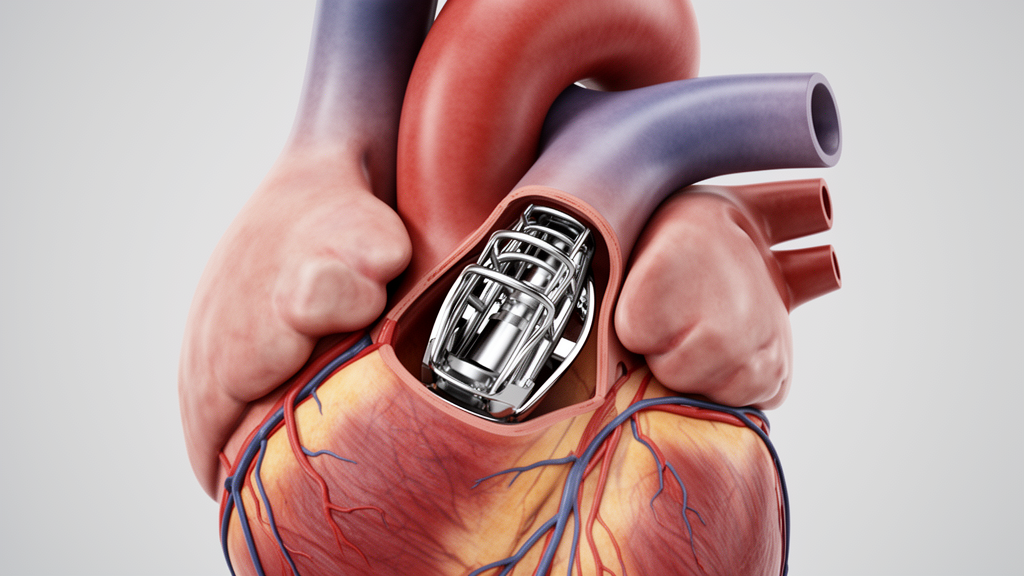
A narrower inferoseptal recess identified on pre-procedural computed tomography angiography independently predicts new-onset conduction disturbances following transcatheter aortic valve replacement, according to a retrospective clinical evaluation of 307 consecutive patients treated at Shanghai Changhai Hospital between January 2017 and December 2024. Transcatheter aortic valve replacement has become a primary therapeutic approach for individuals presenting with severe symptomatic aortic stenosis, yet post-procedural conduction abnormalities such as complete left bundle branch block and high-grade atrioventricular block continue to represent frequent and clinically significant complications that often lead to permanent pacemaker implantation. While anatomical markers including membranous septum length, left ventricular outflow tract configuration, interventricular septal thickness, and calcification within the device landing zone have previously been evaluated, the inferoseptal recess—a pivotal component of the central fibrous body situated between the aortic leaflet of the mitral valve and the ventricular septal endocardium—had not been directly evaluated as a clinical predictor of post-procedural conduction injury.
To investigate this anatomical relationship, investigators examined 348 patients evaluated for transcatheter valve interventions and applied predefined exclusion criteria to avoid confounding influences on rhythm analysis. Forty-one patients were excluded from the analysis, including seven individuals with pre-existing permanent pacemakers, 13 with pre-existing complete left bundle branch block, nine who underwent valve-in-valve procedures, 10 whose transcatheter procedures were unsuccessful, and two individuals with incomplete cross-sectional imaging data. The remaining 307 patients had a median age of 75 years and included 178 men, representing 58.0 percent of the cohort. Baseline medical conditions were generally comparable across the study population, showing diabetes in 23.1 percent of patients, hyperlipidemia in 45.0 percent, hypertension in 59.3 percent, and coronary artery disease in 39.1 percent, although individuals who developed post-procedural conduction disturbances exhibited modest baseline differences including higher body mass index, elevated rates of chronic obstructive pulmonary disease, higher median brain natriuretic peptide concentrations, and elevated median serum creatinine.
Computed tomography angiography was performed using a dual-source CT scanner with retrospective electrocardiographic gating, beginning with an initial non-contrast acquisition for calcium scoring followed by contrast-enhanced vascular acquisition extending from the carotid bifurcation beyond the femoral artery bifurcations. Enhanced imaging datasets were analyzed via multiplanar reformations reconstructed at 40 percent and 75 percent of the RR interval, measuring virtual aortic valve annulus indices during systole and inferoseptal recess dimensions during diastole. Two independent observers blinded to clinical records and patient outcomes performed anatomical quantifications, with the width of the inferoseptal recess defined on the virtual annular plane as the distance separating the right fibrous trigone from the medial boundary of the membranous ventricular septum. Height and depth were measured on reconstructed oblique-coronal views, while the difference between membranous septum length and implant depth was calculated alongside aortic root rotation angles, showing good within-observer repeatability and inter-observer reliability.
The composite primary endpoint occurred in 57 of the 307 evaluated patients, establishing an incidence rate of 18.6 percent for new-onset conduction disturbances within 30 days of valve implantation. Among the affected individuals, 37 patients developed new-onset persistent complete left bundle branch block and three developed complete right bundle branch block that persisted until hospital discharge. Seventeen patients, representing 5.5 percent of the total study population, required permanent pacemaker implantation within the one-month surveillance window, including 16 individuals who developed complete atrioventricular block and one patient who exhibited first-degree atrioventricular block accompanied by left anterior fascicular block and complete right bundle branch block requiring pacing on the fifth postoperative day. Patients experiencing primary conduction outcomes demonstrated higher frequencies of baseline right bundle branch block on pre-operative electrocardiograms, larger baseline left ventricular end-diastolic dimensions, and higher non-coronary sinus calcification burdens compared to patients without conduction disturbances.
Anatomical imaging comparisons revealed that patients who developed post-procedural conduction disturbances presented with a significantly narrower width of the inferoseptal recess, displaying a median width of 3.18 millimeters compared to 6.14 millimeters in patients who remained free of conduction injuries. These patients also demonstrated marked counter-clockwise aortic root rotation, exhibiting a median rotation angle of negative 7.50 degrees compared to positive 7.15 degrees in unaffected counterparts. Conversely, longitudinal dimensions of the recess did not differ between the clinical groups, as median inferoseptal recess height measured 5.95 millimeters in affected patients versus 5.97 millimeters in unaffected individuals, while recess depth measured 3.28 millimeters versus 3.09 millimeters. Furthermore, procedural characteristics showed that 92.5 percent of the overall cohort received self-expanding bioprosthetic valves and 7.5 percent received balloon-expandable devices, with patients who developed conduction disturbances receiving slightly larger median prosthesis sizes.
Receiver operating characteristic analysis identified an optimal inferoseptal recess width threshold of 4 millimeters, which yielded the highest Youden index of 0.516. Internal stability testing through 1000 bootstrap resampling iterations demonstrated a median optimal cut-off of 3.95 millimeters, with 91.2 percent of bootstrap thresholds falling between 3.5 and 4.5 millimeters and an estimated optimism bias of 0.033 in Youden index performance. In primary multivariable regression using Firth penalized-likelihood methods to address potential estimation bias from quasi-complete separation, continuous inferoseptal recess width remained an independent inverse predictor of conduction disturbances with an odds ratio of 0.76 per millimeter increase. When analyzed as a dichotomous factor, a recess width of 4 millimeters or less was associated with an odds ratio of 7.13, while pre-existing right bundle branch block, counter-clockwise aortic root rotation, left ventricular end-diastolic diameter, and the difference between membranous septum length and implant depth remained independent covariates.
Assessing predictive performance gains revealed that incorporating a dichotomized recess width of 4 millimeters or less into a baseline clinical model comprising pre-existing right bundle branch block, baseline QRS duration, and self-expanding valve selection produced a statistically significant discrimination increase, raising the c-statistic by 0.088 and yielding a continuous net reclassification improvement of 1.02 and an integrated discrimination improvement of 0.14. When added to an expanded baseline model that already integrated computed tomography metrics including aortic root rotation, left ventricular diameter, and membranous septum implantation depth differences, the c-statistic rose by 0.028 with a net reclassification improvement of 0.98. In pre-specified subgroup evaluations using penalized regression, a recess width of 4 millimeters or less was independently associated with permanent pacemaker implantation, yielding an odds ratio of 12.07 after correcting for separation bias, and was similarly confirmed as an independent risk factor for new-onset complete left bundle branch block.
Stratifying predictor variables by clinical availability confirmed that a strictly pre-procedural model comprising recess width, baseline right bundle branch block, aortic root rotation, ventricular diameter, and QRS duration achieved an area under the curve of 0.887. The subsequent addition of five peri-procedural variables—including membranous septum implantation depth difference, prosthesis type, prosthesis size, pre-dilation, and post-dilation—yielded an area under the curve of 0.906, representing an incremental increase of only 0.019, while the odds ratio for recess width remained stable. Supervised machine learning algorithms trained on the development cohort of 261 patients further confirmed these findings, with a Random Forest model achieving an area under the curve of 0.918 in internal validation. When tested in a chronologically separated temporal holdout cohort of 46 consecutive patients treated in the final segment of the study interval, the model maintained favorable calibration, discrimination, and clinical net benefit on decision curve analysis.
Interpretability assessments using SHapley Additive exPlanations demonstrated that computed tomography-derived anatomical measurements served as the dominant drivers of machine learning risk predictions, identifying wider inferoseptal recesses, smaller left ventricular end-diastolic diameters, and lower non-coronary sinus calcification as protective factors against conduction disturbances. Within the model architecture, recess width exerted a greater contribution to prediction outputs than the difference between membranous septum length and prosthesis implant depth. Individualized prediction analyses illustrated that patients exhibiting narrow recess widths below 3 millimeters combined with negative membranous septum depth differences and heavy calcification demonstrated estimated risk probabilities exceeding 0.80, whereas patients presenting with wide recesses and positive depth differences maintained low predicted probabilities despite moderate local calcium burdens.
The study authors noted multiple methodological constraints inherent to the retrospective, single-center design, emphasizing that the derived 4-millimeter threshold and machine learning framework require external validation across multi-center prospective cohorts before being applied to routine clinical guidance. In addition, the predominance of self-expanding bioprosthetic valves limits direct extrapolation to populations treated primarily with balloon-expandable platforms, while the 30-day surveillance interval restricted evaluation to early conduction outcomes. Procedural techniques, device iterations, and operator experience also evolved over the eight-year study timeframe between 2017 and 2024, potentially influencing event rates in the temporal validation cohort. The authors concluded that the inferoseptal recess width provides a quantifiable anatomical marker of conduction axis vulnerability, establishing an interpretable pre-procedural computed tomography framework for risk stratification that warrants prospective multicenter assessment.
Subject of Research: Inferoseptal recess anatomy and conduction disturbances after transcatheter aortic valve replacement
Article Title: Inferoseptal Recess Anatomy Predicts Conduction Disturbances After Transcatheter Aortic Valve Replacement
Article References: Guan, Y., Yan, H., Yang, L., Pang, G., Wang, R., Wang, X., Liu, S., Song, J., Shan, X., Qiao, F., Song, Z., Bai, Y., Jin, Z., Guo, Z., & Zhu, N. (2026). Inferoseptal Recess Anatomy Predicts Conduction Disturbances After Transcatheter Aortic Valve Replacement. Hellenic Journal of Cardiology. https://doi.org/10.1016/j.hjc.2026.10.004
Image Credits: AI Generated
DOI: 10.1016/j.hjc.2026.10.004
Keywords: transcatheter aortic valve replacement, inferoseptal recess, conduction disturbances, complete left bundle branch block, permanent pacemaker implantation, computed tomography angiography, aortic stenosis, central fibrous body, membranous septum, aortic root rotation, machine learning, random forest, SHAP analysis, Firth penalized regression, risk stratification, cardiac imaging, cardiovascular complications
News Source: Ophelia Keating. (November 26, 2026). Heart Recess Width Predicts Conduction Disturbances After Catheter Valve Replacement. Scienmag.