Surface degradation represents one of the primary mechanisms driving premature mechanical component failure across modern industrial manufacturing, spurring intensive engineering investigations into efficient surface repair and reinforcement technologies. While electroplated hard chrome plating historically served as the predominant manufacturing benchmark for enhancing component surface hardness, friction reduction, and corrosion resistance, increasingly severe environmental pollution and stringent regulatory constraints have restricted its sustainable operational deployment. Conventional thermal spraying provides broad operational adaptability for localized maintenance and large components, yet it produces coatings bonded mechanically to substrates, resulting in comparatively modest adhesion strength alongside inherent defect profiles such as residual porosity. Overlay welding offers robust metallurgical bonding across target workpieces, but its low deposition productivity and restricted compatibility with diverse alloy formulations severely constrain large-scale industrial utility. In response to these persistent manufacturing challenges, extreme high-speed laser cladding has emerged as an advanced surface modification solution, engineered specifically to deposit dense, metallurgically bonded protective layers with minimal substrate thermal alteration.
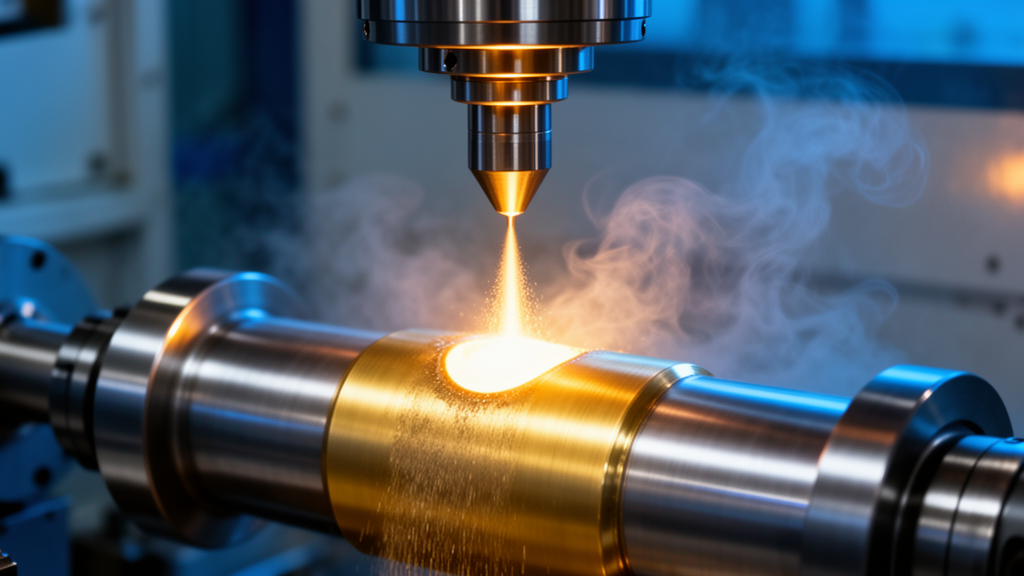
First introduced through collaborative equipment development by the Fraunhofer Institute for Laser Technology and RWTH Aachen University in 2017, extreme high-speed laser cladding fundamentally reconfigures the spatial energy distribution characteristic of conventional laser processing. Rather than directing high-power laser energy primarily into the metallic substrate to create a deep molten pool, the extreme high-speed configuration focuses its energy beam directly into the descending powder stream above the workpiece. This spatial beam manipulation ensures that cladding particles reach a fully molten liquid state prior to contacting the substrate surface, which substantially diminishes the duration and volume of the liquid melt pool. Operating at energy densities near 3 kW/cm2, the technique achieves cladding deposition speeds ranging from 20 to 200 m/min, with specialized processing windows extending up to 500 m/min. Consequently, extreme high-speed laser cladding achieves surface area processing rates up to 0.6 m2/h—a ten-fold productivity improvement over conventional laser cladding rates of approximately 0.06 m2/h—while elevating powder material utilization efficiency to between 85% and 95%.
Despite its substantial operational throughput, the rapid thermal cycling inherent to extreme high-speed laser cladding introduces acute metallurgical challenges that dictate comprehensive process optimization. Because the laser spot traverses target surfaces at extraordinary linear velocities, the resulting heating and cooling rates induce steep local temperature gradients and concentrated internal stress distributions. Ding and colleagues demonstrated that while extreme high-speed processing of Inconel 625 superalloy achieves superior surface precision compared to conventional cladding, accelerated cooling dynamics frequently yield non-uniform elemental partitioning and microstructural segregation. Similarly, investigations by Sun and colleagues revealed that rapid thermal dissipation during the deposition of chromium-rich stainless steel coatings suppresses complete martensitic phase transformation, directly lowering matrix hardness. When brittle material systems such as high-carbon alloys or structural ceramics are deposited, severe thermal cycling frequently triggers crack initiation and residual tensile stress concentrations, demanding rigorous process parameter balancing or supplementary post-processing treatments to ensure mechanical integrity during operational service.
Material selection serves as the initial critical variable in establishing stable metallurgical interfaces while avoiding catastrophic interfacial failure. The material spectrum evaluated for extreme high-speed laser cladding spans conventional alloy systems, self-fluxing formulations, high-entropy alloys, amorphous alloys, ceramics, and advanced composites. In studies of CrFeCoNiMo0.2 high-entropy alloys by Huang and colleagues, extreme high-speed processing delivered substantial grain refinement and elevated surface precision compared to conventional methods, noticeably augmenting corrosion resistance and mechanical strength. Wang and colleagues established that iron-based amorphous coatings deposited under extreme cooling regimes exhibit higher volumetric fractions and more homogeneous spatial distributions of amorphous phases. For ceramic systems prone to severe thermal shock cracking, Liu and colleagues utilized continuous gradient architectures of ZrB2-SiC to bridge physical incompatibilities with metallic substrates.
The structural characteristics of deposited layers depend directly on the interdependent physical relationships governing laser power, focal spot diameter, scanning speed, overlap ratio, and powder feed rate. Together, laser power, beam diameter, and traversing speed dictate the effective laser energy density delivered to the interacting materials, determining substrate dilution and heat-affected zone depth. Experimental investigations by Yang, Chen, and Shen demonstrated that systematically increasing scanning velocity promotes grain refinement, uniform elemental homogenization, and substantial reductions in coating dilution and thermal penetration. Conversely, Yan and colleagues established that an excessively low track overlap ratio produces pronounced surface ripples and deficient protective thickness, whereas excessive overlap induces localized re-sintering, surface indentation, and degraded structural performance. Chen and colleagues noted that increasing laser power during FeCrBSi deposition induces an initial decrease in microhardness followed by subsequent elevation, driven by variations in amorphous retention and grain growth. Meanwhile, Tan and colleagues revealed that tungsten carbide particles sized between 30 and 65 micrometers maximize coating wear performance through uniform dispersion strengthening, whereas coarser particles agglomerate and disrupt grain growth orientation.
To navigate complex multi-parameter interactions without relying exclusively on laborious empirical trial-and-error, researchers deploy systematic mathematical and statistical optimization methodologies. Classical experimental design frameworks—incorporating orthogonal arrays, Taguchi methods, and response surface methodology—provide structured empirical models relating operational variables to geometric and mechanical responses. Wang and colleagues utilized orthogonal arrays to optimize single-layer cladding of K648 superalloy, demonstrating via variance analysis that powder feed rate governs track width, laser power controls height, and scanning speed dictates penetration depth. To resolve conflicting optimization goals, Xv and colleagues combined Taguchi design with the Analytic Hierarchy Process and Fuzzy Comprehensive Evaluation models to optimize Fe-Cr-Ni coatings on ASTM 1045 steel. Additionally, response surface methodology allowed Yong and colleagues, as well as Yan and colleagues, to establish high-precision predictive response surfaces mapping laser power, traversing velocity, and mass feed rates against geometric cladding height and cross-sectional bead width.
Intelligent computational algorithms and machine learning architectures have expanded optimization capabilities by modeling highly non-linear parameter landscapes from extensive experimental datasets. In a comparative algorithmic study by Xv and colleagues, AdaBoost predictive models demonstrated superior regression accuracy over Random Forest configurations, isolating traversing speed as the dominant parameter influencing track height and surface roughness while validating overlap ratio as the primary factor controlling near-surface grain size. Artificial neural networks, notably Back Propagation configurations and genetic algorithm-optimized variants, are increasingly coupled with multi-objective metaheuristics. For example, Zhang and colleagues synthesized Generalized Regression Neural Networks with the second-generation Non-dominated Sorting Genetic Algorithm to optimize CoCrFeNiMn high-entropy alloy processing parameters, restricting predictive discrepancies within a 10% relative error margin. Ongoing computational initiatives integrate multi-modal sensor streams—encompassing high-speed melt pool vision, pyrometric thermal fields, and optical emission spectroscopy—with reinforcement learning algorithms to enable dynamic closed-loop parameter calibration during active fabrication cycles.
Complementing data-driven algorithms, numerical simulation frameworks provide critical physical insights into transient molten pool fluid mechanics, thermal distributions, and residual stress evolution. li and colleagues implemented finite element models to analyze NiTi shape memory alloy cladding under varying laser power levels, revealing that expanded molten pool dimensions under elevated power inputs amplify volumetric contraction stresses and promote pronounced component deformation. Addressing rotational geometry, Lv and colleagues engineered specialized three-dimensional numerical formulations for cylindrical components, achieving correlation with experimental heat-affected zone depths within a 14% discrepancy margin. Predictive accuracy has been further advanced by Li and colleagues through combined multi-source heat formulations, while Zhang and colleagues incorporated annular nozzle powder flow dynamics validated against high-speed photographic imaging.
When processing crack-sensitive alloy formulations where thermal optimization alone cannot eliminate steep internal stresses, external physical field assistance provides decisive microstructural control. Ultrasonic surface rolling applies high-frequency mechanical impacts to the cladding layer, inducing dynamic recrystallization, dendrite fragmentation, and profound grain refinement. Concurrently, electromagnetic induction-assisted hybrid processing preheats the metallic substrate prior to laser powder deposition. Li and colleagues proved that this integrated preheating strategy suppresses temperature gradients, minimizes cracking in Ni60 and Ni60-WC coatings, and significantly lowers dilution compared to conventional laser-induced hybrid cladding. Furthermore, secondary laser remelting sweeps the solidified track without consumable feeding, smoothing surface topography, promoting compositional homogenization, and dissolving residual micro-defects.
Subsequent thermal conditioning treatments represent an established avenue for homogenizing segregated elemental structures and releasing stored internal strain energy. Li and colleagues observed that targeted annealing schedules stimulate protective surface oxide film growth on NiTi coatings, markedly bolstering corrosion endurance, while Dong and colleagues identified that increasing annealing temperatures modulates equiaxed grain fractions and precipitate distributions in Ni/316L coatings. Furthermore, post-processing sequences combining power spinning with post-spinning heat treatment, pioneered by Li and colleagues, refine grain structures toward dense dendritic eutectic morphologies that substantially improve sliding wear resistance. Synthesizing these advancements, extreme high-speed laser cladding continues to transition from empirical laboratory exploration toward intelligent industrial maturity. Future advancements will depend on multi-field physical coupling, automated closed-loop digital twin control platforms, and end-to-end industrial consortia integrating specialized alloy powder synthesis, optical delivery hardware, and rigorous qualification standards across advanced manufacturing sectors.
Subject of Research: Process optimization, material systems, and external field assistance in extreme high-speed laser cladding
Article Title: Process optimization of extreme high-speed laser cladding: materials, parameters, external field assistance, and future trends
Article References: Duan, B., Zhao, H., Lin, N., Zhou, L., Wang, X., Ma, G., Wang, H., & Wu, Y. (2026). Process optimization of extreme high-speed laser cladding: materials, parameters, external field assistance, and future trends. Surface Science and Technology, 4(1), Article 27. https://doi.org/10.1007/s44251-026-00134-8
Image Credits: AI Generated
DOI: 10.1007/s44251-026-00134-8
Keywords: extreme high-speed laser cladding, surface modification, laser cladding optimization, powder utilization, high-speed laser cladding, ultrasonic surface rolling, induction hybrid cladding, laser remelting, microstructural refinement, residual stress reduction, wear resistance, corrosion resistance, high-entropy alloys, finite element analysis, intelligent optimization algorithms, tungsten carbide composites
News Source: Denise Maddox. (November 26, 2026). Extreme High-Speed Laser Cladding Optimization Cuts Defects Across Advanced Industrial Coatings. Scienmag.