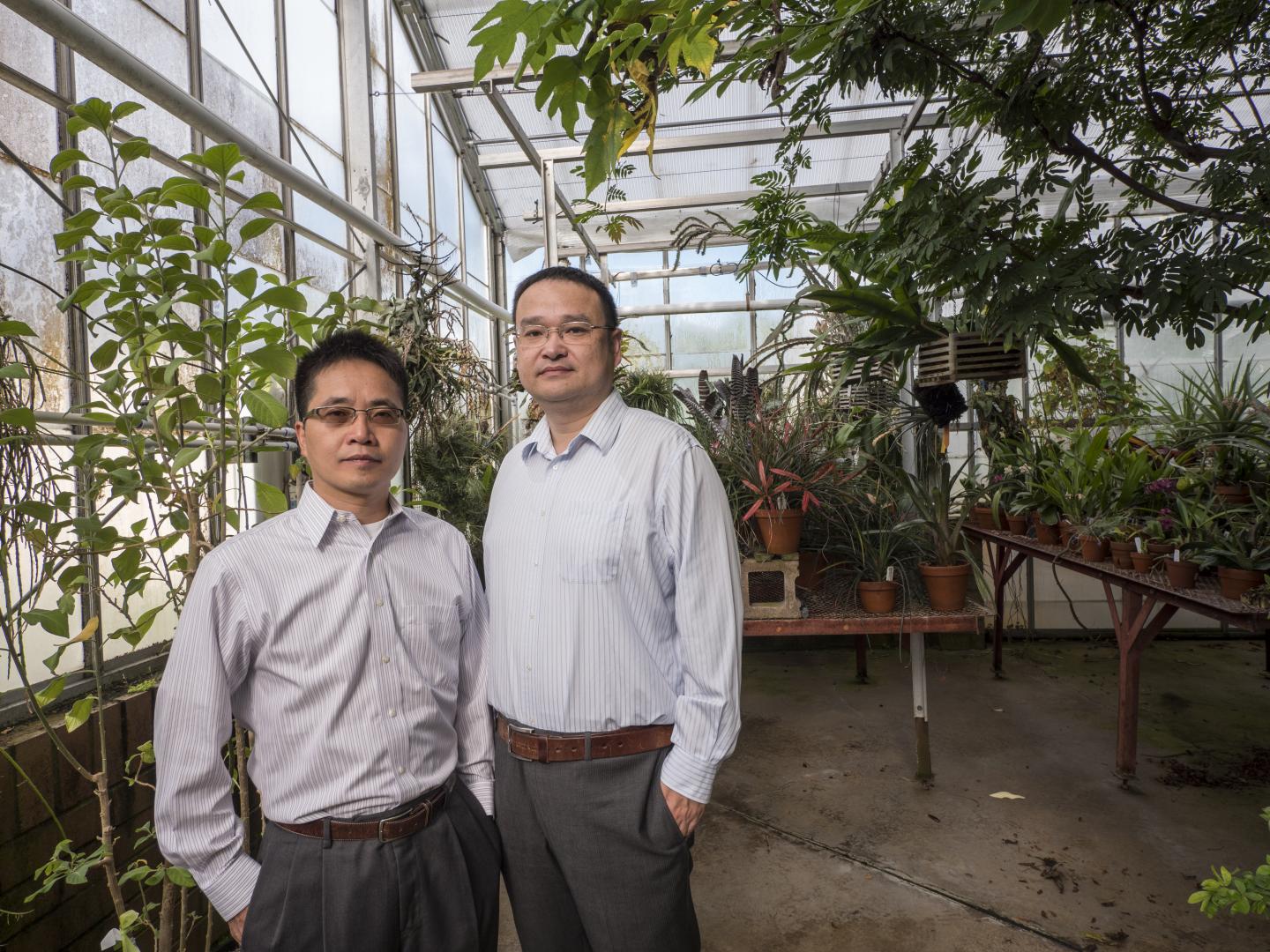
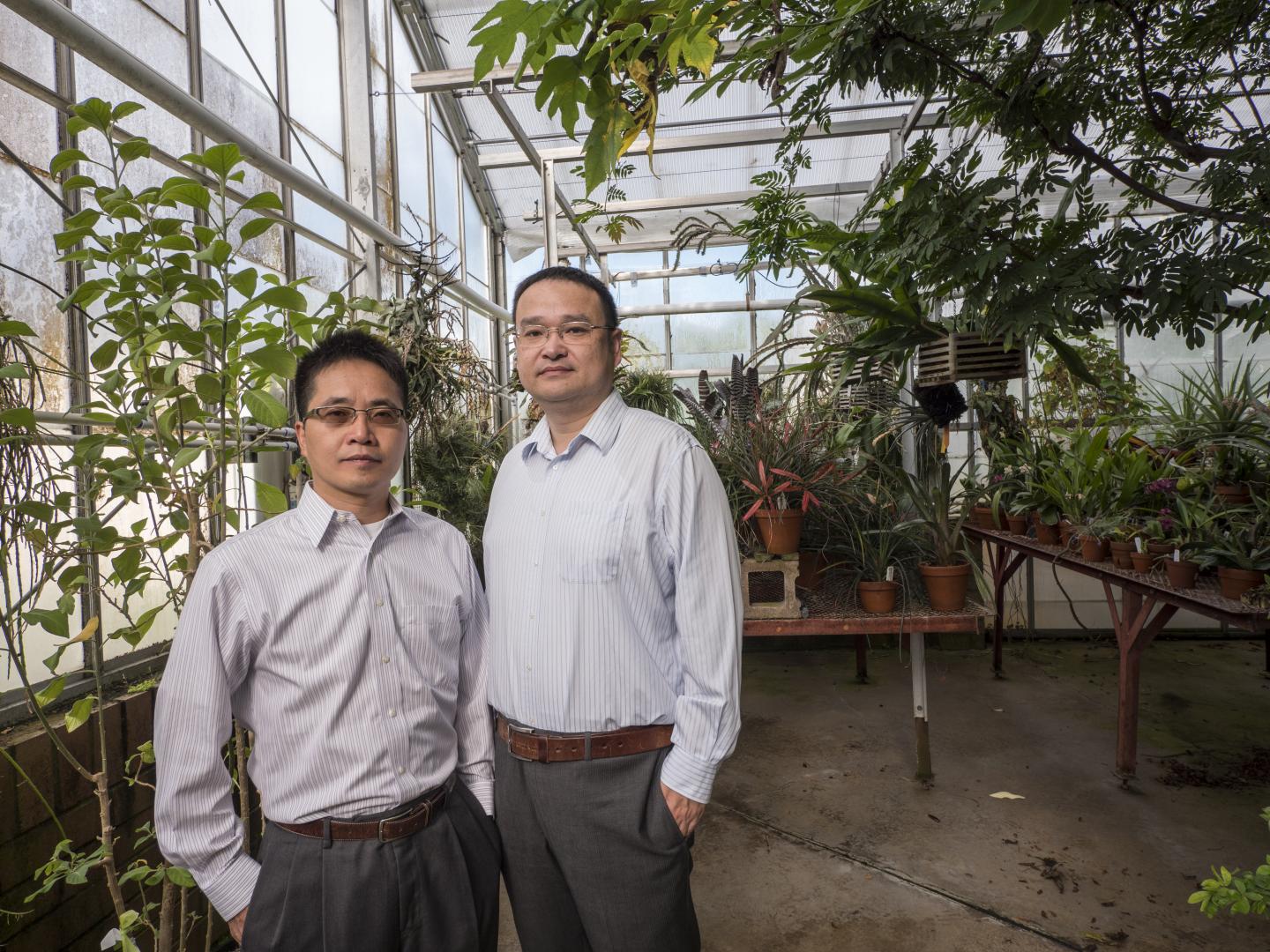
Credit: Glenn Asakawa / University of Colorado Boulder
University of Colorado Boulder engineers have received a $2.45 million grant from the U.S. Department of Agriculture (USDA) to develop a scalable, cost-effective greenhouse material that splits sunlight into photosynthetically efficient light and repurposes inefficient infrared light to aid in water purification.
The four-year research program could yield next-gen technology capable of solving food, energy and water security challenges posed by global population growth and climate change.
The study, administered under the USDA and National Science Foundation's Innovations at the Nexus of Food, Energy and Water Systems (INFEWS) program, will be led by researchers from CU Boulder's Department of Mechanical Engineering in collaboration with Michigan State University's Department of Horticulture.
"We are excited to work on a project that addresses one of the most important global challenges with our multidisciplinary colleagues at CU and MSU," said Assistant Professor Ronggui Yang, who will lead the team.
Greenhouses have been used since the 1960s and remain the standard for effective plant productivity compared to open field agriculture. But the structures carry high energy costs, requiring tremendous amounts of energy for heating, ventilation, electrical lighting, and water for evaporative cooling. By the year 2050, current greenhouse capabilities will likely be unable to keep up with worldwide human consumption, making an increase in productivity an urgent mandate.
Under normal conditions, plants only use around 50 percent of incoming sunlight for photosynthesis while the remaining half goes unused.
"The new CU Boulder technology will take the form of a semi-translucent film that splits incoming light and converts the rays from less-desired green wavelengths into more desirable red wavelengths, thus increasing the amount of photosynthetically efficient light for the plant with no additional electricity consumption," said Xiaobo Yin, an assistant professor of Mechanical Engineering and Materials Science and Engineering at CU Boulder.
The thin engineered material can be applied directly to the surface of greenhouse panels.
The technology also makes use of the photosynthetically ineffective light by redirecting it to aid in solar-driven water purification, an application that MSU professors James Klausner, Andre Benard and Erik Rungle will work to develop further.
"The near-infrared wavelengths can help clean brackish wastewater, allowing it to be recirculated in an advanced humidification-dehumidification interface and further reducing the greenhouse's energy footprint," said Yang.
The innovation could help improve U.S. agricultural competitiveness and lead to new best practices for greenhouse systems in different climates, especially in arid regions with limited freshwater availability where crops cannot be grown profitably.
The technology expands on the researchers' previous successful efforts to develop a suite of scalable engineered materials that can cool structures and improve solar panel efficiency, among other applications.
The researchers plan to create a pilot greenhouse facility to test the material's properties over the course of multiple tomato production cycles and, later, expand the test to leafy greens such as lettuce and herbs.
###
Media Contact
Trent Knoss
[email protected]
303-735-0528
@cubouldernews
http://www.colorado.edu/news