Credit: University of California San Diego
If you think you can use the solar panels on your roof to power your home during an outage, think again. During an outage, while your home remains connected to the grid, the devices that manage your solar panels are powered down for safety reasons. In other words, this permanent connection to the grid makes it impossible for homeowners to draw on power generated by their own renewable energy resources.
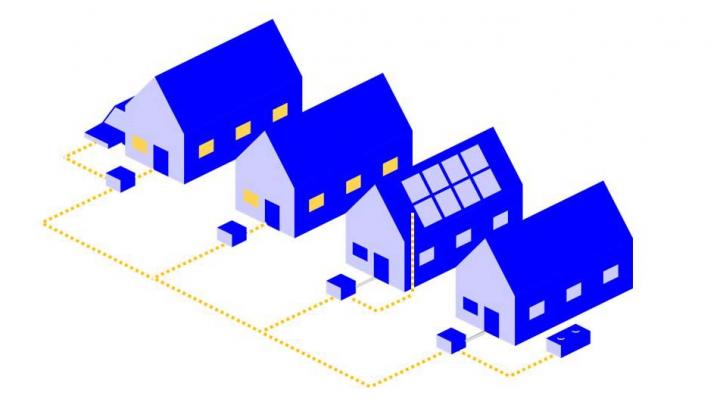
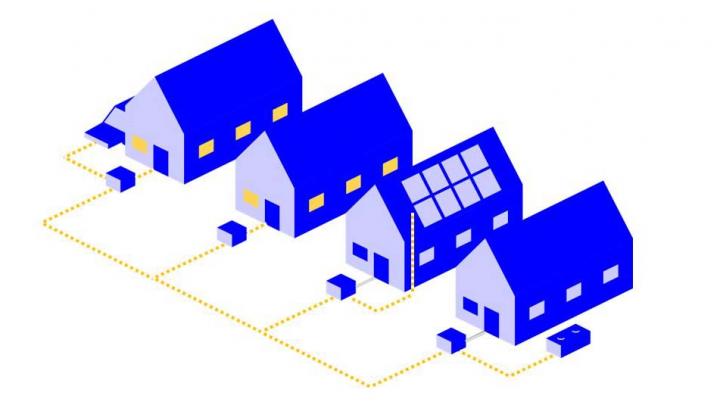
A team of engineers at the University of California San Diego wants to change this. They have developed algorithms that would allow homes to use and share power from their renewable energy sources during outages by strategically disconnecting these devices, called solar inverters, from the grid. The algorithms work with existing technology and would improve systems' reliability by 25 to 35 percent. Researchers detail the algorithms and their applications in a paper they presented at the American Control Conference in Seattle, Wash.
"We were inspired to start investigating a way to use renewable power during outages after Hurricane Sandy affected eight million people on the East Coast and left some without power for up to two weeks," said Abdulelah H. Habib, a Ph.D. candidate in mechanical engineering at UC San Diego and the paper's first author.
Just a few hours without power can cause massive losses to both product and revenue. Every year, 7 million customers experience power outages. Outages that last more than 5 to 10 minutes cost customers more than $80 billion each year.
How the algorithm works
The innovation here is the algorithm's capability to prioritize distribution of power from renewable resources during an outage. The equations take into account forecasts for solar and wind power generation as well as how much energy storage is available, including electric vehicles, batteries and so on. The algorithm combines that information with the amount of energy that the residents are projected to use as well as the amount of energy that a cluster of homes can generate.
The algorithm could also be programmed to include a priority function, based on different parameters. For example, customers who are willing to pay more could get priority to get power during an outage. Or customers who generate more energy than they produce during normal operations would not lose power during an outage. More importantly, the algorithm could give priority to customers who are in urgent need of power, because they use life support equipment, for example.
Hardware and storage
Researchers investigated what energy storage configuration would work best with their algorithm. Although having energy storage systems in each home leads to optimal performance, most customers preferred to share a community-scale storage system, which dramatically cut down costs.
"Houses connected together are much more resilient during outages," said Raymond de Callafon, a professor of mechanical engineering at the University of California San Diego, and one of the senior authors of the paper. "They're also more resilient to price fluctuations. They can do a much better job at sharing resources and it benefits every house."
The algorithms work with existing technology but they require each home to be equipped with circuit breakers that can be remotely controlled–and these devices are not yet widespread. Utilities also would have to install advanced communications methods that allow the power systems in a residential cluster to talk to one another.
In addition, all homes with solar panels are equipped with inverters, which turn the direct current power generated by the panels into alternating current that can circulate on the grid. These are so called "grid following" devices, because they can only connect to the grid. To bring together a cluster of homes, each house needs to be equipped with a "grid forming" inverter, which can connect to similar devices at other residences.
Next steps
Next steps include showing that the system is reliable in the lab, with software and hardware both in the loop. Finally, regulations would have to change nationwide. In most states, individual home owners are not allowed to sell power to other residential owners. Until new regulations are in place, researchers point out that the technology would also benefit businesses equipped with renewable power sources that need constant power and do not have backup generator.
###
Media Contact
IOANA PATRINGENARU
[email protected]
858-822-0899
@UCSanDiego
http://www.ucsd.edu
Original Source
http://jacobsschool.ucsd.edu/news/news_releases/release.sfe?id=2299