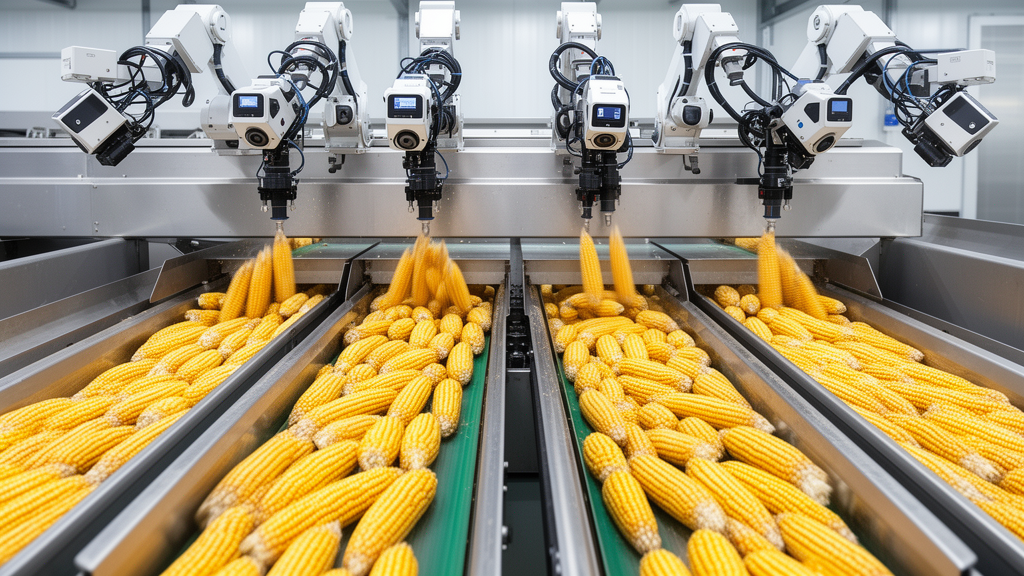
Agricultural engineers have developed and validated an automated four-channel hardware-software collaborative vision sorting system designed to inspect and divert defective whole corn ears on high-throughput processing lines. Harvesting and hybrid seed production inevitably introduce defective items, such as ears exhibiting retained husks or genetic impurity, into post-harvest processing pipelines. If impure ears enter the market, they compromise seed purity, reduce heterosis, and lead to poor stress resistance and uneven field stands. Meanwhile, unremoved tough husks obstruct hot air circulation inside drying towers, precipitating fungal growth and irreversible loss of seed germination, while also threatening to jam downstream threshing drums. By moving automated inspection upstream to the whole-ear stage prior to threshing, the research team demonstrated a scalable mechanism to eliminate these defective ears before costly processing and cross-contamination occur.
Traditional whole-ear inspection in many developing agricultural markets continues to depend heavily on manual visual labor, an approach constrained by human fatigue, subjective inconsistency, high labor costs, and the recurring need for retraining when crop varieties switch. Although downstream optical sorters inspect individual kernels after threshing, kernel-level examination inherently fails to detect macroscopic phenotypic attributes such as overall ear surface texture, varietal color patterns, and husk retention. Previous attempts to automate whole-ear evaluation have typically relied on robotic arms with restricted throughputs of roughly 45 ears per minute, or conventional image analysis methods that struggle to distinguish subtle texture variations. Furthermore, earlier engineering prototypes incorporating rotary-flap divert mechanisms suffered from frequent ear jamming during high-speed operation, highlighting the need for a non-blocking diversion structure alongside coordinated multi-channel controls.
To overcome these operational limitations, the researchers constructed a multi-channel sorting apparatus measuring 2000 mm in length, 580 mm in width, and 1350 mm in height, featuring a conveyor belt subdivided into four parallel 100 mm channels. The system operates via a coordinated master-slave architecture that distributes computational and real-time tasks between a host computer and a lower-level microcontroller. The host personal computer handles video frame acquisition, region of interest extraction, neural network inference, and user interface monitoring, while a single 16 MHz Arduino Mega 2560 microcontroller monitors four independent PNP normally closed photoelectric sensors and regulates four independent solenoid valves driving pneumatic push-rods. Instead of assigning individual microcontrollers to each conveying track, the centralized microcontroller handles real-time execution across all four channels through periodic task polling and dedicated circular First-In, First-Out queues.
Image acquisition is managed by a single shared 2-megapixel global shutter industrial camera equipped with a 3.6 mm focal length lens, mounted 310 mm above the conveyor belt under continuous illumination from four 50 W LED light sources. The global shutter configuration exposes all sensor pixels simultaneously, preventing the geometric skew and shape distortion commonly observed with rolling shutter sensors when items move along a belt traveling at 0.53 meters per second. When an ear passes beneath an edge-mounted photoelectric sensor, the signal transition registers as a falling edge on the microcontroller, which records the event and transmits the channel identifier to the host computer after a calibrated delay of 500 ms. The host computer then extracts the latest channel-specific region of interest, measures 480 by 96 pixels, resizes it to 224 by 224 pixels, and executes neural network classification, returning an actuation command only when an abnormal ear is recognized.
Visual classification is driven by CornNet, a lightweight convolutional neural network reconstructed from the VGG16 architecture to achieve rapid inference under restricted computational budgets. The network features five serial convolutional blocks—each comprising a convolution layer, max-pooling layer, batch normalization, and a rectified linear unit activation—supplemented with an embedded Squeeze-and-Excitation attention mechanism at the end of each block to capture salient ear features. By drastically reducing convolutional layers and channels, CornNet requires only 0.102 million parameters and 0.070 GMACs of computational overhead, resulting in a compact 0.42 MB file size. On a desktop platform powered by an Intel Core i9-13900H processor and an NVIDIA RTX 4070 graphics card, the model demonstrated inference latencies of 2.00 ms (500.9 frames per second) for variety purity detection and 1.80 ms (555.6 frames per second) for husk status classification.
The deep learning models were trained on independent datasets collected from mechanically harvested fields in Jiuquan, Gansu, China, using a custom Capture-as-labeling interface integrated into the host software. For the variety purity dataset, 1524 initial physical ears provided images of 901 normal ears displaying uniform kernel color and morphology alongside 623 abnormal ears exhibiting color variations, impure mixtures, and irregular arrangements. The husk dataset comprised 472 original images, including 210 cleanly husked normal ears and 262 incompletely husked abnormal ears. Through combined offline data augmentation involving brightness adjustments, noise addition, and horizontal flipping, followed by dynamic online transforms during training, the training corpora were expanded to 3656 samples for variety purity and 1136 samples for husk status. In static test set evaluations, CornNet achieved an accuracy of 97.38% with precision, recall, and F1-score all reaching 96.80% on variety purity, alongside an accuracy of 97.87% and an F1-score of 98.08% on husk status.
To prevent operational deadlocks within the single-core microcontroller, the team engineered a non-blocking cooperative scheduling cycle operating across four predefined scanning intervals. The microcontroller executes a 10 ms polling routine to scan photoelectric sensors, a 2 ms task to manage trigger-message transmission, a 20 ms cycle to parse serial commands from the host computer at 115200 baud, and a second 2 ms task to process pending actuator events. Each channel maintains an independent circular queue with an effective capacity of 99 events, ensuring that pending sorting tasks in one channel do not overwrite or stall activities on adjacent lanes. When an abnormal classification command is received, the microcontroller waits for a calibrated delay of 900 ms before energizing the corresponding solenoid valve for 200 ms, driving a pneumatic push-rod directly outward to intercept the ear and alter its parabolic trajectory into an abnormal collection bin.
Online performance was evaluated through manual feeding trials across four structurally identical four-channel prototypes, designated M1 through M4, operating at a feeding rate of approximately 2200 ears per hour per channel. Under both non-mixed conditions (sequential feeding of 20 normal and 20 abnormal ears) and mixed conditions (randomized feeding of 20 normal and 20 abnormal ears), each prototype completed five repeated trials per channel. Across all prototypes and trials, mean classification accuracy ranged from 96.75% to 97.50%, mean diversion accuracy ranged from 97.88% to 98.13%, and comprehensive sorting accuracy ranged from 94.88% to 95.50%. Standard deviations between prototypes remained low, ranging between 0.25 and 1.75 percentage points, confirming consistent hardware-software execution. Initial tracking errors on outer conveyor edges were resolved during preliminary testing by providing supplementary illumination to counteract external ambient lighting variations.
To validate the system under operational factory conditions, two four-channel sorting prototypes were joined in parallel to form an eight-channel assembly directly coupled to the discharge outlet of an industrial husking machine. Over three continuous trials with 180-second logging windows, the eight-channel system received an average of 941 ears per test window, representing an estimated mass flow rate of 2.82 tons per hour based on an assumed ear mass of 0.15 kg. The host vision computer successfully registered 901 ears while missing 40, yielding a missed detection rate of 4.25%. Among successfully registered ears, the visual classification accuracy reached 98.78% (890 correctly classified out of 901) and pneumatic diversion accuracy reached 98.11% (884 correctly diverted out of 901), resulting in an overall field sorting accuracy of 92.8% across all 941 incoming ears.
Analysis of field trials highlighted physical bottlenecks that govern continuous sorting performance during upstream machine coupling. While the nominal theoretical throughput of a single four-channel unit is estimated between 1.35 and 1.54 tons per hour (and 2.70 to 3.08 tons per hour for an eight-channel setup), peak instantaneous discharge rates from the husking machine reached 3.5 to 4.0 tons per hour. Non-uniform ear distribution caused temporary surges where closely spaced or contiguous ears continuously blocked the photoelectric sensors, preventing discrete trigger generation and causing 40 ears to bypass inspection. Additionally, electromagnetic interference and back electromotive force from high-power industrial motors initially caused erratic solenoid actuation, a problem resolved by reinforcing control circuitry and installing parallel flyback diodes across valve coils. The authors noted that future developments will focus on integrating vibratory feeding beds to regulate material flow, implementing continual learning strategies for rapid variety adaptation, and testing low-power edge-computing architectures.
Subject of Research: Automated vision-based sorting of harvested corn ears using lightweight neural networks and multi-channel pneumatic actuators
Article Title: Development of a four-channel hardware-software collaborative vision sorting system for high-throughput corn ear processing lines
Article References: Zheng, X., Wang, M., Li, Y., Chen, M., Li, J., Ma, X., & Fu, Q. (2026). Development of a four-channel hardware-software collaborative vision sorting system for high-throughput corn ear processing lines. Smart Agricultural Technology, 15, Article 102759. https://doi.org/10.1016/j.atech.2026.102759
Image Credits: AI Generated
DOI: 10.1016/j.atech.2026.102759
Keywords: corn ear sorting, machine vision, CornNet, agricultural automation, pneumatic diversion, seed processing, deep learning, variety purity, husk detection, Arduino Mega 2560, multi-channel sorting, high-throughput sorting, convolutional neural networks, smart agricultural technology, industrial validation, post-harvest inspection
News Source: Alan Morgan. (November 26, 2026). Collaborative Vision System Sorts Corn Ears Across Four Parallel High-Throughput Channels. Scienmag.