A comparative investigation into fermentation starters used for Chinese Jiangxiangxing Baijiu has identified four volatile eight-carbon compounds and extensive microbial community restructuring as the central drivers behind defective mold-flavored high-temperature Daqu. Traditional high-temperature Daqu operates as an open solid-state microecological system composed of wheat, barley, and peas, providing critical hydrolytic enzymes, functional microorganisms, and precursor compounds that govern liquor aroma and overall product quality. However, exposure to fluctuating ambient environments frequently results in batch variations and sensory defects, of which a moldy or musty aroma is among the most economically damaging off-flavors. To uncover the mechanistic basis of this sensory deterioration, a research team analyzed defective mold-flavored Daqu samples alongside normal control blocks obtained from a commercial Baijiu facility in Maotai Town, Guizhou Province. By coupling volatilomics, sensory olfactometry, free amino acid profiling, and high-throughput sequencing, the researchers established that the defect arises from altered precursor availability and microbial population shifts rather than a generalized increase in total volatile production.
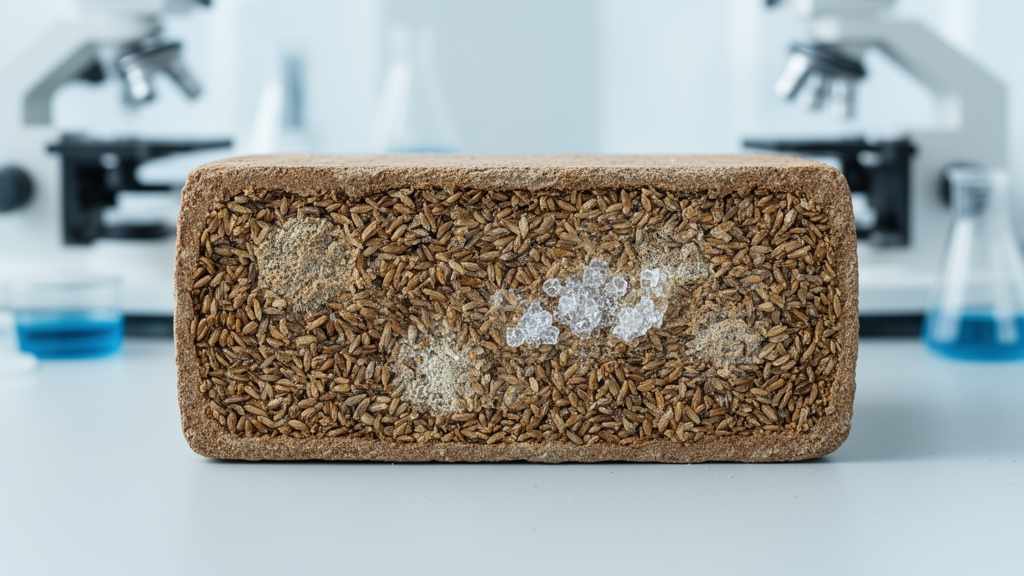
Physical and preliminary compositional examinations demonstrated distinct differences between the defective starter bricks and the normal control material collected from the production site. The mold-flavored Daqu samples displayed elevated average moisture content measured at 17.60 ± 4.38 percent, in contrast to the normal Daqu control blocks, which registered an average moisture content of 9.90 ± 3.35 percent. Visually, the mold-defective blocks exhibited a characteristic white wheat coloration overlaid with visible greenish or white fungal mycelia and emitted a noticeable mushroom-like, damp odor. Conversely, the normal control samples displayed standard baseline Daqu aromas without prominent off-notes. Following sample preparation and cryogenic storage at minus eighty degrees Celsius, the team conducted systematic headspace solid-phase microextraction coupled with gas chromatography-mass spectrometry on eight independent defective samples and ten independent normal samples, testing each in technical triplicate. Across all evaluated starter samples, the analytical framework identified 125 distinct volatile compounds spanning eleven chemical classes, including prominent representations of esters, aromatic molecules, pyrazines, terpenes, ketones, and alcohols.
Chromatographic quantification revealed that the total volatile content in mold-flavored Daqu was markedly lower than that observed in normal Daqu, demonstrating that the sensory defect does not stem from volatile compound hyper-accumulation. Esters formed the most abundant chemical class across both sample cohorts, followed in abundance by aromatic compounds and pyrazines. While normal Daqu maintained higher overall concentrations of esters, pyrazines, and alcohols, the defective samples exhibited relative increases in total ketones and terpenes. Interestingly, despite possessing lower total contents of esters and pyrazines, the mold-flavored blocks contained a higher number of individually detected ester and pyrazine species. Furthermore, several aromatic compounds—such as ethylbenzene, m-xylene, p-xylene, naphthalene, 1,4-dimethoxybenzene, and various phenyl alcohols—appeared exclusively within the defective Daqu. Although compounds like xylenes, ethylbenzene, and naphthalene may point toward exogenous contact with raw materials or processing equipment rather than natural fermentation pathways, their identification highlights substantial chemical divergence between the two manufacturing outcomes.
To rigorously distinguish between the chemical fingerprints of the two starter groups, the researchers conducted partial least squares discriminant analysis using Z-score normalized and logarithmic-transformed volatile data. The resulting multivariate statistical model demonstrated clear separation between the mold-flavored and normal cohorts, achieving robust explanatory and predictive metrics with an R2X of 0.702, an R2Y of 0.773, and a predictive capability Q2 value of 0.886. Model stability was further confirmed through 200 permutation tests, where a negative intercept on the Y-axis for the Q2 regression line verified the absence of statistical overfitting. Utilizing a variable importance in projection threshold exceeding 1.0, the investigators identified 25 differential candidate compounds driving the separation of the groups. Prominent discriminant metabolites included 13-methyltetradecanoic acid methyl ester, 2-octanone, and methyl 12-methylmyristate. While these discriminant scores effectively separated the batches mathematically, the researchers emphasized that compositional abundance alone cannot clarify sensory impact, requiring gas chromatography-olfactometry and aroma dilution methods.
Olfactory characterization using gas chromatography-olfactometry-mass spectrometry combined with aroma extract dilution analysis tracked the precise sensory contribution of individual volatiles via flavor dilution factors. Across both groups, 40 aroma-active compounds were detected by a trained three-member panel, encompassing 11 aromatic compounds, 8 pyrazines, 6 alcohols, 5 ketones, 5 esters, 2 acids, and 3 miscellaneous compounds. In normal Daqu, five compounds achieved the maximum dilution factor of 729, notably trimethylpyrazine, 2,3-dimethyl-5-ethylpyrazine, isovaleric acid, 4-ethylguaiacol, and phenylethanol, supporting desirable roasted, nutty, and fruity notes. Within mold-flavored Daqu, four primary odorants reached the highest flavor dilution factor of 729: 1-octen-3-ol, isovaleric acid, ethyl phenylacetate, and 4-ethylguaiacol. Most crucially, 1-octen-3-ol, which delivers an intense mushroom-like sensory descriptor, exhibited the single largest flavor dilution disparity between the two starters, registering 729 in defective samples while remaining completely undetectable at olfactory thresholds in normal control samples, thereby directly implicating it in the sensory defect.
Confirmation of sensory impact required quantitative liquid-liquid extraction coupled with odor activity value determinations, defined as the ratio of an odorant’s quantified concentration to its established sensory threshold in air or water. Restricting quantitative focus to compounds exhibiting both flavor dilution factors above 9 and variable importance scores above 1.0 yielded 21 compounds with odor activity values exceeding 1.0 in defective Daqu. Unusually high odor activity values were documented for pervasive background contributors such as 4-ethylguaiacol, isovaleric acid, and isoamyl alcohol. Crucially, four eight-carbon structures known for fungal notes exhibited odor activity values exceeding unity alongside substantial sensory dilution scores: 1-octen-3-ol exhibited a mean concentration of 0.014 milligrams per kilogram and an odor activity value of 1445.31; 3-octanone averaged 0.044 milligrams per kilogram with an activity value of 33,595.71; 2-octanone reached an activity value of 10.15; and 3-octanol recorded an activity value of 20.49. These four C8 metabolites were designated as the principal candidate volatile drivers of the moldy aroma.
An evaluation of nitrogenous nutrient pools via ultra-performance liquid chromatography-tandem mass spectrometry revealed systemic shifts in free amino acid turnover between normal and defective fermentation starters. Consistent with the reduction in total volatile molecules, total free amino acid content was significantly lower in mold-flavored Daqu than in normal Daqu. Nevertheless, out of 21 quantified amino acids, four specific residues—cysteine, cysteine-b, glutamine, and lysine—exhibited selective enrichment within the mold-flavored blocks. This non-uniform accumulation suggests altered metabolic equilibrium rather than passive degradation. Cysteine availability serves as a recognized biochemical precursor for enzymatic desulfhydrase reactions that generate hydrogen sulfide and pungent volatile sulfur compounds. Similarly, lysine enrichment provides direct metabolic substrate for microbial decarboxylation pathways yielding cadaverine, while glutamine accumulation reflects distinct balances in microbial assimilation and deaminase activity. Although enzymatic pathway conversion rates were not directly quantified in the mash, the altered amino acid pool underscores an altered microecological metabolic state preceding distillation.
High-throughput amplicon sequencing of bacterial 16S rRNA genes and fungal internal transcribed spacer regions yielded greater than 99.72 percent Good’s coverage, providing robust depth for profiling microbial ecology across six biological replicates per group. Alpha-diversity metrics revealed divergent ecological behaviors between kingdoms: bacterial communities in mold-flavored Daqu exhibited significantly lower richness and diversity across Chao1, Observed Species, Shannon, and Simpson indices compared to normal controls. Conversely, fungal communities showed no significant difference in richness between the two types, yet displayed significantly elevated diversity within the defective starters. Beta-diversity assessments through principal coordinates analysis and analysis of similarities confirmed marked community divergence (P = 0.001). Bacterial assemblages exhibited particularly stark discrimination, producing an analysis of similarities R statistic of 0.769, whereas the fungal community comparison yielded an R statistic of 0.496. These findings confirmed that mold-flavored sensory defects correspond to profound restructuring of core bacterial and fungal consortia.
Taxonomic composition analysis at the genus level uncovered drastic population displacements between normal and defective Daqu blocks. While Firmicutes dominated the bacterial phyla of both types due to heat-resistant spore survival under high fermentation temperatures, genus-level distributions diverged completely. In normal Daqu, Bacillus served as the dominant bacterial taxon, accounting for 55.15 percent of community abundance, whereas Kroppenstedtia represented merely 5.13 percent. In striking contrast, mold-flavored Daqu became overwhelmingly dominated by Kroppenstedtia, which surged to 73.22 percent relative abundance, while Bacillus collapsed to just 0.22 percent. Within the fungal kingdom, Ascomycota predominated over Mucoromycota in defective starters. At the genus level, Thermomyces represented 54.38 percent of fungal sequences in normal Daqu but decreased to 15.54 percent in defective blocks, accompanied by significant shifts across Rhizomucor, Rhizopus, Aspergillus, and Nigrospora. The functional loss of dominant Bacillus and Thermomyces strains likely impairs normal substrate saccharification and starch hydrolysis, allowing alternative metabolic profiles to develop.
Correlation networks using strict association thresholds (|r| ≥ 0.7, P < 0.05) linked specific microbial taxa directly to both C8 off-flavor compounds and enriched amino acids. The two ketones, 3-octanone and 2-octanone, shared identical positive correlation networks with six microbial genera: Monascus, Saccharomycopsis, Blumeria, Hyphopichia, Pantoea, and Oceanobacillus. Meanwhile, 1-octen-3-ol correlated positively with Pantoea and Oceanobacillus, and 3-octanol correlated with Acinetobacter and Nigrospora. Dominant Kroppenstedtia displayed positive correlations with free leucine, valine, alanine, and threonine, alongside volatile esters and alcohols, but correlated negatively with cysteine. Conversely, Bacillus exhibited exactly opposite associations across those same volatile and amino acid targets. While these network linkages identify plausible microbiological origins for lipid-derived C8 off-flavors, the authors emphasized that direct causal proof requires future aroma recombination and omission trials. Nonetheless, tracking Kroppenstedtia surges and C8 ketone accumulation offers valuable diagnostic targets for commercial quality control and fermentation monitoring during Jiangxiangxing Baijiu manufacturing.
Subject of Research: Identification of key odorants and microbial shifts in mold-flavored high-temperature Daqu
Article Title: Analysis of key aroma compounds with Mold-flavored in defective high-temperature Daqu: Substances composition and dominant microorganisms
Article References: Li, Q., Li, G., Yang, J., Tang, P., & Guo, X. (2026). Analysis of key aroma compounds with Mold-flavored in defective high-temperature Daqu: Substances composition and dominant microorganisms. Food Chemistry: X, 40, Article 104837. https://doi.org/10.1016/j.fochx.2026.104837
Image Credits: AI Generated
DOI: 10.1016/j.fochx.2026.104837
Keywords: High-temperature Daqu, Jiangxiangxing Baijiu, Mold-flavored defect, Volatile compounds, HS-SPME-GC-MS, GC-O-MS, Aroma extract dilution analysis, Odor activity value, 1-Octen-3-ol, 3-Octanone, 2-Octanone, 3-Octanol, Kroppenstedtia, Bacillus, Thermomyces, Free amino acids, Solid-state fermentation, Microbial community structure
News Source: Bethany Barker. (November 26, 2026). Four C8 Compounds and Altered Microbes Drive Mold-Flavored Defect in Daqu. Scienmag.