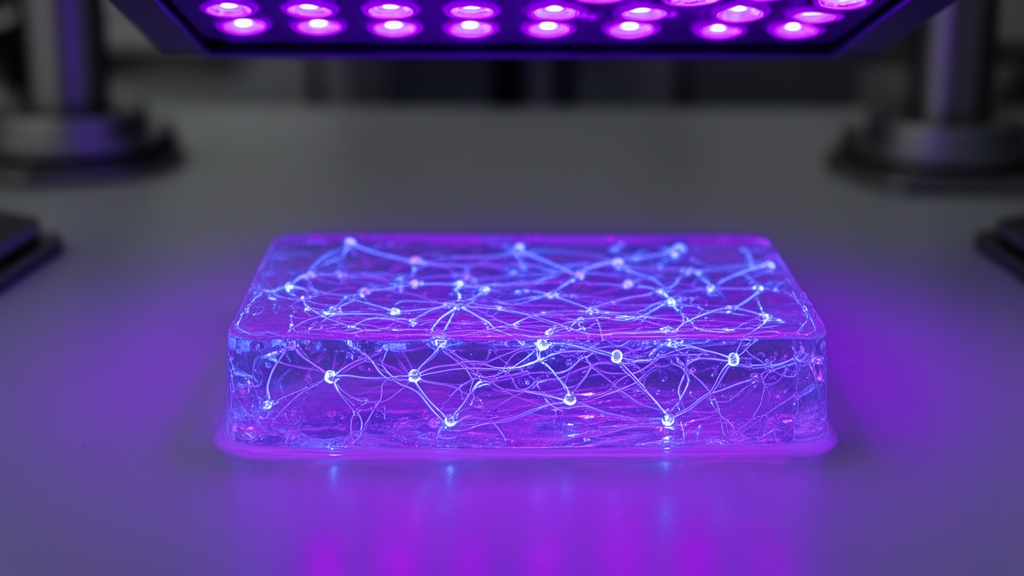
A research team has demonstrated a kinetic-guided ultraviolet light-emitting diode photopolymerization method to synthesize ionic conductive double-network hydrogels with high structural integrity and rapid curing kinetics. Using an integrated one-pot preparation procedure, the investigators fabricated agarose and poly(N-hydroxyethyl acrylamide-co-acrylic acid) double-network hydrogels incorporating calcium ions, designated as Agarose/P(HEAAm-co-AA)/Ca²⁺. Cured under 365-nanometer ultraviolet light-emitting diode irradiation, the resulting material system achieved a high degree of monomer conversion alongside robust structural cohesion.
Ultraviolet light-emitting diode photopolymerization has gained recognition as an energy-efficient and rapid technique for the fabrication of polymeric hydrogels. However, the ultimate physical, electrical, and mechanical characteristics of the cured network remain heavily dependent upon the reaction kinetics of the photoinitiator. These kinetics dictate the rate of radical generation, direct the progression of network formation, and govern final performance. To address these interconnected variables, the researchers established a systematic processing-structure-property framework to correlate photopolymerization behavior directly with material properties.
To initiate the photochemical reaction, the researchers employed Chivacure 300 as the designated photoinitiator during the 365-nanometer ultraviolet exposure. Comprehensive photolysis analysis demonstrated that Chivacure 300 possessed an apparent molar extinction coefficient of 21.44 liters per mole centimeter at the target wavelength of 365 nanometers, paired with a reaction half-life of 7 minutes and 42 seconds. According to the reported findings, these photochemical characteristics provided effective and continuous free-radical generation throughout the ultraviolet light-emitting diode curing schedule.
The experimental investigation systematically evaluated how photoinitiator concentration and ultraviolet exposure duration influenced the assembly of the polymer network. The research team assessed network formation and overall hydrogel performance across multiple analytical metrics, specifically conducting degree of conversion, gel fraction, structural morphology, rheological behavior, tensile property, ionic conductivity, and total water content analyses. This comprehensive testing regimen enabled the team to track how differing curing conditions altered internal mesh features and crosslinking behavior.
When prepared with a photoinitiator loading of 2 weight percent and subjected to 15 minutes of ultraviolet curing, the synthesized double-network hydrogel demonstrated near-complete polymerization. Quantitative measurements revealed an exceptional degree of conversion of 99.9 ± 0.26 percent and a final gel fraction of 75.4 ± 0.71 percent. These conversion and gel fraction figures confirmed that the chosen curing parameters promoted extensive polymer chain propagation and high insoluble network formation within the hydrogel matrix.
Mechanical assessments highlighted substantial elasticity and load-bearing capacity for the cured double-network hydrogels under the optimized 15-minute curing schedule. Uniaxial tensile evaluations demonstrated that the Agarose/P(HEAAm-co-AA)/Ca²⁺ hydrogel achieved a tensile strength of 0.32 ± 0.02 megapascals along with an elongation at break of 482 ± 62 percent. The recorded elongation underscores that the interpenetrating network architecture accommodates extensive mechanical deformation before structural failure occurs.
Electrical characterization showed that the double-network hydrogel reached an ionic conductivity of (47.16 ± 6.39) × 10⁻⁴ siemens per meter, while a corresponding single-network hydrogel control exhibited a markedly higher conductivity of (128.30 ± 20.50) × 10⁻⁴ siemens per meter. This measurable difference highlights how the denser crosslinking density, mesh structure, and double-network architecture influence ionic transport pathways. Ultimately, the kinetic-guided processing-structure-property framework demonstrates how ultraviolet light-emitting diode curing conditions can tailor conductive hydrogel systems for flexible soft-material applications.
Subject of Research: Kinetic-guided UV-LED photopolymerization of ionic conductive double-network hydrogels
Article Title: Kinetics-guided rapid UV-LED photopolymerization of ionic conductive double-network hydrogels
Article References: Mohd Farizal, M. A., Adrus, N., Rosli, N. S. B., Wong, C. K., Mokhtar, N. S., & Jamaluddin, J. (2027). Kinetics-guided rapid UV-LED photopolymerization of ionic conductive double-network hydrogels. Polymer Bulletin, 84(1), Article 67. https://doi.org/10.1007/s00289-026-06827-2
Image Credits: AI Generated
DOI: 10.1007/s00289-026-06827-2
Keywords: UV-LED photopolymerization, double-network hydrogels, ionic conductivity, Chivacure 300, photoinitiator kinetics, agarose, P(HEAAm-co-AA), calcium ions, gel fraction, degree of conversion, tensile strength, elongation at break, photolysis, rheological behavior, mesh structure, crosslinking density, single-network hydrogel, flexible soft materials
News Source: Neil Sanderson. (November 26, 2026). UV-LED Curing Achieves High Polymer Conversion in Conductive Double-Network Hydrogels. Scienmag.