A multidisciplinary clinical oncology team has documented the successful management of a locally advanced, initially unresectable uterine perivascular epithelioid cell tumor following preoperative targeted systemic therapy, representing the first reported application of neoadjuvant mTOR inhibition for a gynecologic PEComa. Perivascular epithelioid cell neoplasms are exceedingly rare mesenchymal tumors arising in varied anatomical sites including the kidney, liver, soft tissues, retroperitoneum, and uterus, with gynecologic presentations comprising roughly one-quarter of cases. In this published clinical case, preoperative administration of albumin-bound sirolimus produced marked tumor regression, converting an anatomically complex, surgically hazardous pelvic mass into an operable lesion and achieving complete gross surgical resection. This clinical success underscores the therapeutic value of preoperative targeted pathway inhibition in overcoming initial surgical contraindications and optimizing outcomes.
The patient, a 54-year-old woman, initially presented to clinical evaluation experiencing abdominal pain, progressively increasing abdominal girth, and new-onset shortness of breath. Diagnostic computed tomography pulmonary angiography identified a near-occlusive thrombus localized within the right lower lobe pulmonary arteries, prompting immediate hospital admission for full therapeutic anticoagulation under hematology consultation. Concurrently performed abdominopelvic computed tomography revealed a massive, heterogeneous pelvic mass measuring 30.0 by 27.0 by 13.7 centimeters featuring extensive central necrosis, closely abutting the uterine corpus and obscuring radiological visualization of both ovaries. This percutaneous approach established a definitive histopathological diagnosis while allowing oncologists to identify potential systemic therapy options during the mandatory surgical delay.
Histopathologic evaluation of the initial core needle biopsy demonstrated a malignant perivascular epithelioid cell tumor, displaying two mitotic figures per five high-power fields and scattered nuclear atypia without evidence of necrosis or lymphovascular invasion. Comprehensive genomic profiling of the biopsy tissue identified an inactivating TSC2 gene alteration, characterized by the loss of exons two through twelve accompanied by an exon twelve rearrangement, alongside concurrent genomic losses of CDKN2C and CIC. Inactivating alterations in TSC2 dysregulate the mechanistic target of rapamycin signaling pathway by abolishing normal upstream inhibitory control. Recognizing the distinct molecular vulnerability conferred by this genomic profile, gynecologic oncologists collaborated directly with sarcoma specialists to devise an individualized treatment plan. The multidisciplinary team selected targeted preoperative mTOR inhibition, aiming to achieve substantial tumor cytoreduction while safely accommodating the required therapeutic anticoagulation interval essential for clinical stabilization.
The patient commenced neoadjuvant therapy utilizing nanoparticle albumin-bound sirolimus, also designated nab-sirolimus, administered intravenously at a standard dose of 100 milligrams per square meter of body surface area on days one and eight of a repeating 21-day cycle. Repeat computed tomography imaging performed three months after treatment initiation confirmed complete radiological resolution of the pulmonary embolism and showed no evidence of distant metastatic disease. Most importantly, follow-up imaging demonstrated marked primary cytoreduction, with the pelvic mass shrinking from its initial pretreatment dimensions to 20.7 by 17.2 by 7.7 centimeters.
Following favorable tumor regression and pulmonary stabilization, the patient underwent definitive surgery consisting of exploratory laparotomy, total abdominal hysterectomy, bilateral salpingo-oophorectomy, infracolic omentectomy, and radical pelvic tumor debulking. Intraoperatively, surgeons encountered a 20-centimeter, soft, hypervascular mass arising from the posterior uterine wall, with the omentum and small bowel mesentery densely adherent to the tumor surface. Both ovaries appeared grossly normal on direct inspection. Regional nodal assessment revealed an enlarged left external iliac lymph node, which was excised; no additional enlarged pelvic or para-aortic lymph nodes were detected. Through meticulous surgical dissection, the operative team achieved complete gross resection with negative surgical margins, satisfying the primary benchmark of R0 oncologic surgery and ensuring thorough cytoreductive clearance.
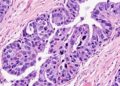
Final histopathologic analysis of the completely resected gross specimen identified a 22-centimeter malignant uterine perivascular epithelioid cell tumor demonstrating prominent histological treatment effect and tumor-type necrosis, without lymphovascular space invasion. Microscopic examination revealed typical sheets and radial perivascular distributions of epithelioid cells with moderate eosinophilic cytoplasm, round central nuclei with nucleoli, and scattered nuclear atypia. Histologic examination of the resected left external iliac lymph node and infracolic omentum revealed no tumor involvement. Based on complete resection and absence of extrauterine dissemination, the patient was assigned a final pathological stage of IB uterine PEComa, and clinical surveillance was recommended without immediate adjuvant therapy, reflecting the therapeutic value of complete gross surgical extirpation.
Perivascular epithelioid cell tumors are uncommon mesenchymal neoplasms characterized histologically by epithelioid or spindled cells coexpressing melanocytic and myogenic markers. Diagnostic immunohistochemical profiling routinely demonstrates positivity for melanocytic proteins including HMB45, the most sensitive diagnostic marker, and MelanA, the most specific, alongside smooth muscle actin and desmin. The PEComa family encompasses angiomyolipoma, lymphangioleiomyomatosis, clear cell sugar tumors, and PEComa not otherwise specified. Because these neoplasms exhibit variable size and hypervascularity on cross-sectional imaging, gynecologic PEComas are frequently misdiagnosed preoperatively as common benign uterine leiomyomas. Histologically, their distinctive dual melanocytic and myogenic differentiation frequently mimics high-grade leiomyosarcoma or metastatic melanoma. While most PEComas follow a benign clinical course, fewer than 10 percent exhibit aggressive malignant behavior, requiring careful microscopic evaluation and molecular testing to guide clinical decision-making and ensure precise diagnostic classification before instituting definitive systemic therapy.
At the molecular level, PEComas segregate into two distinct oncogenic classes: tumors harboring inactivating alterations in TSC1 or TSC2, and tumors driven by TFE3 translocations. Normally, hamartin and tuberin, encoded by TSC1 and TSC2, form a tumor suppressor complex that negatively regulates mTOR signaling. Inactivating mutations disrupt this suppression, inducing constitutive mTORC1 activation that accelerates tumor cell proliferation and angiogenesis. Truncating FLCN mutations also disrupt mTOR regulation in under 5 percent of cases, whereas TSC1 alterations occur in 10 to 20 percent and TSC2 mutations appear in 30 to 40 percent. Systemic mTOR inhibitors bind intracellular FKBP12, inhibiting mTORC1 and blocking phosphorylation of downstream effectors S6K1 and 4EBP1. Conversely, TFE3 translocations occur in 6 to 25 percent of PEComas, exhibiting biology independent of mTOR signaling and reduced drug responsiveness, emphasizing the clinical need for molecular confirmation through fluorescence in situ hybridization.
PEComas arise most frequently as sporadic neoplasms, though approximately 10 percent develop in association with tuberous sclerosis complex, an autosomal dominant disorder caused by germline mutations in TSC1 or TSC2. Prognostic stratification of PEComas historically relied on Folpe criteria, but revised consensus guidelines define malignancy by the presence of three or more high-risk pathologic features, including size over five centimeters, infiltrative growth, high nuclear grade, necrosis, vascular invasion, or mitotic activity exceeding one per 50 square millimeters. Across published clinical literature, overall survival rates for PEComas are estimated at 82 percent at two years and 69 percent at five years.
Systemic therapy is essential for unresectable or metastatic disease, as cytotoxic chemotherapy and radiotherapy offer minimal therapeutic efficacy. Nanoparticle albumin-bound sirolimus is the only FDA-approved therapy for advanced malignant PEComa, based on the prospective phase II AMPECT trial of 34 patients, which demonstrated an overall response rate of 39 percent, updated to 38.7 percent, median progression-free survival of 10.6 months, and median overall survival of 53.1 months with notable response enrichment in TSC2-mutated tumors. Further supporting mTOR inhibition, a retrospective study of 53 patients by Sanfilippo and colleagues demonstrated an overall response rate of 41 percent and progression-free survival of 9.0 months, outperforming VEGF inhibitors at 8.3 percent and 5.4 months, gemcitabine at 20 percent and 3.4 months, and anthracyclines at 13 percent and 3.2 months. This uterine case expands limited prior neoadjuvant reports in hepatic and iliac tumors, demonstrating that preoperative mTOR inhibition can downstage massive gynecologic tumors and enable complete surgical resection.
Subject of Research: Neoadjuvant mTOR inhibitor therapy for locally advanced uterine perivascular epithelioid cell tumor
Article Title: Neoadjuvant sirolimus resulting in tumor response and successful surgical resection of a uterine perivascular epithelioid cell tumor (PEComa): A case report
Article References: Carrasco, T. S., Witt, C. E., Smuliski, T. D., & Lara, O. D. (2026). Neoadjuvant sirolimus resulting in tumor response and successful surgical resection of a uterine perivascular epithelioid cell tumor (PEComa): A case report. Gynecologic Oncology Reports, Article 102256. https://doi.org/10.1016/j.gore.2026.102256
Image Credits: AI Generated
DOI: 10.1016/j.gore.2026.102256
Keywords: PEComa, uterine perivascular epithelioid cell tumor, nab-sirolimus, mTOR inhibitors, neoadjuvant therapy, TSC2 alteration, surgical resection, gynecologic oncology, AMPECT clinical trial, hamartin-tuberin complex, mTORC1 signaling, pulmonary embolism, immunohistochemistry, HMB45, MelanA, targeted sarcoma therapy
News Source: Nathaniel Bowman. (November 26, 2026). Neoadjuvant Sirolimus Shrinks Rare Uterine PEComa Enabling Complete Surgical Resection. Scienmag.