Credit: Courtesy Dr. Vera Weisbecker
A new study involving The University of Queensland, which might be useful for biomedical research, re-writes parts of the rulebook on how mammalian brains – including our own – could have evolved.
It includes the possibility that distinctive dominance of our own cerebral hemispheres is not, as previously suggested, just a side-effect that forces brains of a particular size to have particular proportions.
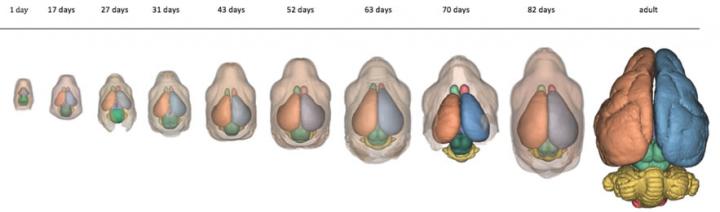
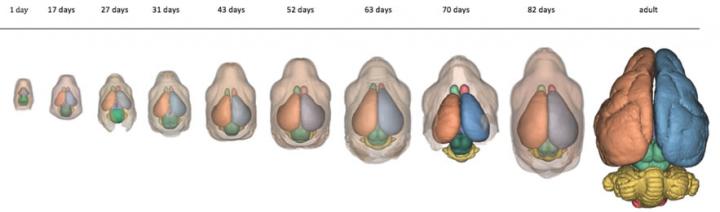
Dr Vera Weisbecker of UQ's School of Biological Sciences said the study represented the first dataset comparing brain growth in different mammals, gathered through a novel method of non-invasive micro-CT (computed tomography) scanning which allowed the fast data acquisition of soft tissue growth in tiny mammals.
"This approach, termed DiceCT, can be widely applied, not just for evolutionary studies but also as a powerful tool for biomedical investigations of brain development in disease, congenital defects, or injury," she said.
"Our results using information from brain growth in marsupial mammals also provide a new test of the long-debated 'late equals large' hypothesis first published in 1995, to explain the way brains evolve across species."
The "late equals large" hypothesis holds that the brain proportions of different mammals, for example, people and wallabies, are shaped by a universal rule that makes them differ according to their size.
This is because larger brain parts are thought to have a later and longer process of neurogenesis – the development of neurons or nerve cells from neural stem cells and progenitor cells.
Dr Weisbecker said the "late equals large" rule had been controversial for more than two decades.
"For these cell-level 'rules' to be translated into specific brain proportions, we would also expect to see these rules reflected in predictable growth patterns of the mammalian brain, particularly in species from the same group of mammals," she said.
"Our research looked for such common patterns in brain development by providing the first data on brain growth for three species of marsupial mammals and the results show that this hypothesis does not work.
"In addition, when we compared adult brain proportions, we saw that the relationship between brain proportions and size depends on what group of mammals we look at, which is also incompatible with a universal rule for brain proportions."
Dr Weisbecker said the research was a world first attempt at quantifying mammalian brain growth across several species.
"Instead of one neurogenesis-based rule, we suspect that the evolution of brain parts, including the huge human cerebral hemispheres, results from a complex combination of factors including the early molecular processes which divide the brain long before it starts growing," she said.
"In addition, all parts of the brain need to be tightly interconnected, so that the broad pattern of mammalian brain partitions might be due to constraints of brain function combined with a very early, possibly species-specific, developmental brain 'blueprint'."
Dr Weisbecker said her lab aimed to tell the evolutionary story of today's diverse land vertebrates through developmental biology.
"My research thrives on the huge diversity of animals that Australia has to offer," she said.
The new study, Testing hypotheses of developmental constraints on mammalian brain partition evolution, using marsupials, is published in Scientific Reports (doi: 10.1038/s41598-017-02726-9) and also involves researchers from UQ's Centre for Advanced Imaging, the University of Melbourne, and CSIRO Health and Biosecurity Flagship.
###
Media Contact
Dr. Vera Weisbecker
[email protected]
61-733-657-071
@uq_news
http://www.uq.edu.au
Related Journal Article
http://dx.doi.org/10.1038/s41598-017-02726-9