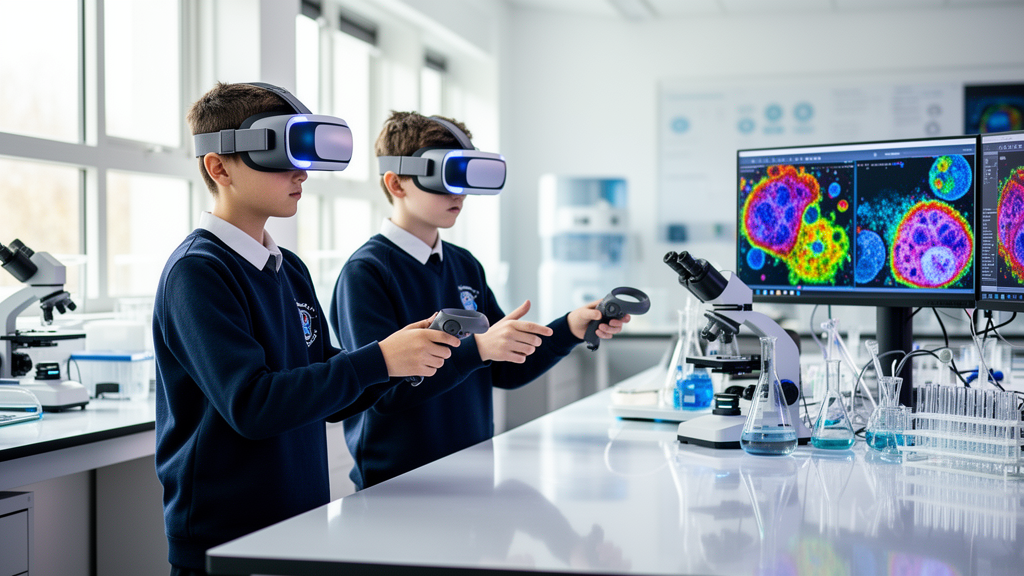
A quasi-experimental investigation evaluating immersive instructional technology in secondary life science education has demonstrated that an interactive virtual reality laboratory significantly enhances learners’ computational thinking, biological knowledge acquisition, and learning motivation during complex cellular division lessons. Conducted with ninth-grade biology students undergoing an eight-week instructional unit on oocyte meiosis, the study revealed that learners who actively manipulated three-dimensional cellular structures within a dedicated virtual environment achieved substantially higher post-intervention scores than peers instructed through conventional two-dimensional textbook diagrams and blackboard illustrations. By measuring cognitive competencies alongside multidimensional motivational orientations, the research team demonstrated that moving beyond passive observational media toward structured, interactive digital problem-solving enables secondary school learners to internalize complex dynamic biological mechanisms with measurably greater cognitive precision and academic engagement.
Understanding microscopic biological events has historically represented a stubborn pedagogical hurdle for secondary science instructors and students alike. Biological phenomena such as cell division unfold across multiple spatial and temporal scales, demanding that learners simultaneously track dynamic structural reorganizations, causal sequences, and intricate regulatory checkpoints. In typical classroom settings, instruction relies heavily on static two-dimensional diagrams printed in textbooks or drawn on blackboards, accompanied by oral explanations. Prior educational research indicates that students frequently struggle to construct accurate, coherent mental representations from these disconnected static images, often resorting to rote memorization of descriptive anatomical terms rather than developing a mechanistic comprehension of underlying physiological logic. When biological processes involve asymmetric partitioning, genetic recombination, and coordinated chromosomal segregation, traditional representational formats frequently fail to convey the governing causal relationships that dictate life cycles.
Although virtual reality has gained traction in educational settings for visualizing static anatomical structures and molecular models, existing digital interventions have largely treated the technology as a passive observational display. In typical virtual implementations, students merely watch pre-scripted three-dimensional animations where they can rotate perspective or zoom in on structures, remaining passive observers rather than active investigators. This observational model leaves learners unable to manipulate operational parameters, test scientific hypotheses, or receive iterative feedback on the procedural validity of their decisions. Educational researchers have noted that prioritizing superficial visual fidelity over cognitive scaffolding often fails to foster deep structural understanding, leaving students capable of recognizing morphological forms while remaining unable to explain the causal machinery and logical sequences that govern cellular behavior.
To overcome these structural limitations, the researchers grounded their pedagogical design in an integration of Cognitive Load Theory and Self-Determination Theory. Cognitive Load Theory posits that learning complex biological processes imposes heavy mental demands on working memory because students must simultaneously process interrelated information streams, including structural changes, temporal timelines, and causal pathways. Traditional flat representations exacerbate this cognitive burden by forcing learners to mentally animate static depictions. By contrast, a well-designed virtual environment externalizes three-dimensional spatial coordinates and temporal movements, freeing working memory resources for higher-order reasoning. Concurrently, Self-Determination Theory indicates that learning motivation is cultivated when an instructional environment satisfies basic psychological requirements for autonomy, competence, and relatedness. Interactive virtual simulations support learner autonomy through user-guided investigation, foster competence via immediate corrective feedback, and encourage relatedness through direct cognitive engagement with simulated biological systems.
A central theoretical innovation of the investigation was the systematic incorporation of computational thinking as both an instructional scaffold and an explicit cognitive outcome. Within biological education, computational thinking encompasses the application of abstraction, decomposition, pattern recognition, and algorithmic sequencing to comprehend complex scientific systems. In the context of oocyte meiosis, abstraction enables students to extract fundamental operational rules while filtering out secondary cellular clutter; decomposition allows them to dissect the overall division cycle into manageable sub-processes such as spindle alignment, chromosomal migration, and asymmetric cytokinesis; pattern recognition involves detecting recurring structural configurations across successive meiotic stages; and algorithmic thinking provides the procedural logic necessary to trace the precise sequential dependencies and regulatory checkpoints required for viable daughter cell formation.
The empirical evaluation took place in a secondary school in mainland China, involving forty-seven ninth-grade students aged fifteen to sixteen years. Because of standard administrative scheduling constraints, the researchers implemented a quasi-experimental design using two pre-existing classes: an experimental cohort comprising twenty-five participants, including thirteen males and twelve females, and a control cohort comprising twenty-two participants, including twelve males and ten females. Baseline assessments established that the two cohorts displayed no statistically significant differences in prior academic achievement in biological science. To ensure rigorous ethical standards, written informed consent was obtained from all participating students and their legal guardians following institutional review board protocols. Potential confounding factors were systematically addressed; both groups were taught by the same experienced biology educator who adhered to a strict instructional fidelity protocol, and a two-week hardware familiarization period was conducted prior to formal data collection to neutralize novelty and Hawthorne effects.
The curricular intervention extended across eight weeks, aligning exactly with the school’s prescribed educational schedule for cell division. Both student cohorts were presented with identical biological content, learning objectives, and curriculum benchmarks, isolating the instructional delivery medium as the primary experimental variable. The control group completed traditional lecture-centered coursework relying entirely on static two-dimensional media, transcribing pre-drawn textbook figures, copying blackboard illustrations into notebooks, labeling anatomical components, and answering teacher-directed oral review prompts. Conversely, the experimental group engaged with the custom-developed virtual reality laboratory, utilizing handheld controllers to physically align, manipulate, and separate simulated homologous chromosomes in three-dimensional space, navigating interactive checkpoints and receiving scaffolded, iterative feedback whenever procedural errors occurred during simulated cellular division.
To evaluate learning outcomes comprehensively, the investigators deployed three psychometrically validated instruments administered before and after the eight-week intervention. Biological knowledge acquisition was measured using an assessment consisting of fifteen multiple-choice questions alongside five scenario-based open-ended problems requiring students to apply conceptual rules and computational problem-solving to meiotic challenges, scored by independent raters with substantial inter-rater reliability. Computational thinking proficiency was evaluated using the Computational Thinking Abilities Middle Grades Assessment, which examines domain-general algorithmic logic, decomposition, and systematic problem analysis independently of specific curricular topics. Finally, learner motivation was assessed using the Biology Motivation Questionnaire II, an adapted five-point Likert instrument measuring five distinct psychological subdimensions: intrinsic motivation, self-efficacy, self-determination, grade motivation, and career motivation.
Statistical evaluation using analysis of covariance, with pre-test scores serving as baseline covariates, revealed that the virtual reality intervention exerted a statistically significant positive effect on both primary cognitive measures. For computational thinking abilities, students in the virtual reality condition achieved an adjusted post-test mean score of 80.50 with a standard deviation of 8.60, significantly outperforming the control group’s adjusted mean of 74.00 with a standard deviation of 8.90. This difference yielded a statistically significant main effect with a partial eta squared of 0.16, indicating a large effect size under standard statistical benchmarks. Similarly, the biological knowledge post-test demonstrated superior mastery in the experimental cohort, which reached an adjusted mean of 80.10 compared to 73.50 in the traditional instruction cohort, producing a statistically significant main effect with a partial eta squared of 0.17.
The evaluation of motivational outcomes demonstrated similarly pronounced advantages across all five evaluated subdimensions of the Biology Motivation Questionnaire II. Analysis of covariance confirmed a statistically significant overall main effect of instructional condition on post-test motivation scores, with the intervention explaining twenty percent of the total variance. Examination of specific subscales showed that the strongest improvements occurred in intrinsic motivation, which exhibited a partial eta squared of 0.20, and self-efficacy, which likewise demonstrated a partial eta squared of 0.20. Significant positive shifts were also recorded for self-determination, grade motivation, and career motivation, with partial eta squared values of 0.18, 0.17, and 0.15, respectively. These granular findings confirm that the interactive digital laboratory supported learner confidence, subject interest, and perceived vocational relevance rather than simply elevating generalized classroom curiosity.
Bivariate correlation analyses between post-intervention computational thinking dimensions and biological knowledge acquisition scores provided further empirical insight into how procedural thinking connects to disciplinary mastery. All four computational dimensions demonstrated statistically significant positive associations with final biology performance. Notably, algorithmic thinking displayed the strongest correlation with biological content mastery, exhibiting a correlation coefficient of 0.52. Problem decomposition demonstrated a correlation coefficient of 0.38, followed by pattern recognition at 0.35 and abstraction at 0.30. These significant associations suggest that students who develop structured procedural logic and the ability to segment complicated cellular pathways into discrete operational phases are substantially better equipped to comprehend, integrate, and retain dynamic biological mechanisms.
While these findings underscore the instructional promise of interactive digital environments, the authors identified several methodological boundaries that contextualize the study’s conclusions. The investigation was conducted within a single secondary school in mainland China with a sample of forty-seven ninth-grade students, meaning that broad generalizations across differing educational systems, age brackets, or scientific domains require further empirical validation. Furthermore, the post-test design captured immediate learning gains following an eight-week curriculum, leaving the long-term retention and conceptual transfer of these competencies unexamined. The authors also cautioned that the observed positive correlations between computational thinking and biological knowledge do not prove direct causal pathways, nor did the study formally test statistical mediation between cognitive gains and affective motivation, highlighting the need for future longitudinal investigations to trace these dynamic interactions over time.
Subject of Research: Virtual reality instruction in secondary school biology education
Article Title: Effects of virtual reality-based instruction on secondary school learners’ computational thinking, biological knowledge acquisition, and motivation during oocyte meiosis learning
Article References: Xian, J., Wu, J. G., & Li, H. (2026). Effects of virtual reality-based instruction on secondary school learners’ computational thinking, biological knowledge acquisition, and motivation during oocyte meiosis learning. Computers & Education: X Reality, 9, Article 100167. https://doi.org/10.1016/j.cexr.2026.100167
Image Credits: AI Generated
DOI: 10.1016/j.cexr.2026.100167
Keywords: Virtual Reality, Computational Thinking, Biology Education, Oocyte Meiosis, Cognitive Load Theory, Self-Determination Theory, Algorithmic Thinking, Decomposition, Pattern Recognition, Abstraction, Science Motivation, Secondary Education, Cell Division, Interactive Learning, Educational Technology, Quasi-Experimental Design
News Source: Denise Maddox. (November 25, 2026). Virtual Reality Laboratory Improves Secondary Students’ Computational Thinking and Biology Knowledge. Scienmag.