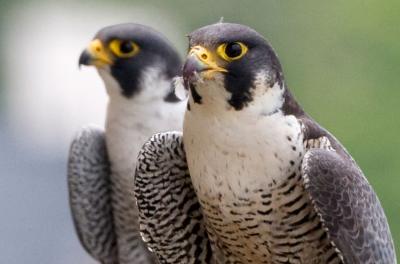
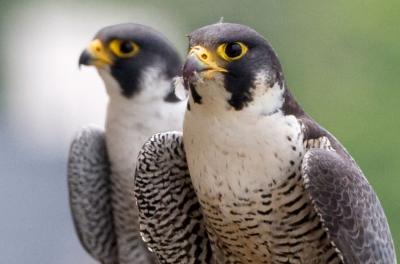
Credit: Photo by Stephanie Ware, The Field Museum
Peregrine Falcons, in their normal habitat on isolated cliffs, mate for life. But some 25 pairs now nest on Chicago skyscrapers and bridges, and city living has them in much closer quarters than they used before humans dominated the landscape. A group of Field Museum and University of Illinois, Chicago scientists investigated whether typical breeding patterns hold true for these new city-dwellers and, in a paper published in PLOS ONE, confirmed that even in the big city, the birds that prey together, stay together.
"Peregrine Falcons that now live in the Chicago region are living in very different conditions than you'd normally see for these birds, so we wondered if the falcons' mating habits had changed too. They're in much closer proximity to each other than they'd be in a more rural environment, and we thought they might be more promiscuous with more potential mates nearby," explains co-author John Bates, Associate Curator of Birds at The Field Museum. "Each spring this population also has migratory Peregrines passing through on their way to all parts of Canada, so we didn't know what we were going to find, but it turns out that almost all of the mated pairs in the city remain monogamous through the years."
Peregrine Falcons nearly went extinct in the US in the 1960s due to thinning of their eggshells caused by the pesticide DDT. However, historic egg collections at the Field and other museums provided evidence for the harm caused by DDT, and it was banned. In the decades since, reintroduction efforts have enabled Peregrine Falcons to make a comeback in the Midwest, with populations thriving in urban areas in twelve states. Ninety percent of the breeding pairs in the Midwest nest on buildings and bridges in the Chicago area.
To determine if these breeding pairs in Chicago remained faithful to each other, the scientists used a combination of field observations and DNA testing. The Chicago Peregrine Program, a group run by Field Museum scientist Mary Hennen, monitors the nesting falcons in the city and collects blood samples from the young each year when she measures and bands them. Many of the falcons they observe have ankle bands to identify them, enabling researchers to observe which falcons are nesting together. In addition to these observations, the scientists compared blood samples from falcon chicks and adults to determine parentage–DNA testing revealed that of the 35 broods tested, only one showed that the parents "cheated." Even this case the researchers believe what happened was that a male lost his mate and then that same season, paired with a new female who laid eggs that were not his.
"Whenever you have animals living in habitats that have been influenced by human development, you have to wonder how the animals' life histories will be altered," says Bates. "It's important to do studies like this one to see how birds are adapting to living in human environments, so that we can monitor changes through time."
###
The study was Isabel Caballero's PhD. dissertation at the University of Illinois at Chicago and The Field Museum; she is currently a post-doctoral fellow at Texas A&M University.
Media Contact
Kate Golembiewski
[email protected]
312-665-7103
@FieldMuseum
http://www.fieldmuseum.org