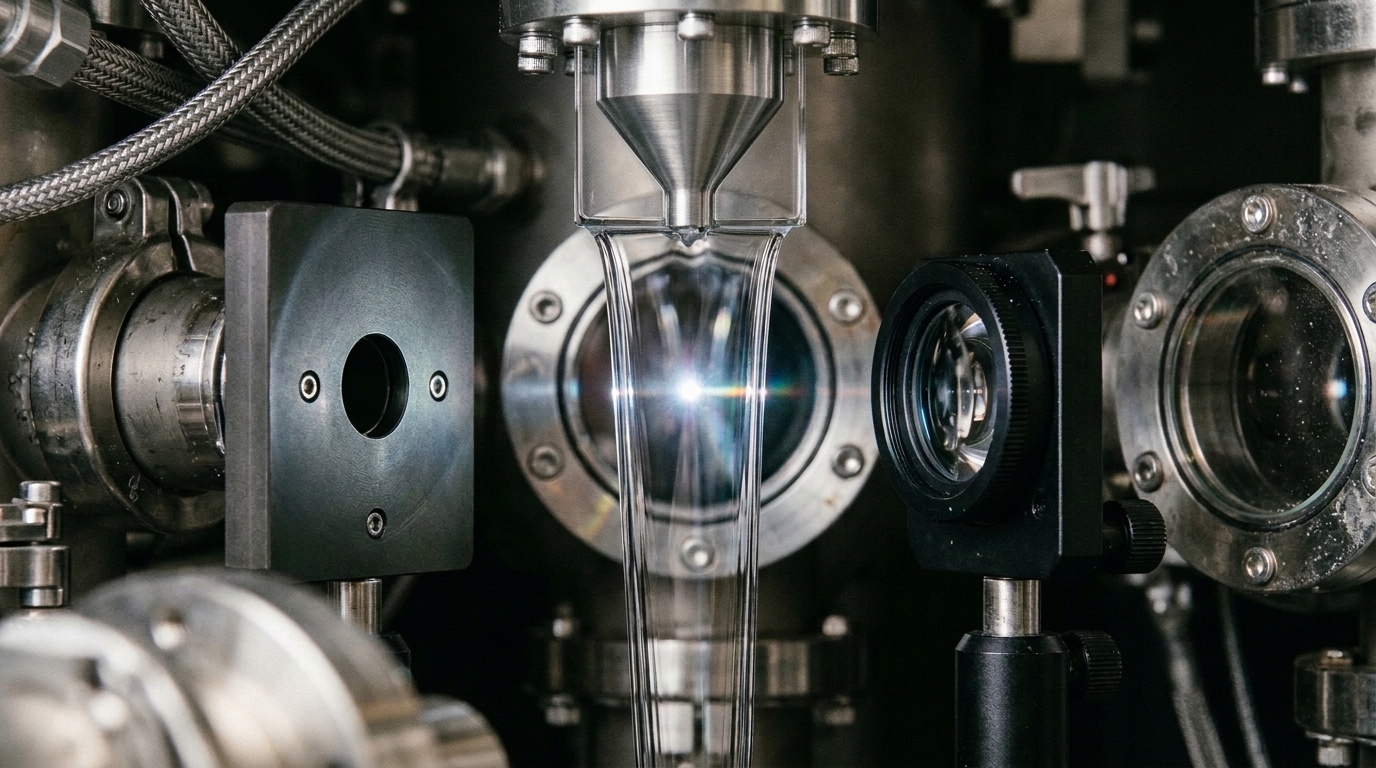
Researchers have demonstrated the laser-induced streaking of megaelectronvolt electrons in a liquid medium using a state-of-the-art liquid-phase ultrafast electron diffraction setup. The experimental investigation revealed that liquid-phase laser-induced streaking originates from a direct electron–light interaction mediated by the liquid’s dielectric response, rather than from plasma lensing as previously identified in the gas phase. This dielectric-mediated mechanism governs the physical interaction across distinct operating regimes, occurring consistently regardless of whether the optical laser intensity is maintained above or below the ionization threshold of the liquid environment.
Interactions between free electrons and optical fields in liquids constitute fundamental physical processes that underpin a broad range of ultrafast measurement and diagnostic techniques. These scientific methodologies include time-resolved photoelectron spectroscopy, attosecond spectroscopy, and liquid-phase ultrafast electron diffraction. Despite the central role these interactions play across ultrafast spectroscopic and diffraction methods, the direct physical behavior linking free electrons and optical fields within a liquid environment had remained largely unexplored prior to the current experimental investigation.
To analyze the interaction, the authors established a comprehensive experimental and theoretical framework addressing the electron streaking phenomenon.
The conclusion that liquid streaking stems from dielectric mediation rather than plasma lensing is supported by systematic measurements of several critical experimental parameters. The researchers measured the direct dependencies of the streaking effect on the laser incident angle, the laser field strength, and the liquid thickness.
The study also demonstrated that laser-induced streaking can be completely suppressed under current experimental conditions by configuring the experimental system at near-collinear electron–laser incidence angles. Remarkably, this total suppression of the streaking effect persists even when the optical laser intensity exceeds the ionization threshold of the liquid.
These findings elucidate a previously unknown interaction mechanism in liquid media and provide essential guidance for future liquid-phase ultrafast electron diffraction experiments. Additionally, the researchers reported that the liquid laser-induced streaking phenomenon holds strong potential to serve as a practical, built-in timing tool for synchronization in ultrafast liquid-phase electron diffraction investigations.
Subject of Research: Laser-induced streaking of megaelectronvolt electrons in liquid media
Article Title: Laser-induced streaking of megaelectronvolt electrons in a liquid medium
Article References: Chen, K., Lv, P., Huang, B., Yun, L., Du, Y., Song, B., Wang, J., Wang, Q., Wang, Z., Yang, Y., Ye, Q., Zhai, C., Zheng, L., Zheng, S., Li, R., & Yang, J. (2026). Laser-induced streaking of megaelectronvolt electrons in a liquid medium. Nature Photonics. https://doi.org/10.1038/s41566-026-02044-5
Image Credits: AI Generated
DOI: 10.1038/s41566-026-02044-5
Keywords: laser-induced streaking, megaelectronvolt electrons, ultrafast electron diffraction, liquid-phase electron diffraction, dielectric response, electron-laser interaction, optical fields, plasma lensing, time-resolved photoelectron spectroscopy, attosecond spectroscopy, scattering patterns, ionization threshold, liquid water, near-collinear incidence, laser field strength, liquid thickness, strong-field ionization, built-in timing tool
News Source: Denise Maddox. (November 25, 2026). Dielectric Response Mediates Laser Streaking of Megaelectronvolt Electrons in Liquids. Scienmag.