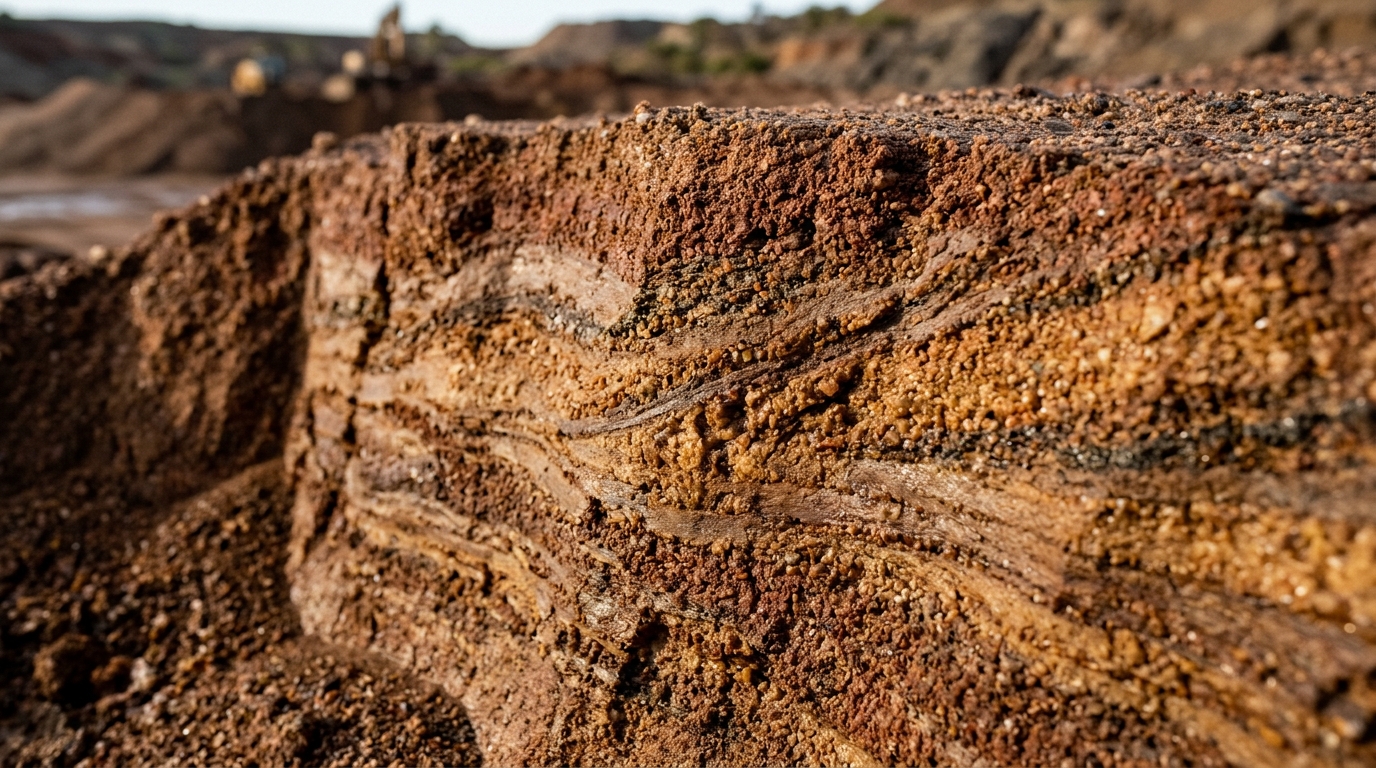
A comprehensive laboratory investigation into alluvial monazite tailings from northeastern Nigeria reveals that the mineral waste displays pronounced transitional geomechanical behaviour, characterized by one-dimensional compression paths that remain persistently non-convergent even under high vertical effective stresses. The findings demonstrate that unlike conventionally behaving soils that eventually converge toward a single, unique normal compression line regardless of their beginning packing density, monazite tailings retain an enduring memory of their initial state. This initial state dependency produces distinct, roughly parallel compression paths across an initial specific volume range spanning 2.0878 to 2.4827 during laboratory loading up to 3,076 kilopascals. When the researchers tested an artificial intelligence formulation previously calibrated on iron ore tailings to predict this transitional phenomenon, the empirical model substantially underestimated the experimental transitional index, exposing critical predictive limitations when transferring tailings models across contrasting ore geologies.
Tailings handling and repository stability have emerged as pressing global concerns due to accelerating worldwide mining and metallurgical processing driven by clean energy transitions, renewable technologies, and nuclear power development. As demand expands for rare earth elements sourced from heavy mineral sand deposits and alluvial monazite ores, extraction processes generate massive quantities of leftover slurry and pulverized particulate waste that are routinely pumped into surface storage dams or impoundment facilities. The researchers emphasize that historical failure records compiled by mine safety organizations point to severe risks, with more than thirty serious or very serious tailings storage facility collapses projected to occur across the present decade. Because tailings dam stability, potential run-out hazards, and susceptibility to static or cyclic liquefaction are dictated directly by the underlying geomechanical properties of the impounded particulate materials, establishing rigorous, material-specific mechanical and physical signatures is indispensable for mitigating ecological catastrophes and advancing circular economy initiatives focused on mine waste repurposing.
To obtain reliable baseline data on poorly documented rare earth wastes, the study investigated disturbed alluvial monazite tailings sampled directly from two distinct dump locations in Bauchi, situated at geographic coordinates 10 degrees 27 minutes 1.50 seconds North and 10 degrees 25 minutes 35.2 seconds East. The source ore originated within regional igneous and metamorphic bedrock that underwent extensive geologic weathering, downstream transport, and alluvial deposition before commercial excavation. To liberate pure monazite and associated heavy mineral concentrates, processors subjected the excavated alluvial sands to multi-stage metallurgical separation circuits incorporating gravity concentration, magnetic separation, and electrostatic sorting. The rejected tailings collected for geotechnical characterization represented the particulate residuals discharged from these mechanical concentration stages. While visual examination at the deposit suggested an apparently uniform material, the researchers conducted detailed granulometric, geochemical, and microstructural screenings to capture the true physical heterogeneity inherent to processed alluvial geomaterials.
Granulometric testing combining wet sieving with sedimentation hydrometer methods in accordance with ASTM D6913 and ASTM D7928 standards classified the monazite tailings as silty sand under the Unified Soil Classification System. The particle size distribution curves revealed that the specimens are non-clayey, non-plastic, and well graded, showing an exceptionally broad particle spectrum with coefficients of uniformity Cu spanning from 366.7 to 533.3 and coefficients of curvature Cc between 0.44 and 4.68. The fine fraction of the tailings contained clay fractions between 6 and 8 percent and overall fines contents, representing combined silt and clay particles smaller than 0.063 millimeters, ranging from 28 to 36 percent. The computed grain size index IGS yielded values from 0.0011 to 0.0021, reflecting the combined influence of coarse mean diameters and remarkably wide particle size distributions.
Microstructural examination using a scanning electron microscope equipped with an energy-dispersive spectrometer at a 100-micrometer field of view illuminated the structural fabric governing particulate interactions within the tailings. The micrographs demonstrated that the physical skeleton consists of irregularly shaped particles alongside loosely continuous particle clusters without any preferred dimensional orientation. This spatial arrangement forms a relatively isotropic and less heterogeneous particulate fabric permeated by both inter-particle and inter-cluster void networks. Complementary geochemical quantification via vacuum-mode X-ray fluorescence operating with a rhodium super-sharp end-window tube and Scientific XRS-FP fundamental parameter software identified silicon dioxide as the predominant chemical constituent, constituting 72.64 percent of the sample by mass. Aluminum oxide and potassium oxide formed the next most abundant chemical phases at 10.66 percent and 10.33 percent, respectively, accompanied by minor fractions of iron oxide at 3.03 percent, calcium oxide at 0.82 percent, chlorites at 0.56 percent, titanium dioxide at 0.55 percent, tin oxide at 0.44 percent, and sulfur oxide at 0.22 percent. Due to instrument detection limits thresholded at 0.001 percent by weight, residual trace concentrations of heavy rare earth elements remained below direct XRF detection.
Mineralogical identification executed on pulverized dry samples using X-ray powder diffraction scanning across diffraction angles between 5 and 70 degrees two-theta with copper K-alpha radiation corroborated the geochemical dominance of silica. Quantitative phase analysis confirmed that crystalline quartz comprises 78 percent of the mineral assembly, while framework aluminosilicates make up the remaining balance, specifically orthoclase feldspar at 15 percent and albite plagioclase at 7 percent. Crystalline monazite minerals were not directly resolved in the diffraction patterns, which the authors attributed to characteristic physical constraints of powder diffraction on processed tailings. These analytical constraints include trace residual mineral concentrations falling below the typical 1 to 5 percent crystalline detection threshold, diminutive crystalline domain sizes, potential peak overlapping with dominant quartz and feldspar reflections, heterogeneous phase distribution, or database refinement limitations following thorough industrial mineral beneficiation.
To evaluate volumetric deformation under one-dimensional vertical confinement, the researchers conducted eight distinct oedometer compression tests on specimens reconstituted inside 50-millimeter-diameter, 20-millimeter-high confining rings. Test specimens were carefully prepared across diverse initial states by systematically varying initial moisture additions using distilled water and tamping three successive layers with a steel-headed rod to eliminate interlayer voids and entrapped air. Before incremental mechanical loading, each specimen was mounted on a front-end loading frame, subjected to an initial seating surcharge of 100 grams, and flooded with distilled water for 12 to 24 hours to ensure thorough saturation. Initial degrees of saturation Sr ranged between 0.44 and 0.68, classifying the prepared specimens as moist soils prior to compression. Vertical loading advanced incrementally up to a maximum applied dead-weight load of 65 kilograms across an oedometer mechanical lever arm ratio of 11, subjecting the soil skeleton to maximum vertical effective stresses reaching 3,076 kilopascals.
Calculations of volumetric packing utilized three independent water-content and dimensional formulations to determine initial specific volumes with a rigorous mean experimental accuracy of plus or minus 0.018. Across the testing suite, initial specific volumes ranged between 2.0878 and 2.4827, corresponding to widely differing starting void ratios. The resulting one-dimensional compression curves traced fairly similar shapes in the volumetric plane, with steepening yields occurring as vertical effective stresses increased. However, the compression trajectories failed to converge toward a unique normal compression line at the terminal loading stress of 3,076 kilopascals. Instead, the compression paths remained distinctly separated and sub-parallel throughout post-yield loading. The residual vertical offset in specific volume between the loosest and densest specimens measured 0.3685 at maximum stress, an offset more than twenty times larger than the experimental measurement uncertainty, establishing definitive evidence of non-convergent, transitional soil behaviour.
Analysis of post-yielding normal compression lines positioned across parallel high-stress segments yielded a unified compression index Cc of 0.25. This magnitude highlights relatively high compressibility within the coarse silty sand tailings, placing the monazite tailings within the compressibility range documented for gold tailings while surpassing values reported for denser iron ore tailings. Tracking the evolution of volumetric offsets between the loosest and densest states across progressive loading increments showed that separation distances decreased at a very slow pace as stress levels rose. Extrapolating this trajectory indicated that full convergence toward a single reference state would remain unattainable even under stresses exceeding 10 megapascals, a pressure regime rarely encountered in typical impoundment depths and difficult to simulate without severe laboratory apparatus constraints.
To rigorously quantify the extent of transitional behaviour, the investigators computed the empirical parameter m, defined by the linear slope relating specific volume at an initial reference stress of 20 kilopascals to specific volume at the terminal stress of 3,076 kilopascals. On a theoretical scale where 0 represents standard, fully convergent classical soil behaviour and 1 represents complete non-convergence with persistent state preservation, the monazite tailings yielded an m value of 0.73. Evaluating parameter m across intermediate loading increments revealed a very slow, monotonic decrease with increasing vertical effective stress, confirming that volumetric convergence remains sluggish throughout the entire stress history. Notably, comparative tests conducted on specimens prepared with nearly identical starting densities displayed nearly identical compression curves and indices, reinforcing that mechanical response is strictly governed by initial preparation state.
The study subsequently benchmarked the experimental findings against an artificial intelligence predictive framework formulated by Okewale and Grobler, which was originally trained on iron ore tailings data to estimate parameter m using input parameters consisting of mean grain size D50, coefficient of uniformity Cu, coefficient of curvature Cc, and fines content Fc. While this ten-variable non-linear equation accurately predicted transitional parameters for tin tailings (predicting 0.71 against a measured 0.79) and columbite tailings (predicting 0.66 against a measured 0.61), it failed when applied to monazite tailings, predicting an m value of only 0.28 compared to the measured 0.73. The researchers identified fundamental granulometric divergences as the primary driver of this predictive breakdown. While the AI model successfully flagged the presence of transitional behaviour, its numerical output severely underrepresented the actual degree of non-convergence.
The authors noted specific experimental boundaries in their testing program, observing that while two companion specimens tested at similar initial states verified behavioral consistency, formal replicate tests across every identical moisture and density condition were not conducted. Furthermore, advanced microstructural evaluations such as mercury intrusion porosimetry were unavailable to directly monitor potential internal fabric rearrangements, particle breakage, and pore-throat evolution during high-pressure compression stages. Nonetheless, the findings definitively establish that alluvial monazite tailings exhibit robust, state-dependent transitional compression that cannot be safely captured by empirical models calibrated on other mine waste types. As mining for rare earth elements expands globally to power modern energy systems, geotechnical engineers tasked with designing safe disposal facilities, assessing dam stability, or planning reclamation must directly account for non-convergent volumetric mechanics rather than relying on generalized tailings frameworks.
Subject of Research: Geomechanical and transitional compression characteristics of alluvial monazite rare earth mining tailings
Article Title: On the geomechanical signatures of tailings: a case of monazite tailing
Article References: Okewale, I. A., & Grobler, H. (2026). On the geomechanical signatures of tailings: a case of monazite tailing. GeoEnergy Communications, 2(1), Article 18. https://doi.org/10.1007/s44421-026-00031-8
Image Credits: AI Generated
DOI: 10.1007/s44421-026-00031-8
Keywords: monazite tailings, tailings geomechanics, transitional behaviour, rare earth mining, oedometer testing, one-dimensional compression, specific volume, soil mechanics, silty sand, X-ray fluorescence, X-ray diffraction, tailings dam safety, alluvial deposits, compressibility index, particle size distribution, coefficient of uniformity, Okewale and Grobler, iron tailings model
News Source: Violet Maxwell. (November 25, 2026). Monazite Tailings Display State-Dependent Transitional Compression and Defy Existing Iron-Trained Models. Scienmag.