A comprehensive twenty-week longitudinal investigation conducted within a high-capacity commercial broiler slaughterhouse in Paraná, Brazil, has revealed that Salmonella bacteria persist across the entire processing chain despite notable reductions achieved at specific intervention steps. Over the course of the study, researchers tracked broiler carcasses along seven sequential points on the processing line, performing two thousand one hundred individual microbiological evaluations. The initial pre-scalding stage exhibited the highest overall pathogen occurrence at 78.66 percent, with an average initial microbial load of 1.30 log most probable number per gram. Although subsequent thermal and physical interventions succeeded in significantly lowering these bacterial loads, complete eradication was not achieved, resulting in a final average concentration of 0.33 log most probable number per gram following carcass immersion chilling. These findings highlight that standard industrial processing operations mitigate surface contamination burdens while permitting resilient microbial populations to survive through to the finished product.
The study was designed to address substantial knowledge gaps surrounding the quantitative dynamics of Salmonella throughout commercial poultry processing lines, where previous research had largely relied on qualitative presence-absence testing at isolated stages. Operating at an industrial scale with a capacity of 400,000 birds slaughtered per day across two shifts, the facility operated under official federal inspection and held authorization for international export. To standardize the evaluation of technological operations while capturing routine industrial variation, the investigative team sampled fifteen randomly selected broiler carcasses each week across twenty consecutive weeks between August 2020 and March 2021. Individual carcasses were identified prior to slaughter and tracked sequentially through each technological phase, yielding one hundred and five rinse samples per week. Sampling was deliberately restricted to operational days devoid of sanitary slaughter batches to avoid confounding the baseline assessments with pre-identified high-risk flocks from supplying farms.
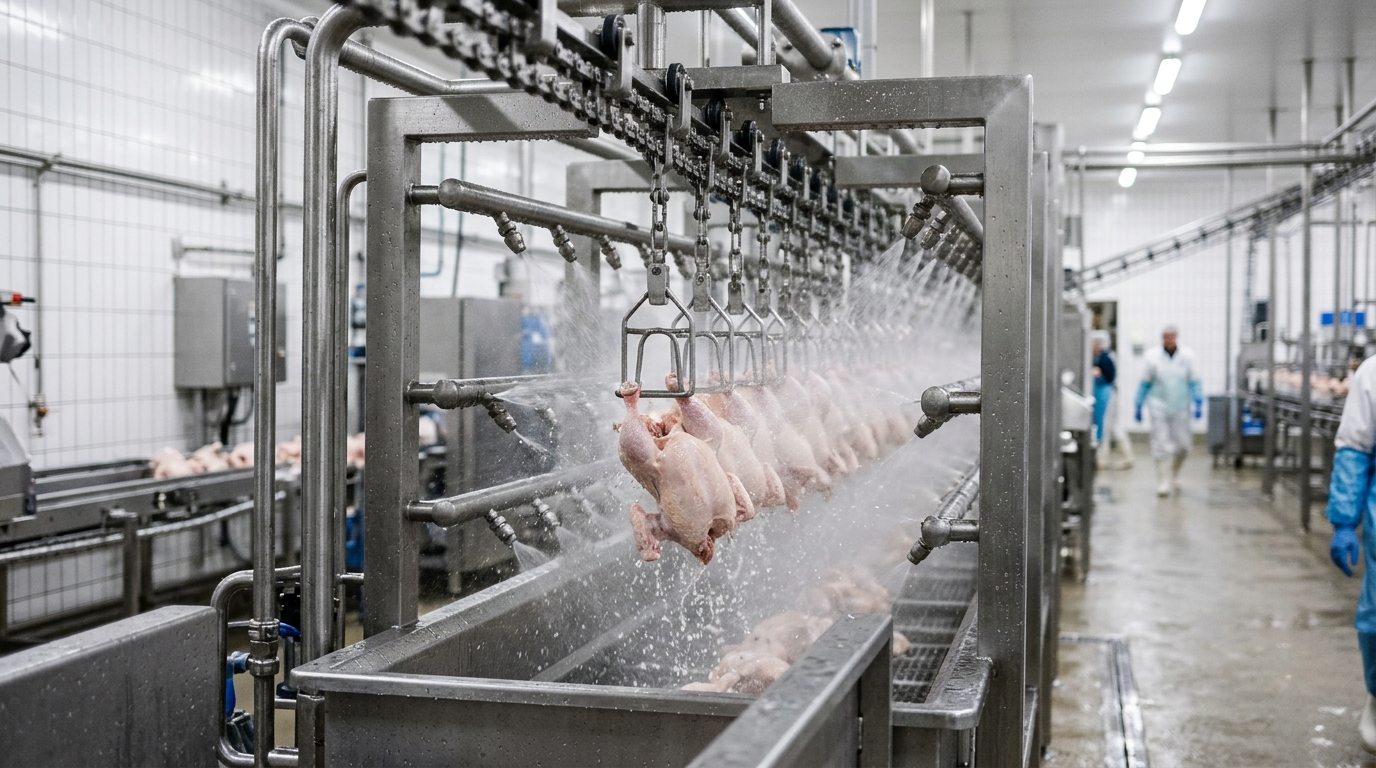
Microbiological tracking involved seven precisely defined collection points along the primary processing flow: pre-scalding, post-scalding, post-defeathering, post-evisceration before critical control point 1B, post-evisceration after critical control point 1B, post-final washing prior to the chilling tanks, and post-chilling. Critical control point 1B served as the primary plant inspection checkpoint dedicated to visually detecting and removing carcasses displaying visible bile, fecal, or gastrointestinal contamination following automated evisceration. Surface rinsing of whole carcasses was performed using four hundred milliliters of buffered peptone water, from which bacterial quantification was executed using a miniaturized most probable number technique with serial microplate dilutions and selective plating. Presumptive Salmonella colonies underwent serological agglutination and definitive molecular confirmation targeting the genus-specific invA gene via polymerase chain reaction, while qualitative occurrence was assessed in parallel using standardized enrichment methodologies according to ISO 6579 protocols.
Statistical evaluation of occurrence demonstrated an overall pathogen detection rate of 45.3 percent across all two thousand one hundred analyses, with significant differences recorded between the sampling points. Pathogen occurrence was significantly higher at pre-scalding compared to all other processing stages except the immediate post-evisceration stage before critical control point 1B, which registered a 49.33 percent occurrence rate. Following the initial thermal scalding stage, contamination occurrence dropped markedly to 42.66 percent, while post-defeathering registered 43.01 percent, post-evisceration after critical control point 1B registered 38.01 percent, post-final washing registered 28.99 percent, and post-chilling registered 36.66 percent. Nonparametric analyses confirmed that the stages following scalding constituted a statistically homogeneous grouping regarding qualitative pathogen occurrence, indicating that presence-absence metrics alone masked meaningful fluctuations in microbial volume occurring across intermediate mechanical steps.
Quantitative enumeration revealed critical operational junctures where bacterial loads fluctuated significantly along the slaughter line. Subsequent operations at critical control point 1B and the final carcass spray wash successfully reduced bacterial counts further, with final washing contributing an additional 0.12 log reduction. Nevertheless, passage through the immersion chilling tanks led to a renewed rise in mean bacterial contamination, underscoring chilling systems lacking chemical disinfectants as vulnerable stages where shared immersion water can facilitate cross-contamination among agitated carcasses.
Analysis of weekly production dynamics illustrated substantial temporal volatility in contamination severity across the twenty-week monitoring duration. Overall weekly mean occurrence rates ranged from low values of 10.47 percent and 11.43 percent during weeks twenty and seventeen to severe peaks of 86.66 percent and 89.53 percent during weeks seven and eleven. High pathogen counts at the final post-chilling stage were observed during specific weeks, notably weeks seven, nine, eleven, and twelve, where post-chilling values averaged 1.3, 0.7, 1.2, and 0.9 log most probable number per gram, respectively. In several instances, highly contaminated incoming flocks at pre-scalding coincided with elevated contamination at final discharge. Conversely, during other sampling weeks exhibiting equivalent initial contamination burdens, such as weeks one, two, six, thirteen, fourteen, and sixteen, carcasses exited the chilling tanks with very low microbial counts, demonstrating that technological line execution and machine performance dictate whether incoming bacterial burdens translate into contaminated final products.
Operational processing variables exerted distinct influences on Salmonella concentrations across specific stages of the slaughter line. Statistical evaluations demonstrated that increased shackle line speed—categorized as operating either below or above 10,500 birds per hour within a total observed range of 7,000 to 10,800 birds per hour—correlated with significantly higher Salmonella counts at post-evisceration before inspection, post-evisceration after inspection, and post-chilling. Researchers noted that higher slaughter speeds may hinder visual verification at critical control point 1B, potentially contributing to increased carcass contamination after this stage. Similarly, bird weight proved influential, with higher carcass weight significantly associated with increased Salmonella counts during evisceration and final washing. By contrast, feed withdrawal duration showed no statistically significant correlation with microbial loads under the observed plant parameters.
Serological characterization of 211 recovered isolates identified five distinct serovars, with Salmonella Heidelberg demonstrating an overwhelming predominance by accounting for 91.5 percent of all typed strains. The remaining serovars occurred at much lower frequencies, represented by Salmonella Infantis at 5.7 percent, Salmonella Minnesota at 1.4 percent, Salmonella Coeln at 0.9 percent, and Salmonella Saintpaul at 0.5 percent. While all five serovars were present on incoming birds at the pre-scalding stage, only Salmonella Heidelberg was recovered consistently across every single sampling stage along the processing line.
Molecular subtyping via pulsed-field gel electrophoresis of 97 representative Salmonella Heidelberg isolates demonstrated pronounced genetic homogeneity across the facility over time. Applying a 90 percent similarity threshold, researchers categorized the isolates into eight distinct macrorestriction clusters designated I through VIII. Isolates collected across widely separated weeks and distinct processing stages regularly grouped within the same pulsotypes, indicating the continuous circulation of closely related clonal profiles throughout the multi-month trial.
Because the study only evaluated carcass isolates without sampling supplying farms or the processing environment, researchers could not determine whether these strains were repeatedly introduced from farms, persisted within the plant, or spread via cross-contamination. Furthermore, while pulsed-field gel electrophoresis provided robust macrorestriction profiling, it possesses less discriminatory power than whole-genome sequencing methods. The authors concluded that effective industrial management of Salmonella requires integrated quality systems that monitor continuous quantitative microbial loads and operational variables alongside routine qualitative presence screening, reinforcing control at mechanical defeathering, evisceration lines, and continuous water immersion chilling systems.
Subject of Research: Salmonella contamination dynamics and operational factors during commercial broiler slaughter
Article Title: Behavior of surface contamination by Salmonella spp. on broiler carcasses during slaughter stages
Article References: Schmiedt, J. A., Tadielo, L. E., dos Santos, E. A. R., Barcellos, V. C., Bach, L. G., Dias, V. H. C., Casas, M. R. T., de Melo Tavares, R., Yamatogi, R. S., Nero, L. A., & dos Santos Bersot, L. (2026). Behavior of surface contamination by Salmonella spp. on broiler carcasses during slaughter stages. Brazilian Journal of Microbiology, 57(1), Article 277. https://doi.org/10.1007/s42770-026-02061-0
Image Credits: AI Generated
DOI: 10.1007/s42770-026-02061-0
Keywords: Salmonella, broiler slaughter, food safety, poultry processing, Salmonella Heidelberg, microbial contamination, cross-contamination, scalding, evisceration, immersion chilling, pulsed-field gel electrophoresis, most probable number, slaughter line speed, foodborne pathogen, carcass rinse, veterinary microbiology
News Source: Morgan Morrow. (November 25, 2026). Salmonella Persists Across Broiler Slaughter Stages Despite Significant Processing Reductions. Scienmag.