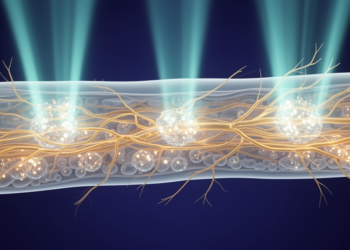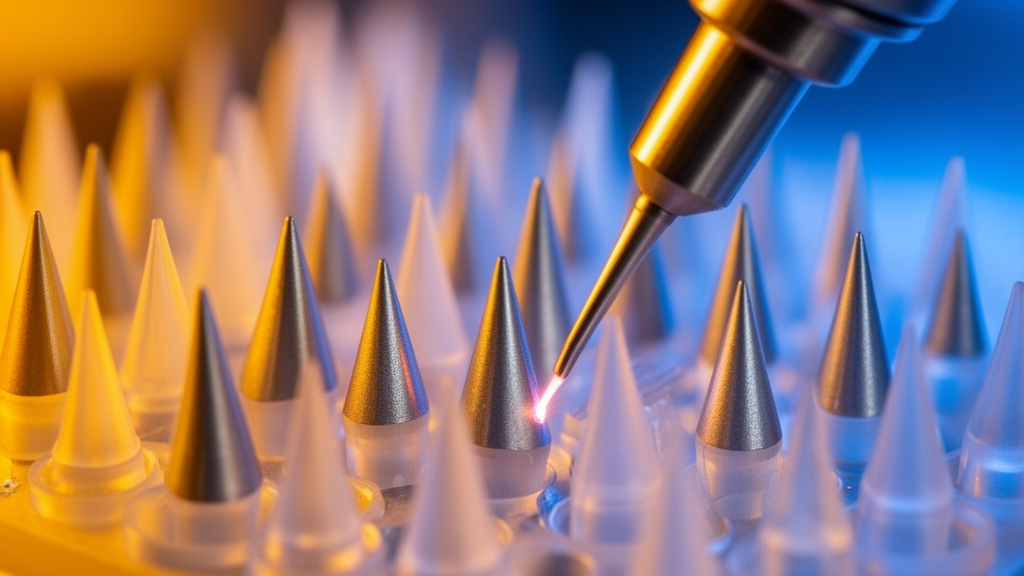
Researchers have developed an industrially feasible, chemical-free microfabrication platform that patterns biodegradable molybdenum electrodes directly onto bioabsorbable poly(L-lactic acid) substrates, successfully demonstrating functional microneedle-based sensors for minimally invasive physiological monitoring. Published in the journal Biomedical Materials and Devices, the study addresses a critical technological bottleneck in transient bioelectronics: the difficulty of patterning conductive metallic circuits onto temperature-sensitive, biodegradable polymers without employing aggressive chemical solvents or harsh thermal conditions. To overcome these long-standing processing constraints, the engineering team devised a four-stage protocol comprising substrate molding, oxygen plasma surface modification, radio-frequency magnetron sputtering, and pulsed ultraviolet laser ablation. Through this multi-step approach, the investigators successfully created precise conductive traces across both planar polymer surfaces and complex three-dimensional microneedle architectures. The resulting electronic devices operate without leaving permanent synthetic residues within the body, offering a safe and mechanically robust pathway toward semi-implantable and fully implantable diagnostic tools capable of measuring physiological hydration and monitoring tissue properties with minimal patient trauma.
Among these sustainable options, poly(lactic acid) polymers stand out prominently because they have been designated as generally recognized as safe by the United States Food and Drug Administration. However, integrating electronic functionality into such materials poses severe engineering hurdles due to their fragile structural properties. Semi-crystalline polymers like poly(L-lactic acid) readily alter their crystallinity, molecular orientation, and bulk mechanical characteristics whenever subjected to elevated thermal processing cycles. Furthermore, these biodegradable matrices possess relatively low thermal operating thresholds and degrade catastrophically when exposed to the corrosive wet-chemical etchants or organic strippers routinely required in conventional photolithographic patterning. Conventional implantable electronics also rely predominantly on noble metals such as gold, silver, platinum, or titanium; while highly conductive, these inert elements persist indefinitely inside the human body rather than dissolving harmlessly after completing their diagnostic mission.
To establish fully bioabsorbable electronic contacts, the researchers selected molybdenum as their primary conductor, exploiting its recognized biocompatibility, high electrical conductivity, and gradual dissolution profile in simulated biological environments. While alternative bioresorbable metals like magnesium, zinc, and iron dissolve rapidly, molybdenum demonstrates a slower, more controllable degradation rate that makes it ideal for medical applications requiring extended functional lifetimes. To construct the underlying structural supports, the researchers prepared high-purity poly(L-lactic acid) substrates using polymer pellets characterized by a molecular weight of 12.1 kilograms per mole and a polydispersity index of 1.34. The pellets were subjected to a thermal molding process commonly utilized in commercial plastics manufacturing, melting the polymer at 200 degrees Celsius inside a cured poly(dimethylsiloxane) mold sandwiched against a coated glass plate. After cooling, the researchers obtained uniform, flat polymer slabs measuring 20 millimeters in length, 20 millimeters in width, and 1 millimeter in thickness, providing a standardized, solvent-free structural base for all subsequent surface modification and metallization experiments.
Directly depositing metallic films onto pristine polymer surfaces typically results in severe interfacial delamination, prompting the team to systematically treat the molded polymer substrates with low-pressure oxygen plasma. Using an operating power of 100 watts and an oxygen chamber pressure of 33 pascals, the researchers systematically exposed the polymer surfaces to plasma discharges across intervals of 0.5, 1.0, and 3.0 minutes to investigate nanoscale morphological and chemical transformations. This physical roughening created a microscopic topography that significantly amplified mechanical interlocking at the polymer interface. Concurrent water contact angle measurements revealed a sharp decrease in surface contact angle from 82.3 ± 0.5 degrees on pristine polymer down to 65.0 ± 1.6 degrees after plasma treatment, confirming that the energetic plasma generated polar functional groups.
Quantitative surface chemical analyses conducted with X-ray photoelectron spectroscopy further unraveled the molecular mechanisms driving this surface activation. While pristine poly(L-lactic acid) exhibited three characteristic carbon peaks corresponding to carbon-carbon and carbon-hydrogen bonds at 285.0 electron volts, carbon-oxygen bonds at 287.0 electron volts, and ester carboxyl groups at 289.1 electron volts, the plasma-treated substrates displayed three additional distinct chemical binding states. Specifically, spectral deconvolution identified newly formed hydroxyl groups at 286.5 electron volts, carbonyl functionalities at 287.7 electron volts, and carbonate species at 290.8 electron volts, directly reflecting the chemical grafting of active oxygen species. Following this surface activation, the researchers deposited a thin layer of molybdenum using radio-frequency magnetron sputtering at a modest power of 50 watts under an argon pressure of 8.8 pascals for 30 minutes. The resulting interfacial adhesive strength was evaluated through standardized ISO 2409 cross-cut tape peeling tests, revealing a dramatic improvement in structural stability across the engineered interfaces.
The cross-cut testing underscored the critical importance of combined physical and chemical surface modifications for preventing thin-film delamination. Molybdenum films deposited onto untreated poly(L-lactic acid) failed completely, experiencing an approximate 100 percent peeling rate as adhesive tape effortlessly stripped the metallic lattice away from the polymer foundation. In sharp contrast, the plasma-treated samples retained their integrity remarkably well, exhibiting only an approximate 12 percent peeling rate along lattice edges and intersections, earning an ISO class 2 adhesion rating. The researchers attributed this heightened adhesion to dual complementary mechanisms: the microscopic physical anchoring provided by the plasma-etched nanoscale cavities, and the intense intermolecular chemical interactions, including hydrogen and covalent bonding, formed between the metallic atoms and the newly induced oxygen-bearing surface groups. Without these combined anchoring effects, subsequent precision subtractive microfabrication would cause severe structural peeling and irrecoverable interface fracture during thermal expansion shifts and mechanical handling.
Having achieved robust metal-polymer bonding, the research group implemented dry ultraviolet laser ablation to pattern fine circuit geometries without relying on chemical etchants. Operating a commercially available laser system equipped with a pulsed ultraviolet source featuring a 355-nanometer wavelength, a 10-nanosecond pulse width, and a 20-micrometer focal spot, the researchers cleanly carved conductive lines by scanning at 100 millimeters per second under a 140-kilohertz repetition rate and 0.7 watts of optical power. The success of this selective ablation relied on the dramatic disparity in optical absorption coefficients between the two materials at the 355-nanometer ultraviolet wavelength. While the underlying poly(L-lactic acid) substrate exhibited a negligible absorption coefficient of approximately 0.003 inverse micrometers, allowing laser light to pass without inducing bulk thermal melting, the molybdenum layer exhibited a strong absorption coefficient of approximately 3.5 inverse micrometers, promoting localized, efficient photothermal evaporation of the metal.
Optical microscopy, scanning electron microscopy, and energy-dispersive X-ray spectroscopy confirmed the formation of clean line-and-space conductor arrays down to 100-micrometer half-pitches, with achievable wire widths spanning 30 to 130 micrometers. Crucially, the enhanced interfacial adhesion achieved through plasma pretreatment played a decisive role in suppressing microscopic crack formation and edge roughness along the laser-ablated tracks. Molybdenum possesses a low thermal expansion coefficient of 4.8 × 10⁻⁶ per kelvin, whereas poly(L-lactic acid) expands at 1.0 × 10⁻⁴ per kelvin; this substantial thermal mismatch generates severe residual stresses during laser heating that normally trigger widespread edge tearing. The reinforced interface successfully resisted these thermal stresses, although the researchers noted that crack suppression broke down when utilizing ultra-thin polymer films measuring under 0.1 millimeters in thickness due to severe substrate deformation under thermal strain. On standard molded substrates, however, the dry laser process yielded clean, continuous metallic traces of high structural fidelity.
Demonstrating the full geometric versatility of their approach, the investigators translated the microfabrication methodology from planar substrates onto three-dimensional microneedle platforms intended for transdermal physiological probing. Following three minutes of oxygen plasma treatment, the structures received a conformal molybdenum coating via a 100-minute magnetron sputtering run at 50 watts, followed by laser micromachining at a scanning speed of 150 millimeters per second and 0.3 watts of laser power to define distinct electrode traces measuring 40.2 ± 5.6 micrometers in width.
To validate diagnostic functionality, the fabricated microneedle electrodes were mounted onto a precision motorized XYZ stage with one-micrometer resolution and driven 500 micrometers deep into excised porcine skin tissues exhibiting varying hydration states. Energized by an alternating-current excitation voltage of 5.0 volts at 1.0 kilohertz, the microneedle electrodes recorded current increases that scaled directly with penetration depth and tissue moisture content, with wetter skin samples yielding higher electrical currents due to reduced tissue impedance. The polymer needles penetrated the fibrous skin tissues without mechanical fracture or electrode delamination, taking advantage of the robust yield strength of poly(lactic acid), which ranges from 0.06 to 0.07 gigapascals compared to 0.02 gigapascals for polycaprolactone. Beyond single-electrode sensing, this non-chemical laser ablation technique uniquely enables the patterning of multiple independent electrodes—such as working, counter, and reference sensors—onto a single microneedle shaft, providing a compact architecture for minimally invasive edema monitoring, though future validation in living animal models remains necessary prior to human clinical translation.
Subject of Research: Microfabrication of biodegradable molybdenum electrodes on bioabsorbable polymer substrates for microneedle sensors
Article Title: Microfabrication of Mo Electrodes on Bioabsorbable Polymer Substrates and Its Application to a Needle-Type Electrode Formation
Article References: Takehara, H., Shimada, K., Naito, K., & Ichiki, T. (2026). Microfabrication of Mo Electrodes on Bioabsorbable Polymer Substrates and Its Application to a Needle-Type Electrode Formation. Biomedical Materials & Devices, 4(1), 1143-1152. https://doi.org/10.1007/s44174-025-00357-7
Image Credits: AI Generated
DOI: 10.1007/s44174-025-00357-7
Keywords: Bioabsorbable polymers, Poly(L-lactic acid), Molybdenum electrodes, Microneedles, Laser ablation, Oxygen plasma treatment, Magnetron sputtering, Biomedical sensors, Surface modification, Interfacial adhesion, Edema monitoring, Porcine skin testing, Electrical resistivity, Contact angle measurement, X-ray photoelectron spectroscopy, Atomic force microscopy, Minimally invasive devices
News Source: Neil Sanderson. (November 25, 2026). Laser Microfabrication Forms Biodegradable Molybdenum Electrodes on Bioabsorbable Polymer Microneedles. Scienmag.