Botanical researchers examining plant growth along steep mountain slopes have discovered that alpine specialist plants preserve stable aboveground biomass and reproductive investment across their elevational ranges, whereas generalist species spanning broader elevations suffer steep biomass losses exceeding fifty percent. In an extensive observational investigation conducted across elevational gradients in the Western Carpathians, researchers tracked how plant architecture and dry matter partitioning responded to environmental transitions associated with increasing altitude. Across mountain gradients, environmental conditions change markedly over short physical distances, characterized by decreasing mean air temperatures, thinner air, shorter vegetative seasons, intensified ultraviolet radiation, and stronger mechanical wind stress. While plant ecologists have long recognized that mountain organisms adapt to vertical gradients through phenotypic plasticity or genetic differentiation, previous empirical investigations primarily tracked widespread generalist species or sampled only a handful of discrete elevational sites. By conducting continuous sampling across extensive vertical spans, the study provides detailed empirical insight into whether high-elevation specialists adjust their physical structures or maintain conservative phenotypes when challenged by harsh mountain climates.
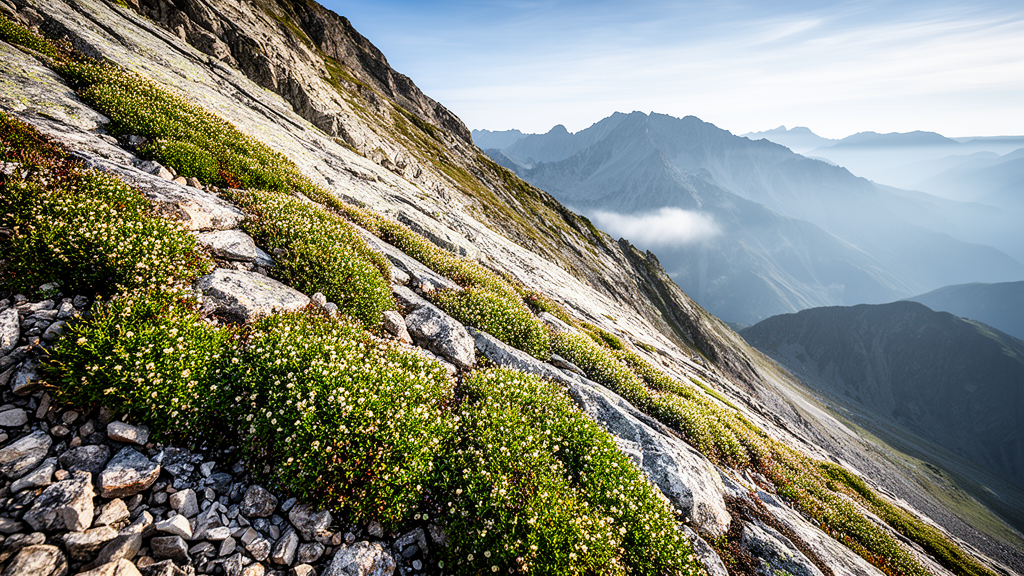
The study focused on the Polish section of the Tatra Mountains within the protected terrain of Tatra National Park, an alpine mountain chain characterized by well-developed vegetation belts spanning from lower montane woodlands to rocky subnival zones. Along the Polish slopes, elevations range between approximately 900 meters and 2,499 meters above sea level at the Rysy peak, creating steep climatic contrasts where mean annual air temperatures decline from roughly six degrees Celsius at the foothills to minus four degrees Celsius at alpine summits. Simultaneously, snow cover persistence increases from one hundred days in basal valleys to nearly two hundred and ninety days on high mountain peaks, accompanied by an increase in annual precipitation from 1,138 millimeters at 844 meters to 1,876 millimeters at 1,991 meters. Within this mountain laboratory, the investigators compared two alpine specialists—Campanula alpina and Doronicum stiriacum—against three species exhibiting wider or lower elevational distributions: Soldanella carpatica, Bellidiastrum michelii, and Senecio subalpinus. These species occupy distinct elevational envelopes across the five regional vegetation belts, providing a rigorous comparative framework to evaluate trait variability across differing ecological strategies.
To capture continuous variation and avoid the interpretive limitations of sparse elevational sampling, the botanical team conducted comprehensive field collections across carefully selected sites distributed evenly throughout each species’ vertical range. The researchers gathered 202 Campanula alpina specimens from 21 distinct sites and 185 Doronicum stiriacum specimens from 20 sites situated between 1,662 and 2,325 meters above sea level, primarily during peak flowering in 2016 with supplementary collections from 2015. At each collection station, nine to ten undamaged individuals in full bloom were harvested at least one and a half meters apart to prevent localized sampling bias. These targeted collections were subsequently integrated with previously compiled datasets from the same geographical region, comprising 383 Soldanella carpatica individuals collected across 40 sites spanning 890 to 2,370 meters in 2018, 340 Bellidiastrum michelii plants sampled from 34 sites between 920 and 2,075 meters in 2016, and 200 Senecio subalpinus specimens collected from 20 sites ranging from 840 to 1,792 meters during 2017 and 2018.
Standardized measurement protocols were rigorously applied to quantify vegetative dimensions and biomass allocation across all sampled individuals. Floral dimensions were recorded immediately following field collection using digital calipers while tissues remained undeformed, measuring corolla tube diameter and length on Campanula alpina and head diameter on Doronicum stiriacum. In the laboratory, Doronicum stiriacum flower heads were rehydrated in water within Petri dishes for one hour to prevent damage to brittle structures, enabling researchers to count total floral numbers and dissect individual ligulate and tubular flowers under stereomicroscopes. Plant height was recorded from the stem base to the highest point of the inflorescence. Whole plants were then meticulously dissected into three distinct structural components: vegetative stems, leaves, and reproductive structures. All tissue fractions were dried for forty-eight hours at eighty degrees Celsius in laboratory ovens with regulated air circulation before dry weight determination on high-precision analytical balances, from which leaf mass fraction, stem mass fraction, and flower mass fraction were calculated relative to total aboveground dry matter.
Statistical modeling of morphological shifts and resource allocation patterns was performed in the R programming environment utilizing linear mixed-effects models implemented through the lme4 package. The statistical models treated elevation as a continuous fixed explanatory effect while designating individual sampling sites as random effects to account for nested spatial variance. Across the dataset, researchers evaluated twelve traits in Campanula alpina, fifteen traits in Doronicum stiriacum, and nine traits each in Soldanella carpatica, Bellidiastrum michelii, and Senecio subalpinus. To compare morphological responsiveness across taxa possessing unequal vertical ranges, the analytical protocol calculated the relative percentage change in model-estimated trait values both per standardized one-hundred-meter elevational increment and across each species’ total vertical distribution from lowest to highest recorded presence.
The mathematical models revealed that plant height decreased substantially with increasing elevation across all five examined species, representing a universal architectural shift. The steepest height reductions occurred in Campanula alpina and Bellidiastrum michelii, both of which experienced up to a sixty-six percent decrease in stature from their lowest to highest elevational boundaries. Among Campanula alpina plants, only three of twelve measured morphological traits exhibited statistically significant elevational variation: height and stem mass fraction declined, whereas flower mass fraction increased toward higher elevations. In Doronicum stiriacum, four of fifteen traits responded significantly to elevation, showing declining plant height and diminishing stem mass fraction alongside modest increases in leaf mass fraction and tubular corolla length. For both high-elevation specialists, all remaining phenotypic dimensions, including absolute vegetative mass and floral biomass, exhibited no statistically significant relationship with increasing altitude.
A striking contrast emerged when comparing total biomass production and organ investment between high-elevation specialists and broader-ranging generalists. While Campanula alpina and Doronicum stiriacum maintained stable aboveground plant mass, leaf mass, and flower mass across an elevation gradient spanning 660 meters, the wider-ranging species demonstrated dramatic biomass declines exceeding fifty percent. In Soldanella carpatica, Bellidiastrum michelii, and Senecio subalpinus, total vegetative dry weight, leaf dry weight, and stem mass dropped precipitously toward higher elevations. Furthermore, absolute flower mass declined significantly in Soldanella carpatica and Bellidiastrum michelii, accompanied by measurable reductions in individual flower mass. In contrast, Senecio subalpinus maintained stable overall floral mass while increasing individual flower weight at higher elevations, illustrating distinct reproductive adjustments among generalists.
Analysis of relative biomass partitioning demonstrated nuanced trade-offs within structural fractions rather than divergent allocation strategies between specialist and generalist groups. Leaf mass fraction remained largely constant along the elevational gradient across most species, showing only a slight increase in Doronicum stiriacum and a marginal decrease in Soldanella carpatica. Stem mass fraction decreased systematically with elevation in four of the five species, remaining stable only in Soldanella carpatica. Concurrently, flower mass fraction increased at higher altitudes in all species except Doronicum stiriacum, reaching its most pronounced upward proportional shift in Bellidiastrum michelii. These consistent partitioning patterns suggest that while absolute growth and accumulation rates differ fundamentally between specialists and generalists, plants that advance into higher terrain frequently prioritize proportionate reproductive investment and suppress excessive elongation of vegetative stems.
The authors interpret the universal reduction in vegetative stature as an aerodynamic and microclimatic adaptation driven by steep environmental transitions near the ground surface. High alpine terrain exhibits severe vertical temperature and wind gradients, where soil and boundary-layer air temperatures can be dozens of degrees warmer than ambient atmosphere just centimeters above ground, while wind velocity increases logarithmically with distance from the surface. In European alpine grasslands, ground-level soil temperatures can reach eighty degrees Celsius on dark surfaces under direct midday sunlight, while canopy temperatures hover near twenty-seven degrees and nearby meteorological stations register only four degrees. By depressing stem elongation and maintaining compact architectures within the aerodynamic boundary layer, mountain plants avoid convective cooling and turbulent mechanical stress. In wider-ranging species, this structural compaction was achieved through significant reductions in stem dry mass, whereas high-elevation specialists retained stable stem biomass despite shortening, indicating denser tissue investment or altered stem geometry.
The persistence of stable aboveground biomass in high-elevation specialists across a 660-meter gradient—corresponding to an estimated drop of approximately 3.6 Kelvin in mean temperature—suggests robust physiological tolerance rather than growth constraint. Generalist species with wider distributions appear increasingly limited by harsh abiotic conditions at upper elevations, where low temperatures restrict tissue formation and result in strong trait variability. Conversely, alpine specialists appear genetically preadapted to function efficiently under cold regimes and short growing seasons, possibly relying on physiological mechanisms such as heightened photosynthetic capacity and metabolic efficiency rather than gross morphological plasticity. While high trait responsiveness in generalists could facilitate competitive dominance under projected climatic warming, the stability of high-elevation species across substantial thermal ranges indicates that direct physiological warming may pose less immediate danger to alpine specialists than intensified ecological competition from upward-migrating generalists.
The investigators emphasized several methodological boundaries and outlined vital directions for subsequent botanical research. Because the investigation evaluated only aboveground organs, underground root systems and root-to-shoot allocation ratios were not quantified, leaving open questions regarding subterranean storage and nutrient acquisition strategies. Additionally, the five study species were sampled across differing field seasons between 2015 and 2018, precluding multi-year assessments of temporal trait stability across fluctuating climatic cycles. The authors also noted that disentangling plastic environmental responses from genetically fixed ecotypic differentiation requires controlled common garden trials featuring reciprocal elevation transplants. Future research expanding species sampling across additional phylogenetic lineages, tracking belowground biomass partitioning, and directly measuring ecophysiological characteristics such as photosynthetic assimilation rates will be essential to resolve how alpine vegetation will navigate changing alpine environments.
Subject of Research: Intraspecific morphological trait variation and biomass allocation in mountain plants across elevation gradients
Article Title: High-elevation plant species exhibit limited morphological variability across elevations, contrary to species with a wider elevational distribution
Article References: Kiełtyk, P., Obidziński, A., & Scheepens, J. F. (2025). High-elevation plant species exhibit limited morphological variability across elevations, contrary to species with a wider elevational distribution. Alpine Botany, 135(2), 187-202. https://doi.org/10.1007/s00035-025-00340-4
Image Credits: AI Generated
DOI: 10.1007/s00035-025-00340-4
Keywords: Alpine Botany, Campanula alpina, Doronicum stiriacum, Soldanella carpatica, Bellidiastrum michelii, Senecio subalpinus, Tatra Mountains, elevation gradient, biomass allocation, plant morphology, phenotypic plasticity, alpine ecology, microclimate, linear mixed-effects models, aboveground biomass, temperature gradient, Carpathian flora
News Source: Drew Townsend. (November 25, 2026). High-Elevation Mountain Plants Maintain Stable Biomass Across Steep Slopes. Scienmag.