Materials researchers have successfully characterized and modeled the non-isothermal thermoviscoelastic behavior of closed-cell polyethylene terephthalate structural foam under compression, establishing how sample geometry influences dynamic measurements and introducing an open-source numerical formulation for composite manufacturing simulations. In industrial production environments, structural composite sandwich components can be fabricated in a single consolidation stage through liquid composite molding methods such as vacuum infusion or resin injection. During these manufacturing cycles, the dry reinforcing fabric skins and the enclosed thermoplastic foam core are placed inside a rigid or semi-rigid tooling cavity, whereupon pressurized liquid polymer resin is injected to impregnate the fibrous plies. The hydrodynamic fluid pressure exerted by the advancing resin front frequently causes macroscopic shifts and localized compressive deformations within the foam core, which alter mold clearance, promote resin pooling, redistribute fluid flow pathways, and ultimately govern the structural integrity of the cured composite assembly.
Accurately predicting these multi-physical manufacturing interactions requires a deep understanding of how the core responds under coupled thermal and mechanical loads, as closed-cell extruded foams exhibit complex, strain-rate-dependent and temperature-sensitive behavior during non-isothermal processing. While structural sandwich performance relies on the intimate bonding achieved during simultaneous resin infusion, fluid-structure forces must remain carefully balanced to prevent premature crushing or plastic yield in the foam core. Previous experimental investigations into thermoplastic strand-extruded polyethylene terephthalate cores demonstrated that mechanical properties depend heavily on cell orientation resulting from extrusion, with dramatic drops in stiffness and compressive yield strength taking place once processing temperatures approach or exceed the glass transition temperature of the parent polymer. However, capturing these dependencies in numerical simulations has been complicated by persistent discrepancies observed in dynamic compression experiments, where several earlier publications reported unexpected and seemingly unphysical stiffening trends when testing closed-cell polymer foams below their thermal transition points.
Dynamic mechanical analysis serves as the primary laboratory technique for evaluating the time- and temperature-dependent viscoelastic properties of solid polymers by subjecting specimens to combined static and cyclic oscillating loads over defined thermal ranges. In dynamic tests, researchers measure the complex modulus, which decomposes into the storage modulus reflecting elastic energy retention and the loss modulus representing viscous dissipation through phase shifts between applied stress and resulting strain. In conventional homogeneous solid polymers, a continuous decrease in the storage modulus across the measured temperature range is typically expected. Conversely, earlier published studies investigating closed-cell structural foams under compressive dynamic mechanical analysis consistently reported an anomalous, non-physical increase in storage modulus as temperatures rose within the glassy regime below the glass transition temperature. Some researchers hypothesized that this counterintuitive stiffening stemmed from localized cell collapse, microscopic structural reconfigurations, or internal volumetric pressure expansion from residual chemical blowing agents trapped inside intact closed cells during extrusion.
To investigate the physical origin of this anomalous response, preliminary dynamic mechanical tests were conducted on commercial closed-cell polyethylene terephthalate foam with a nominal density of one hundred kilograms per cubic meter using a cylindrical sample geometry measuring seven and a half millimeters in diameter. Initial compression measurements performed within a force range of twelve newtons revealed the identical anomalous trend, with storage modulus rising steadily as temperature progressed from room temperature up to the onset of the glass transition. Systematically testing different foam densities from eighty to one hundred and thirty kilograms per cubic meter demonstrated similar patterns, while cyclic thermal reversals and prolonged oven annealing at one hundred and fifty degrees Celsius for one hundred and sixteen hours failed to eliminate the effect. Instead, comparing uniaxial compaction curves with hydrostatic compression data confirmed that small specimens suffered severe localized surface compaction below one percent strain, meaning small laboratory samples merely reflected surface boundary artifacts rather than representative macroscopic foam behavior.
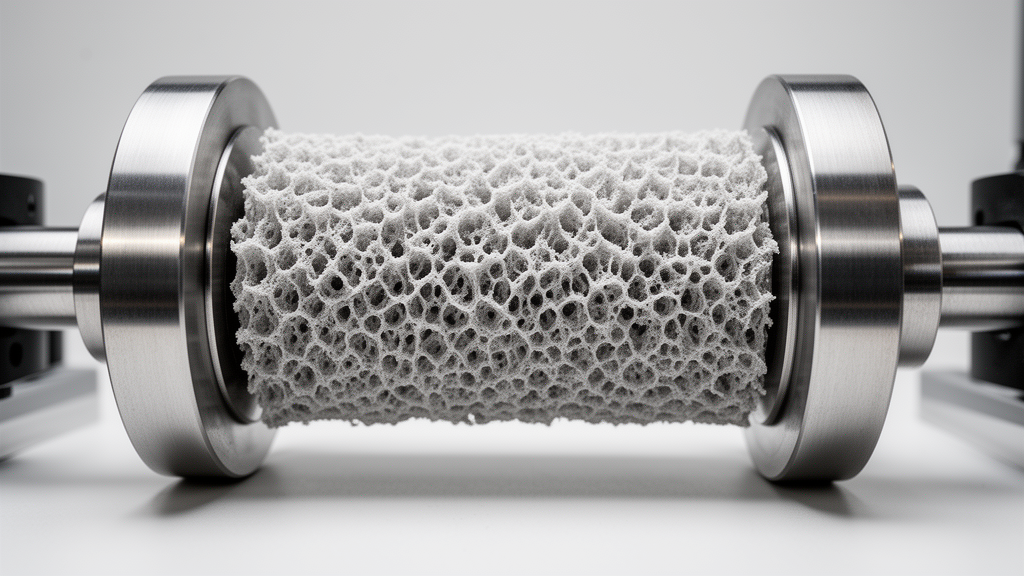
Recognizing that small sample diameters and shallow strain amplitudes failed to engage the core cellular architecture, the investigators engineered a revised experimental methodology utilizing significantly enlarged specimen dimensions and a high-load mechanical test system. To ensure that tested volumes captured representative structural heterogeneity between strand centers and denser strand boundary zones, cylindrical specimens were extracted from extruded blocks with a diameter of seventeen millimeters and a height of twenty millimeters, guaranteeing that every sample contained at least two complete strand boundary interfaces. Experiments were performed using a specialized dynamic mechanical analyzer equipped with a five-hundred-newton force sensor, operating in strain-controlled compression mode with a constant static pre-strain of one percent superimposed by a dynamic strain oscillation amplitude of zero point four percent. Finite element thermal transfer simulations of the sample geometry, combining mass-averaged polymer and air thermal properties, demonstrated that core thermal equilibrium was achieved within one hundred and fifty seconds, prompting the adoption of a five-minute isothermal dwell period prior to initiating frequency sweeps from zero point one to ten hertz across five-kelvin thermal increments.
The upgraded testing configuration successfully eradicated the historical measurement artifacts, yielding a complex modulus that decreased strictly monotonically across the full temperature range from two hundred and ninety-three to four hundred and twenty-three kelvin. Measurements conducted along the principal longitudinal extrusion axis and perpendicular transverse orientations demonstrated exceptional repeatability, exhibiting mean relative errors of zero point seven percent between longitudinal replicates and zero point thirteen percent between transverse specimens. In line with the transversely isotropic cell morphology generated by strand foam extrusion, the storage modulus measured in the longitudinal direction was more than double that recorded in the transverse direction below the glass transition. This directional disparity directly corresponds to the presence of elongated hexagonal honeycomb cells whose primary cell walls and oriented polymer chains align parallel to the extrusion axis, providing superior load-bearing capacity and stiffness along the longitudinal core orientation.
Crucially, while the absolute magnitude of the storage modulus exhibited pronounced mechanical anisotropy, the loss factor, defined as the ratio of loss modulus to storage modulus, followed nearly identical curves across both material orientations. The quantitative disparity in loss factor between distinct test orientations remained exceptionally low, yielding a mean relative error of just one point one percent across directions. This experimental finding substantiated the researchers’ foundational hypothesis that cell morphology predominantly dictates instantaneous elastic stiffness components, whereas the time-dependent viscous relaxation mechanisms are governed almost exclusively by the molecular relaxation dynamics of the underlying polyethylene terephthalate polymer matrix itself. Evaluation of the loss factor peaks across varying frequencies identified the glass transition temperature range as spanning between eighty-seven degrees Celsius at slow loading rates and ninety-nine degrees Celsius at elevated cyclic frequencies, demonstrating clear rate-dependent thermal shifting.
To construct continuous master curves spanning extended operational frequencies, the researchers verified the applicability of the Boltzmann time-temperature superposition principle by constructing Cole-Cole plots of loss modulus against storage modulus. These representations revealed smooth, continuous progressions at temperatures above fifty degrees Celsius and oscillation frequencies exceeding zero point five hertz, while slight low-frequency shifts at colder temperatures were attributable to cut-edge boundary softness. Shift factors required to horizontally translate isothermal frequency segments onto a ninety-degree Celsius reference state were calculated using an arc-length minimization routine. The resulting thermal shift factors were mathematically parameterized using a classical Williams-Landel-Ferry formulation above the glass transition temperature, combined with an Arrhenius activation energy equation to describe the distinct kinetic trajectory governing the rigid polymer matrix in the sub-glass-transition regime.
The macroscopic time-dependent material response was subsequently cast into a Generalized Maxwell Model formulated through a multi-term Prony series representation. Spring and dashpot parameters within the relaxation spectrum were identified in the frequency domain using a bounded quasi-Newton optimization routine with a relative convergence criterion of zero point zero one and a maximum of one thousand iterations. Analyzing discrete parameter fits obtained at individual thermal stages revealed that instantaneous elastic moduli and normalized Prony coefficients varied by less than zero point two percent across the entire investigated thermal window. Consequently, the investigators formulated a streamlined modeling strategy wherein all normalized Prony coefficients and instantaneous elastic moduli are held strictly constant, allowing all temperature-induced stiffness alterations to be calculated exclusively by shifting intrinsic relaxation times according to the fitted Williams-Landel-Ferry and Arrhenius expressions.
Exploiting the directional invariance observed in the mechanical loss factor, the authors introduced a further substantial simplification by applying the identical set of normalized longitudinal Prony coefficients to the transverse material directions, altering only the direction-specific instantaneous Young’s modulus. This minor loss in numerical precision was heavily outweighed by the dramatic reduction in calibration complexity, establishing a robust transversely isotropic constitutive model that requires experimental viscoelastic characterization along only a single foam orientation to predict multi-axial behavior.
To implement the formulation within transient, non-isothermal manufacturing environments, the hereditary stress integral was adapted for numerical time stepping by dividing total strain into stress-dependent mechanical and temperature-dependent thermal expansion tensors. Because instantaneous relaxation times become functions of time under fluctuating temperatures, an exponential transformation was implemented to evaluate the evolving hereditary integral across discrete computational increments. Assuming constant temperature, stable stiffness tensor components, and linear strain rates over sufficiently small time increments, the authors derived an incremental recursive stress algorithm that partitions stress into a thermoelastic Hookean component and two thermoviscoelastic components. The algorithm tracks accumulated viscoelastic stress histories across individual Maxwell branches as internal state variables, while enforcing a linear elastic limiting threshold at extremely large relaxation times to prevent numerical singularities during cold initial processing stages.
The fully parameterized thermoviscoelastic formulation was implemented as a user-defined material subroutine within the open-source finite element code CalculiX, facilitating future numerical coupling with open-source computational fluid dynamics solvers like OpenFOAM for integrated fluid-structure and conjugate heat transfer analysis. To verify the accuracy and numerical stability of the implementation, three-dimensional coupled temperature-displacement simulations of a foam unit cube were compared directly against predictions from a commercial benchmark model in Abaqus. The verification setup imposed an initial ten-percent-per-second compressive displacement for one second followed by a one-hundred-second stress relaxation hold under simultaneous surface heating from three hundred and seventy to four hundred kelvin. The open-source model demonstrated excellent quantitative alignment with the commercial solver across complex multi-axial strain and stress relaxation histories, achieving a temperature mean absolute error of one point forty-eight kelvin, a strain mean absolute error of five point twelve times ten to the negative third, and a stress mean absolute error of thirty-one megapascals. These verified results confirm that the macroscopic model reliably captures non-isothermal relaxation and anisotropic stiffness changes during composite processing.
Subject of Research: Characterization and non-isothermal thermoviscoelastic modeling of closed-cell polyethylene terephthalate structural foam under compression
Article Title: Characterization and Modeling of the Time- and Temperature-Dependent Behavior of a Closed-Cell Polymer Structural Foam under Compression
Article References: Schlegel, S., Schneider, E. A., Rosenschon, M., Riegler, S., Wittemann, F., & Kärger, L. (2026). Characterization and Modeling of the Time- and Temperature-Dependent Behavior of a Closed-Cell Polymer Structural Foam under Compression. Applied Composite Materials, 33(4), Article 128. https://doi.org/10.1007/s10443-026-10509-7
Image Credits: AI Generated
DOI: 10.1007/s10443-026-10509-7
Keywords: Polyethylene Terephthalate Foam, Dynamic Mechanical Analysis, Thermoviscoelasticity, Liquid Composite Molding, Sandwich Structures, Prony Series, Time-Temperature Superposition, Williams-Landel-Ferry Equation, Arrhenius Model, CalculiX, Abaqus Verification, Structural Polymer Foams, Transverse Isotropy, Generalized Maxwell Model, Compression Testing, Finite Element Analysis, Material Characterization
News Source: Denise Maddox. (November 24, 2026). Larger Samples and Higher Strains Resolve Foam Modulus Anomalies in Dynamic Compression. Scienmag.