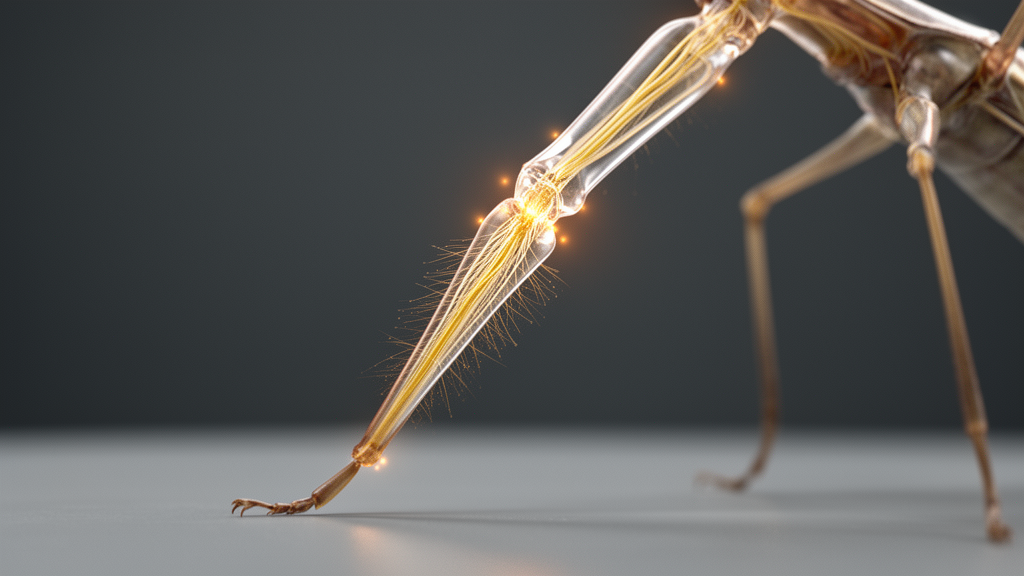
Computational biologists and bio-inspired engineers have designed a hierarchical spiking neural network that decodes joint position and movement velocity from the fractional electrophysiological responses of insect mechanoreceptors. In moving organisms, proprioceptive mechanosensation serves as a ubiquitous sense that monitors cuticle strain, spatial joint alignment, and dynamic displacement to coordinate force and posture. However, peripheral proprioceptors present two fundamental computational challenges when conveying movement information to downstream neural circuits. First, individual mechanosensory neurons possess strictly localized receptive fields that span only a small segment of a joint’s complete working range, creating range fractionation across sensory arrays. Second, these sensory neurons exhibit pronounced spike rate adaptation, producing mixed phasic-tonic firing where output spike frequency fractionally encodes both stimulus magnitude and its temporal derivative, such as joint angle and angular velocity. The newly developed feedforward spiking architecture demonstrates how biological nervous systems resolve these computational bottlenecks, transforming fractionated and blended mechanosensory inputs into separate, highly accurate representations of joint angle and movement speed.
The first layer of the computational architecture simulates peripheral proprioceptive hair fields located near articulating skeletal joints using mathematically compact Adaptive Exponential Integrate-and-Fire neurons. In arthropods, tactile hairs situated in fields on the cuticle deflect as adjacent cuticular plates rotate, functioning as physical lever arms that exert mechanical force on underlying sensory dendrites. To establish realistic spiking dynamics, the researchers modeled hair field afferents based on published electrophysiological recordings from the antennal scapal hair plate of the American cockroach, Periplaneta americana. Real tactile hair neurons exhibit a sharp phasic surge in spike frequency during active deflection, followed by adaptation toward a lower steady-state tonic frequency as the deflection angle is sustained. By incorporating subthreshold membrane voltage integration, exponential spike initiation, and an adaptation current variable, the integrate-and-fire formulation replicated the non-linear mechanotransduction observed in biological afferents while remaining computationally tractable for large-scale multi-limb simulations.
Calibrating the sensory neuron parameters required addressing the physiological properties of spike rate adaptation across varying dynamic conditions. The empirical cockroach recordings documented tactile hairs subjected to ramp-and-hold deflections across five distinct angular velocities ranging from 96 to 980 degrees per second, as well as five hold angles ranging from 15 to 60 degrees. To tune the model, the researchers performed a systematic grid search varying the membrane current conversion factor from 10 to 150 picoamperes per degree and the spike-triggered adaptation parameter from 50 to 350 picovolts. Optimization using mean absolute error identified an optimal parameter combination of 50 picoamperes per degree and 264 picovolts, producing a minimal error of 20 Hertz across peak and steady-state firing benchmarks. To maintain physiological sensitivity during rapid motor reversals, the adaptation time constant was adjusted from 600 milliseconds down to 50 milliseconds with a fourfold scaling of angular velocities, preventing prolonged suppression of afferent responses when joints quickly alter their direction of travel.
To model multi-joint biomechanics across an entire organism, the team mapped the spiking network to a comprehensive kinematic dataset of the Indian stick insect, Carausius morosus. The experimental motion capture data recorded nine adult specimens walking freely along a horizontal walkway forty millimeters wide and 490 millimeters long, utilizing an eight-camera infrared tracking system operating at 200 frames per second. The reconstructed kinematics comprised simultaneous time courses across eighteen leg joints, representing the thorax-coxa, coxa-trochanter, and femur-tibia joints across all six legs. In biological stick insects, proprioceptive hair fields monitor protraction and retraction at the thorax-coxa joint, as well as levation and depression at the coxa-trochanter joint. Although the distal femur-tibia joint naturally relies on an internal chordotonal organ rather than external hair plates, the model extended the hair field encoding paradigm to all eighteen joints because chordotonal scolopidial afferents share identical computational properties of range fractionation, velocity sensitivity, and phasic-tonic adaptation.
In the network’s first layer, each biological joint is monitored by a bi-directional hair plate comprising complementary, opposing hair fields. In nature, cuticular hair plates often occur in opposing pairs where joint flexion deflects one cluster while joint extension deflects the other. The model realized this biological geometry by establishing pairs of antagonistic arrays, each consisting of fifty hairs with adjacent receptive fields distributed across the complete angular excursion of the joint. When a joint rotates away from its resting angle, consecutive hairs deflect proportionally, transforming mechanical displacement into current injections that drive the spiking mechanosensory neurons. Antagonistically oriented hair fields calculate deflection relative to opposing boundaries, maintaining a low, non-zero baseline resting firing rate while guaranteeing that joint movements in opposite directions recruit distinct subpopulations of sensory afferents.
Downstream in the network hierarchy, the second layer consists of first-order interneurons that decode joint position through spatial convergence and integration. For each joint, all sensory afferents within a hair field converge onto a single Leaky Integrate-and-Fire interneuron with a membrane decay time constant of 120 milliseconds and a synaptic weight of 1 millivolt. Because hair fields operate in antagonistic pairs, each joint features two position interneurons dedicated respectively to positive and negative angular displacements relative to the resting angle. When the joint moves into the positive working range, progressively recruited afferents elevate the firing rate of the positive position interneuron up to a peak frequency of 322 Hertz, while the negative interneuron remains quiescent. By subtracting the normalized spike rates of opposing interneurons, the network reconstructs continuous joint trajectories, achieving an exceptionally low average mean squared error of 0.03053 across 1,404 evaluated kinematic time courses.
Statistical evaluation revealed how kinematic differences between joint types influence positional decoding accuracy across the insect body. A two-way analysis of variance examining the effects of leg type and joint type on positional mean squared error demonstrated no significant main effect of leg position, indicating that front, middle, and hind legs perform comparably. Conversely, joint type exerted a highly significant main effect on positional error, with post hoc comparisons confirming that the levating coxa-trochanter joint exhibited significantly higher reconstruction error than either the thorax-coxa or femur-tibia joints. A significant interaction between leg and joint types further indicated that anterior thorax-coxa joints and medial coxa-trochanter joints experienced specific local increases in tracking error. The primary computational sources of positional deviation were transient overshoots during abrupt directional transitions, where sensory phasic peaks momentarily distorted interneuron rate modulation, alongside discrete stair-stepping artifacts arising from finite numerical simulation time steps.
To extract pure movement velocity independent of stationary joint angle, the second layer incorporates specialized velocity-encoding interneurons that exploit afferent phasic dynamics through high-pass filtering. Biological descending interneurons, such as those identified in stick insect antennal mechanosensory pathways, fire in direct linear proportion to angular velocity while remaining completely silent when the joint is stationary. To replicate this computational property using identical sensory inputs, the researchers passed afferent spike trains into a Leaky Integrate-and-Fire neuron configured as a high-pass threshold filter. By setting the membrane decay time constant to 5 milliseconds and calibrating the synaptic weight to 10.8 millivolts, the filter cutoff frequency was positioned just above the steady-state tonic firing rate of the fully deflected mechanosensory neurons. Consequently, sustained static deflection fails to trigger post-synaptic events, whereas dynamic transitions between adjacent receptive fields generate brief phasic bursts that cross the threshold and drive velocity interneuron spiking.
The resulting velocity interneurons demonstrated strong, linear rate encoding across a wide spectrum of physiological angular velocities. When configured with fifty hairs per field and a 10.8-millivolt synaptic weight, the output firing rate increased linearly with angular speed, exhibiting a steep response slope of 2.02 spikes per degree and high linear regression coefficients. When evaluated as a directional binary classifier across 78 walking trials and 18 joints, the velocity interneurons achieved an overall classification accuracy of 0.914, with balanced true positive and true negative rates demonstrating equal reliability during positive and negative joint excursions. The uncorrected mean squared error for velocity decoding was 0.3421, reflecting a persistent temporal lag of approximately 0.025 seconds between peak angular velocity and interneuron firing. This systematic latency occurs because sensory phasic peaks reach their maximum amplitude only when individual hairs attain full deflection; introducing a manual 0.025-second temporal correction reduced the velocity reconstruction error to 0.0910.
The study establishes that biologically grounded integrate-and-fire mechanisms operating within a feedforward architecture can resolve the primary computational challenges of peripheral mechanosensation without requiring complex intracellular filtering. By coordinating local range fractionation with high-pass threshold integration, the network successfully separates mixed phasic-tonic mechanosensory signals into clean, dedicated channels for posture and velocity. While real biological sensilla exhibit non-uniform hair lengths, non-linear cuticular mechanics, and sensory noise, the idealized model demonstrates that basic neurocomputational principles of spatial convergence and adaptive integrate-and-fire dynamics provide a robust template for arthropod proprioception.
Subject of Research: Spiking neural network modeling of insect proprioception and limb kinematics
Article Title: A spiking neural network model for fractional proprioceptive encoding of limb posture and movement in insects
Article References: van der Veen, T., Cohen, Y., Chicca, E., & Dürr, V. (2026). A spiking neural network model for fractional proprioceptive encoding of limb posture and movement in insects. Biological Cybernetics, 120(2), Article 6. https://doi.org/10.1007/s00422-025-01032-2
Image Credits: AI Generated
DOI: 10.1007/s00422-025-01032-2
Keywords: spiking neural network, proprioception, insect kinematics, mechanoreceptors, Carausius morosus, Periplaneta americana, hair fields, integrate-and-fire, AdEx neuron model, interneurons, range fractionation, velocity encoding, motion capture, biomechanics, computational neuroscience, neuromorphic modeling
News Source: Cassandra Pierce. (November 24, 2026). Spiking Neural Network Decodes Insect Limb Kinematics Using Fractional Proprioceptive Modeling. Scienmag.