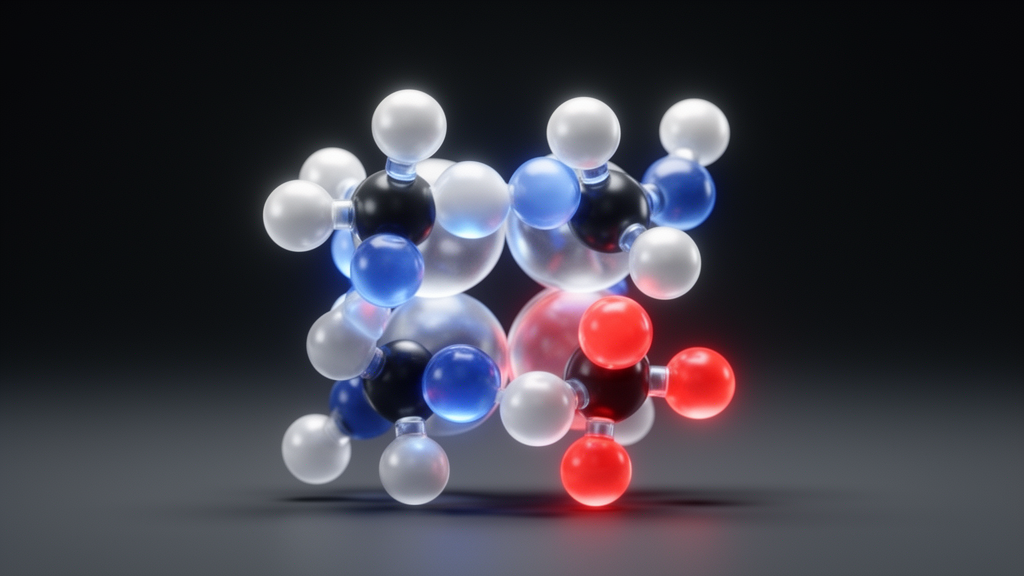
A collective structural shift causes clusters containing exactly six molecules of glycine to exhibit exceptional molecular stability, according to a peer-reviewed study published in the Journal of Chemical Physics. Researchers investigating why certain groupings of molecules remain remarkably stable while others readily break apart discovered that glycine molecules undergo a sharp electrical transformation upon aggregating into a hexamer. Rather than relying solely on symmetrical geometric packing, the six-molecule cluster gains its resilience because its constituent molecules change their internal structural arrangement and convert into zwitterions, establishing stronger bonds with one another.
The investigation was carried out by researchers at Bar-Ilan University, led by doctoral student Michal Roth under the supervision of Professor Yoni Toker from the Department of Physics and Professor Dan Thomas Major from the Department of Chemistry. To examine how glycine molecules assemble and why specific cluster sizes display heightened stability, the scientific team integrated experimental mass spectrometry measurements with computational modeling and molecular dynamics simulations. Their combined experimental and computational approach enabled direct tracking of cluster behaviors and thermodynamic characteristics across varying molecular counts.
In molecular physics and chemistry, groupings of particles that are observed to be substantially more abundant and robust than neighboring sizes are widely recognized as magic number clusters. Traditionally, the stability of such magic number configurations has been attributed to spatial geometry, where a specific quantity of units allows the cluster to form an especially symmetrical and close-packed structural arrangement. Professor Toker noted that while magic numbers represent a well-documented phenomenon, the identification of an intrinsic electronic and structural transformation as the origin of stability represents a newly documented mechanism for molecular clusters.
Glycine, recognized as the simplest of all amino acids, is capable of existing in distinct electrical states depending on its local chemical environment. While standard textbook representations depict glycine in its neutral form, relocating a single proton within the molecule generates a zwitterion, an alternate structure in which one end carries a positive charge while the opposite end carries a negative charge. In an isolated gas phase, a single glycine molecule finds this charged dipolar distribution energetically unfavorable compared to the neutral state. However, because zwitterions exert much stronger intermolecular binding forces on each other, larger aggregates favor shifting into this charged configuration once cluster size provides sufficient cooperative stabilization.
The study determined that this structural transition does not occur gradually, but takes place as an abrupt transformation governed precisely by the number of molecules present. In molecular clusters consisting of five or fewer glycine units, the molecules remain in their neutral form. When a sixth glycine molecule is incorporated, all molecules across the hexamer simultaneously convert into their zwitterionic state. This sudden transition produces an immediate and pronounced increase in cluster binding strength that distinguishes the six-molecule grouping from both smaller and larger assemblies.
Advanced computer simulations performed by the research team quantified the physical magnitude of this collective structural reorganization. Molecular modeling showed that the six-molecule glycine cluster exhibits a calculated dissociation temperature of approximately 1,200 kelvin. In sharp comparison, a cluster containing five glycine molecules demonstrated a calculated dissociation temperature of approximately 450 kelvin, while an assembly of seven molecules broke apart at approximately 480 kelvin. These calculated thermal thresholds show that the hexamer can endure significantly higher thermal energy before dissociating than clusters containing either one fewer or one additional molecule.
These observations carry particular relevance for scientists studying the prebiotic chemical processes associated with the origins of life. Glycine functions as one of the fundamental molecular building blocks of proteins and represents the simplest amino acid detected in extraterrestrial bodies, including comets, asteroids, and meteorites, where it exhibits the highest abundance among detected amino acids. Understanding how amino acids organize, bind, and interact under varied physical conditions provides essential insight into the early chemical mechanisms that preceded biological systems, offering a clear demonstration of how cooperative intermolecular interactions generate emergent properties absent in isolated single molecules.
The authors emphasize the precise scope and boundaries of the research, noting that the study does not directly investigate the polymerization of peptides or the synthesis of proteins. Instead, its findings provide insight into the fundamental intermolecular dynamics and physical interactions that may have influenced the earliest stages of molecular organization. Following the identification of this hexamer stability mechanism, the researchers plan to examine whether other amino acids display comparable collective neutral-to-zwitterionic transitions when organizing into molecular clusters. The study received financial support from the Israel Science Foundation and the Minerva Center for Making New Bonds by Fragmentation.
Subject of Research: Molecular stability and zwitterionic transitions in glycine clusters
Article Title: A new reason for magic numbers: scientists discover the secret behind an unusually stable molecular cluster
Article References: A new reason for magic numbers: scientists discover the secret behind an unusually stable molecular cluster. Original publication (Bibliographic details unavailable.)
Image Credits: AI Generated
DOI: Not provided
Keywords: glycine, amino acids, molecular clusters, magic numbers, zwitterions, mass spectrometry, molecular dynamics simulations, computational modeling, dissociation temperature, origins of life, Bar-Ilan University, gas phase chemistry, Journal of Chemical Physics, glycine hexamer, proton transfer, prebiotic chemistry, astrochemistry
News Source: Bethany Barker. (November 24, 2026). Glycine Hexamer Stability Driven by Abrupt Collective Zwitterionic Transformation. Scienmag.