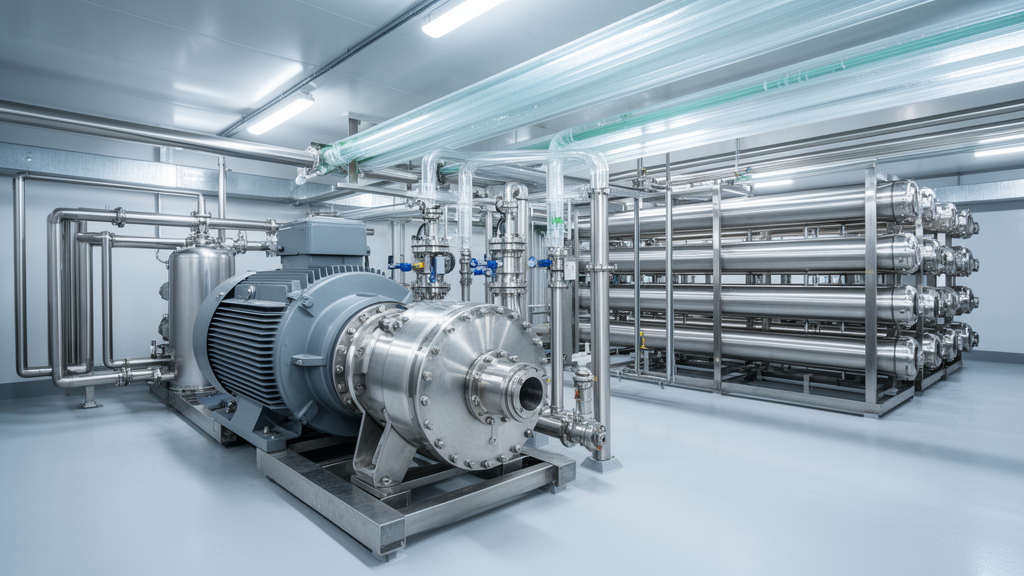
A computational investigation examining the electromechanical dynamics of seawater reverse osmosis desalination has demonstrated that optimizing motor-control parameters can substantially improve drive responsiveness during startup while operating independently of broader process-level energy demands. Desalination through seawater reverse osmosis remains an energy-intensive industrial process where specific energy consumption typically spans between 3.5 and 4.5 kilowatt-hours per cubic meter in conventional operating facilities, although advanced modern installations have achieved figures below 3 kilowatt-hours per cubic meter. Within these facilities, the high-pressure pump represents the primary electrical load, traditionally driven by induction motors or permanent-magnet synchronous motors. To explore how drive-level improvements propagate through downstream hydraulic and membrane systems, researchers implemented an integrated numerical framework combining a permanent-magnet synchronous motor, cascaded field-oriented control, a fixed-displacement pump, and a solution-diffusion membrane transport model. Rather than targeting overall plant energy consumption directly, the computational tuning strategy focused strictly on electromechanical dynamic performance during motor startup.
The simulated drive architecture employed a three-phase surface-mounted permanent-magnet synchronous motor modeled in the synchronously rotating direct-quadrature reference frame. In this configuration, the direct-axis and quadrature-axis inductances are identical at 0.0003 henries, eliminating reluctance torque and causing electromagnetic torque to depend directly on the quadrature-axis stator current. The field-oriented control scheme utilized a cascaded structure comprising an outer mechanical-speed control loop and two inner direct- and quadrature-axis current-control loops. In this arrangement, the speed loop evaluates the difference between the reference speed of 260 radians per second and the simulated rotor velocity to establish the quadrature-axis current command. Meanwhile, the inner current loops regulate stator currents against their reference values, maintaining the direct-axis reference at zero to decouple torque generation from rotor magnetic flux. Operating under a 400-volt direct-current bus with a motor stator resistance of 0.01 ohms and three pole pairs, the drive model established nominal direct- and quadrature-axis electrical time constants of 0.030 seconds, providing a physically defined baseline for evaluating closed-loop behavior.
To tune the six proportional and integral gains governing the three cascaded control loops, the researchers deployed an offline sequential hybrid optimization procedure combining a genetic algorithm with particle swarm optimization. The decision variables consisted of the proportional and integral gains for the speed controller, direct-axis current controller, and quadrature-axis current controller. Optimization was driven by a normalized multi-criterion objective function designed to minimize transient stator copper-loss energy, the integral of squared mechanical-speed tracking error, and percentage speed overshoot across a 0.25-second startup interval, weighted at 0.5, 0.3, and 0.2, respectively. The genetic algorithm stage initiated global exploration across bounded parameter spaces using tournament selection, arithmetic crossover, and mutation before transferring its five best candidate solutions to initialize the particle swarm optimization stage for local refinement. Importantly, specific energy consumption was intentionally excluded from this optimization objective function, treating electromechanical loss reduction as an isolated drive-level target rather than a direct process-level energy minimization.
When evaluated against an intentionally untuned baseline controller configured with gains set to the exact midpoints of the admissible parameter search intervals, the hybrid algorithm achieved dramatic reductions in modeled startup losses. The calculated transient stator copper-loss energy dropped from 303.334 joules under the midpoint baseline to 42.602 joules under the optimized controller, representing an 85.96 percent reduction during the 0.25-second evaluation window. Mechanical speed regulation also improved markedly: evaluated within a plus-or-minus two percent tolerance band around the 260 radians per second target, the rotor settling time decreased from 0.2405 seconds in the baseline configuration to 0.0385 seconds with the optimized gains, approaching the motor winding electrical time constant. Furthermore, numerical analysis of the mechanical power balance at the conclusion of the simulation confirmed that the optimized drive operated within 0.026 newton-meters of mechanical equilibrium against the 19.263 newton-meter pump load, compared to an unresolved torque imbalance of 3.746 newton-meters under the untuned baseline.
Because metaheuristic tuning mechanisms rely on stochastic operators, the authors conducted repeated evaluations across eight independent runs initialized with distinct random seeds to characterize optimization stability. Across these runs, the converged normalized objective function demonstrated tight clustering, yielding a sample mean of 0.35177, a standard deviation of 0.00954, and a coefficient of variation of only 2.71 percent, spanning a narrow range between 0.3460 and 0.3748. In sharp contrast, individual controller gains exhibited extreme dispersion across the eight trials, with coefficients of variation reaching 23.02 percent for the speed integral gain, 57.38 percent for the speed proportional gain, 57.91 percent for the quadrature-axis proportional gain, 146.52 percent for the quadrature-axis integral gain, and 158.03 percent for the direct-axis proportional gain. This striking disparity between objective function stability and parameter variance reveals that the multi-dimensional control landscape contains numerous near-equivalent parameter combinations capable of delivering comparable electromechanical performance.
To investigate the benefits of algorithmic hybridization, a supplementary numerical benchmark compared the sequential genetic algorithm and particle swarm optimizer against standard particle swarm optimization on a reconstructed motor-control model under identical budgets of 500 objective evaluations per run over eight trials. In this benchmark, the hybrid method achieved a 28.02 percent lower mean cost value of 0.037235 compared to 0.051732 for conventional particle swarm optimization, alongside a much smaller standard deviation of 0.000217 compared to 0.040133. However, both algorithms identified nearly identical best-case objective values of 0.037030 and 0.037115, indicating that the principal advantage of the hybrid method lay in run-to-run convergence consistency rather than absolute peak solution quality. Additional sensitivity tests on algorithmic hyperparameters demonstrated that expanding the genetic algorithm population size from 15 to 20 individuals produced negligible change in final cost, whereas reducing the population to 10 slightly elevated mean cost and stochastic variance, and lowering the particle swarm inertia weight from 0.9 to 0.4 modestly improved convergence repeatability.
The mechanical power produced by the optimized motor drive was directly coupled to a positive-displacement high-pressure pump model incorporating pressure-dependent internal leakage. Operating at 260 radians per second against a pressure differential of 6.1 megapascals, the pump model yielded a theoretical displacement flow of 2.808 cubic meters per hour and an actual delivered feed flow of 2.8058 cubic meters per hour, requiring 5.008 kilowatts of shaft power at an effective mechanical-to-hydraulic efficiency of 94.93 percent. This delivered flow was routed into a quasi-steady solution-diffusion transport model evaluating nine commercial thin-film composite reverse osmosis membranes from FilmTec, Hydranautics, and Toray. Solute transport calculations incorporated concentration polarization through coupled Reynolds, Schmidt, and Sherwood numbers alongside Van\’t Hoff osmotic pressure formulations solved via fixed-point iteration. Across simulated startup trajectories, calculated feed pressures stabilized toward membrane-specific operating thresholds within roughly 0.1 seconds, yielding steady-state permeate production rates between 0.328 and 0.689 cubic meters per hour.
To evaluate the quantitative accuracy of the transport formulation, the researchers benchmarked the simulated steady-state performance against industrial original equipment manufacturer design tools, including DuPont WAVE, Hydranautics IMSDesign, and Toray DS. This inter-model comparison uncovered pronounced systematic discrepancies across all nine commercial membranes, with the simplified numerical model underpredicting net driving pressure by a mean absolute percentage error of 64.4 percent and a root-mean-square error of 15.56 bar. Permeate flow rate was likewise underpredicted across all membranes, showing a mean absolute percentage error of 30.0 percent and a root-mean-square error of 0.235 cubic meters per hour. Conversely, process specific energy consumption was predominantly overpredicted, yielding a mean absolute percentage error of 46.9 percent and a root-mean-square error of 2.094 kilowatt-hours per cubic meter. These substantial deviations reflect structural differences between simplified solution-diffusion equations and proprietary manufacturer models that incorporate spacer-specific hydraulics, pressure vessel configurations, and calibrated empirical correction factors.
Process-level energy reductions were subsequently evaluated through the incorporation of an energy recovery device placed on the pressurized concentrate stream. Modeled as a lumped hydraulic recovery unit operating at an assumed conservative baseline efficiency of 55 percent, the device captured residual brine pressure energy, reducing modeled specific energy consumption across the nine membranes from an initial range of 4.98 to 6.94 kilowatt-hours per cubic meter down to 3.74 to 4.89 kilowatt-hours per cubic meter. This intervention yielded relative energy savings between 24.87 percent and 30.49 percent, with variations governed entirely by membrane-specific operating pressures and recovery ratios. A broader parametric sweep spanning energy recovery efficiencies from 0 percent to 95 percent demonstrated monotonic reductions in specific energy consumption, reaching minimums of 2.84 to 3.43 kilowatt-hours per cubic meter at 95 percent efficiency, corresponding to energy savings of 42.95 to 52.67 percent. Crucially, these savings stemmed exclusively from concentrate hydraulic recovery and were completely decoupled from motor controller gain optimization.
Finally, the authors examined long-term operating durability by coupling the transport equations to an illustrative first-order exponential permeability decay model over a 365-day operating horizon. Applying decay coefficients from 0.001 to 0.005 per day under fixed hydraulic conditions revealed profound long-term energy penalties, with specific energy consumption increasing by 1.7 to 29.9 percent for Toray TM800V-400 and surging by 7.9 to 144.0 percent for Hydranautics SWC4-LD. Under the most severe scenario, an 83.9 percent loss in clean membrane permeability forced specific energy consumption to escalate from 6.943 to 16.943 kilowatt-hours per cubic meter. Emphasizing the theoretical nature of these findings, the authors noted that the simulations omit physical test bench verification, fluid compressibility, transient solute diffusion, chemical cleaning cycles, and economic capital expenditure assessments. Consequently, while drive optimization successfully curbs electrical startup losses, determining true plant-wide energy efficiency requires comprehensive physical testing and dynamic system-level modeling.
Subject of Research: Coupled electromechanical motor control and membrane process modeling in seawater reverse osmosis desalination
Article Title: Energy-efficient reverse osmosis desalination through GA-PSO motor control and hydraulic energy recovery
Article References: El Allaoui, A., Loumissi, H., Jouicha, I. I., Dachry, W., Gziri, H., El Ansari, L., & Medromi, H. (2026). Energy-efficient reverse osmosis desalination through GA-PSO motor control and hydraulic energy recovery. Cleaner Water, 8, Article 100335. https://doi.org/10.1016/j.clwat.2026.100335
Image Credits: AI Generated
DOI: 10.1016/j.clwat.2026.100335
Keywords: seawater reverse osmosis, permanent-magnet synchronous motor, field-oriented control, genetic algorithm, particle swarm optimization, specific energy consumption, high-pressure pump, energy recovery device, thin-film composite membrane, net driving pressure, concentration polarization, stator copper loss, motor control optimization, desalination modeling, membrane transport, stochastic repeatability
News Source: Denise Maddox. (November 24, 2026). Simulated Motor Optimization Cuts Startup Loss in Reverse Osmosis Modeling. Scienmag.