Continuous microflow synthesis has emerged as a transformative manufacturing technology for processing hazardous chemical transformations, offering exceptional control over temperature profiles, mass transfer rates, and overall operational safety. In continuous manufacturing, miniaturized channels limit the active inventory of dangerous compounds at any single instant, substantially curtailing the catastrophic potential of runaway reactions. Energetic materials such as nitroguanidine represent ideal testbeds for advancing modern flow chemistry, as conventional batch protocols present severe thermal runaway hazards and necessitate labor-intensive isolation procedures. To address the long-standing challenge of monitoring corrosive, high-viscosity reaction media without disrupting fluid movement, an investigation published in Analytical and Bioanalytical Chemistry demonstrates the application of non-contact inline Raman spectroscopy to track and optimize the continuous synthesis of nitroguanidine in microreactors in real time.
Nitroguanidine serves as an indispensable, stable energetic material across civil and defense sectors, synthesized primarily by reacting guanidinium salts with mixed acid to produce nitronium ions in situ. In traditional manufacturing processes, safety constraints and poor heat removal often hamper efficiency, while reaction evaluation traditionally relies on offline sampling, quenching, and purification stages. Microreactors surmount these mass and heat transfer barriers through their high surface-to-volume ratios, allowing operators to maintain strict isothermal conditions even during vigorously exothermic chemical events. However, working with mixed acids presents notable operational hurdles in microchannels, particularly the exceptionally high viscosity of concentrated sulfuric acid solutions, which generates substantial hydrodynamic resistance and necessitates high system pressure to maintain desired volumetric throughput.
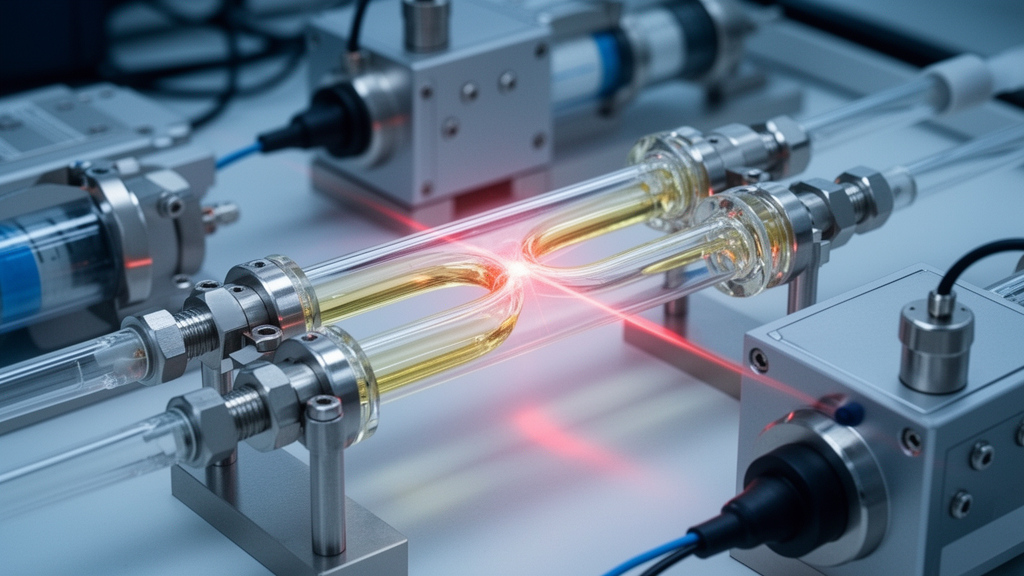
To overcome analytical limitations without introducing fragile or corrosion-prone immersed hardware into aggressive media, the research team implemented a non-invasive process analytical technology framework. The experimental setup coupled an external fiber-coupled Raman spectrometer to the continuous outflow using a specialized clip-on aluminum adapter directly seated onto fluoropolymer perfluoroalkoxy alkane tubing downstream of the reactor plates. By focusing an excitation laser operating at a wavelength of 532 nanometers with an output power of 100 milliwatts directly through the transparent polymer wall, the researchers obtained continuous vibrational fingerprint spectra of the passing fluid. This optical configuration eliminated sample extraction, avoided intermediate quenching waste, and bypassed the mechanical deterioration typically suffered by immersed optical probes in concentrated sulfuric and nitric acid environments.
By scanning various acid ratios at an overall total flow rate of 1.65 milliliters per minute, the team tracked the characteristic symmetric nitrogen-oxygen stretching vibration of the nitronium ion located at 1400 inverse centimeters. The data revealed that mixtures containing more than 47 percent nitric acid by volume failed to yield detectable nitronium bands, while acid compositions possessing between 10 and 20 percent nitric acid by volume produced the most intense Raman signals, defining the optimal window for subsequent nitration trials.
Equipped with real-time vibrational metrics, the authors investigated temperature effects to simultaneously reduce hydraulic resistance and enhance reaction rates while safeguarding equipment integrity below a strict operational pressure ceiling of 9.0 bar. Working with a fluid mixture possessing elevated dynamic viscosity, pumping through narrow channels requires elevated pressure heads that scale unfavorably at higher volumetric flow rates. Raising the microreactor temperature from 40 degrees Celsius to 70 degrees Celsius lowered the viscosity of the sulfuric acid matrix markedly, precipitating a notable decrease in measured operational system pressure from 7.7 bar down to 2.6 bar at a constant flow rate of 1.64 milliliters per minute, corresponding to a residence time of 10.5 minutes.
Vibrational spectra collected during temperature optimization experiments documented the rapid consumption of reactants and the simultaneous generation of nitroguanidine. At lower reactor temperatures of 40 degrees Celsius, the characteristic spectral signature of unreacted guanidinium cations remained clearly identifiable at 3410 inverse centimeters alongside the growing nitroguanidine band at 3351 inverse centimeters, resulting in a product yield of 96 plus or minus 1.9 percent. Raising the temperature to 60 degrees Celsius and 70 degrees Celsius caused the guanidinium band to disappear entirely, confirming complete reactant conversion with yields reaching 100 plus or minus 1.8 percent and 99 plus or minus 0.9 percent, respectively. Operating beyond 70 degrees Celsius, however, led to extensive bubble nucleation within the microchannels—likely resulting from gas solubility alterations and the incipient decomposition of nitroguanidine—which obscured the optical pathway and disrupted steady inline Raman monitoring.
With optimal operating temperatures established at 70 degrees Celsius, the study evaluated the relationship between volumetric throughput and residence time to maximize total material production. System performance was examined across flow rates ranging from 1.64 milliliters per minute up to 4.43 milliliters per minute, the latter approaching the hydraulic boundary with an internal pressure of 8.1 bar and establishing a residence time of only 3.9 minutes. Under these rapid transport conditions, the chemical yield contracted slightly from 99 plus or minus 1.0 percent at 8.0 minutes to 94 plus or minus 1.2 percent at 3.9 minutes, accompanied by the appearance of a subtle guanidinium shoulder in the spectral profiles above flow rates of 3.45 milliliters per minute.
Despite this slight yield decline at shorter residence times, total volumetric product output increased markedly, climbing from 5.1 plus or minus 0.05 millimoles per minute at a 10.5-minute residence time to 8.3 plus or minus 0.08 millimoles per minute at 6.3 minutes, ultimately reaching 12.9 plus or minus 0.17 millimoles per minute at 3.9 minutes. Because continuous downstream processing involves diluting the acidic effluent into a cold aqueous bath followed by filtration and washing, the minor trade-off in conversion was considered acceptable relative to the substantial gains in absolute manufacturing throughput. Nonetheless, a residence time of 6.3 minutes, corresponding to a total flow rate of 2.74 milliliters per minute, was selected as the optimal operating baseline, providing a high conversion yield of 97 percent while maintaining a robust pressure safety buffer against unanticipated process fluctuations.
The investigation subsequently scrutinized the stoichiometric balance between guanidinium ions and nitric acid to evaluate chemical stability and prevent deleterious retro-reactions. Nitroguanidine exhibits vulnerability to degradation in concentrated sulfuric acid environments where the absence of sufficient nitric acid can drive reversible decomposition. By modulating the relative flow rates of the reagent dosing syringes at 70 degrees Celsius, the researchers observed that sub-stoichiometric nitric acid feeds yielded incomplete guanidinium conversion, with yields dropping to 94 plus or minus 1.3 percent at a 1 to 0.85 molar ratio. Conversely, maintaining a slight stoichiometric excess of nitric acid, spanning molar ratios from 1.05 to 1.25 equivalents, stabilized the product output at 8.2 millimoles per minute and sustained yields between 95 and 97 percent without promoting unwanted secondary pathways.
Process robustness and long-term repeatability were corroborated through replicate synthesis trials executed under the optimized operational baseline of 70 degrees Celsius, a 6.3-minute residence time, and a 1 to 1 molar stoichiometry. Continuous tracking of the quantitative nitroguanidine vibrational band at 795 inverse centimeters successfully captured transient dosing events, such as periodic flow disruptions caused by automated syringe pump switchovers, which induced brief, identifiable shifts in pressure and reagent ratios. While an analysis of variance across five repeated runs indicated statistically significant variation attributed to an isolated controller defect in one trial, data from the remaining runs exhibited tight distribution and normal variance, validating the reactor system for dependable synthetic operation.
Beyond demonstrating a highly productive continuous synthesis pathway for an energetic compound, the study illustrates the broader utility of non-invasive process analytical techniques for hazardous chemical manufacturing. Coupling clip-on optical interfaces with microfluidic systems enables chemical engineers to monitor transient intermediate species, detect operational anomalies instantaneously, and map multidimensional parameter spaces without generating analytical chemical waste or exposing personnel to corrosive streams. By converting hazardous batch nitrations into an automated, transparent, and tightly governed continuous process, this analytical paradigm provides a compelling framework for scaling energetic materials manufacturing and advancing sustainable process intensification across modern synthetic chemistry.
Subject of Research: Inline Raman spectroscopy monitoring and parameter optimization of continuous microflow nitroguanidine synthesis
Article Title: Real-time process analysis and optimization of nitroguanidine synthesis in microflow using inline Raman spectroscopy
Article References: Hirschberger, L., Völkl, M. B. R., Karaghiosoff, K., Klapötke, T. M., & Haisch, C. (2026). Real-time process analysis and optimization of nitroguanidine synthesis in microflow using inline Raman spectroscopy. Analytical and Bioanalytical Chemistry. https://doi.org/10.1007/s00216-026-06847-x
Image Credits: AI Generated
DOI: 10.1007/s00216-026-06847-x
Keywords: Nitroguanidine, Inline Raman spectroscopy, Microflow reactor, Process analytical technology, Continuous flow chemistry, Nitronium ion, Energetic materials, Sulfuric acid, Nitric acid, Chemical reaction engineering, Guanidinium carbonate, Viscosity reduction, Reaction optimization, Process monitoring, Flow synthesis, Spectroscopic analysis, Chemical process safety
News Source: Bethany Barker. (November 24, 2026). Inline Raman Spectroscopy Optimizes Hazardous Microflow Nitroguanidine Synthesis at High Yield. Scienmag.