Credit: Kanazawa University
"The diagnosis, 'autism spectrum disorder,' covers a lot of symptoms. For each various symptom, there should be a various brain pathophysiology," said Yuko Yoshimura, an assistant professor in the Research Center for Child Mental Development at Kanazawa University and first author on the paper. "It is important to objectively detect them, and to lead children with ASD and their parents to appropriate support and intervention."
The research team includes scientists from the Gunma Prefectural College of Health Science, the Health Administration Center at the University of Fukui, and the International Education Center at Kyushu University.
They used a brain scanning process, called magnetoencephalography, customized for use in children. During the process, the children wore helmets to measure the magnetic fields of their whole brains. The inferior frontal and superior temporal areas, located in the brain's left hemisphere, were previously found to be structurally important for language processing. The researchers played a female voice speaking the Japanese sound, "ne," which usually prompts communicative exchange between mother and child. The word was repeated with different tones, each designed to invoke different emotional meanings, from negative to neutral to positive.
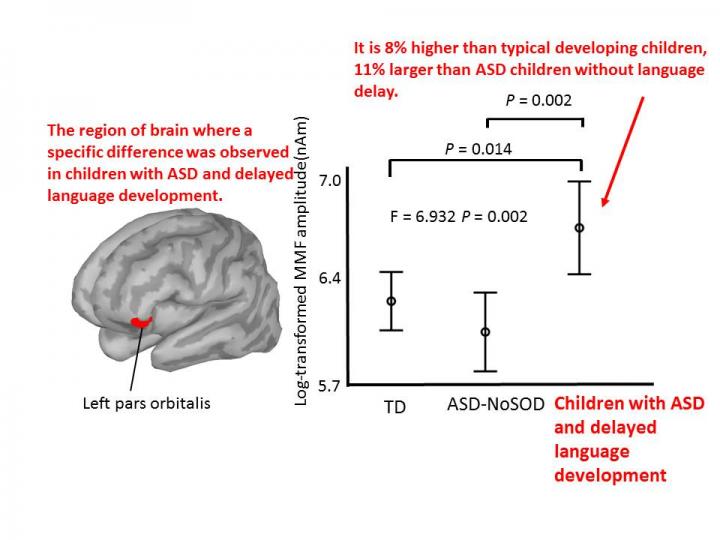
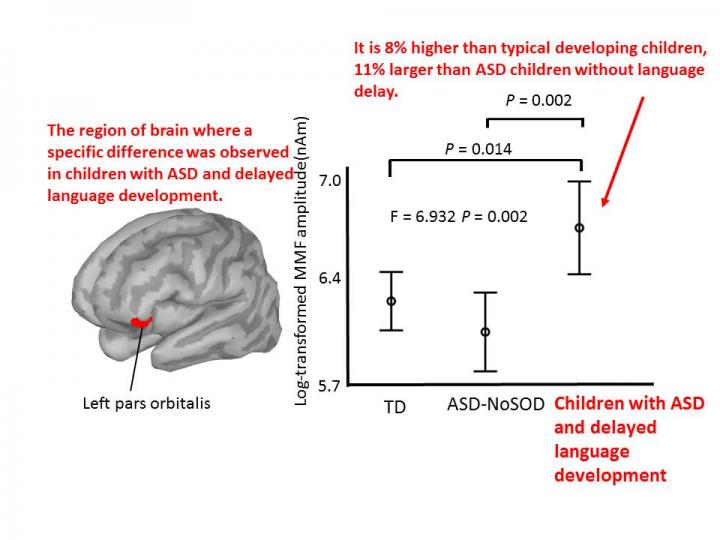
As the children listened to the repeated sound, the scientists recorded the produced wavelengths and compared them to the typical wavelengths produced in people without autism spectrum disorder. The difference between the two productions is called the magnetic mismatch field, and typically indicates a recognition of change from a series of constant stimulation.
The researchers found significant differences in two distinct magnetic mismatch field regions, a first in children so young. Children with ASD had much lower magnetic mismatch fields in the left superior temporal area than typically developing children. However, children with ASD and delayed language development had larger magnetic mismatch fields in the left inferior frontal area than typically developing children and children with ASD who do not have delayed language development.
"In the current child psychiatric field, diagnosis of developmental disorder is performed only by [the child's] behavioral features and their growth history, whereas the biological objective indicator is not included. The importance of individual characteristics including physiological and biological indicators is recently gaining world-wide recognition to realize appropriate treatment and care," Yoshimura said. "Our study demonstrated the brain biological indicator which is related to early stage language acquisition in young children with autism spectrum disorder."
The researchers plan to continue researching physiological and biological indicators in young children with developmental disorders with their child-customized magnetoencephalography system to evaluate brain function in a child-friendly way.
"Our ultimate goal is to build a common, bright future for all children," Yoshimura said. "We hope that children with ASD will receive diagnosis properly based on behavioral features and biological characteristics at [an] earlier stage, and receive appropriate support and treatment corresponding to each individual brain feature."
###
Media Contact
Yumiko Kato
[email protected]
81-762-645-963
http://www.kanazawa-u.ac.jp/e/index.html
Original Source
http://www.nature.com/articles/s41598-017-17058-x http://dx.doi.org/10.1038/s41598-017-17058-x