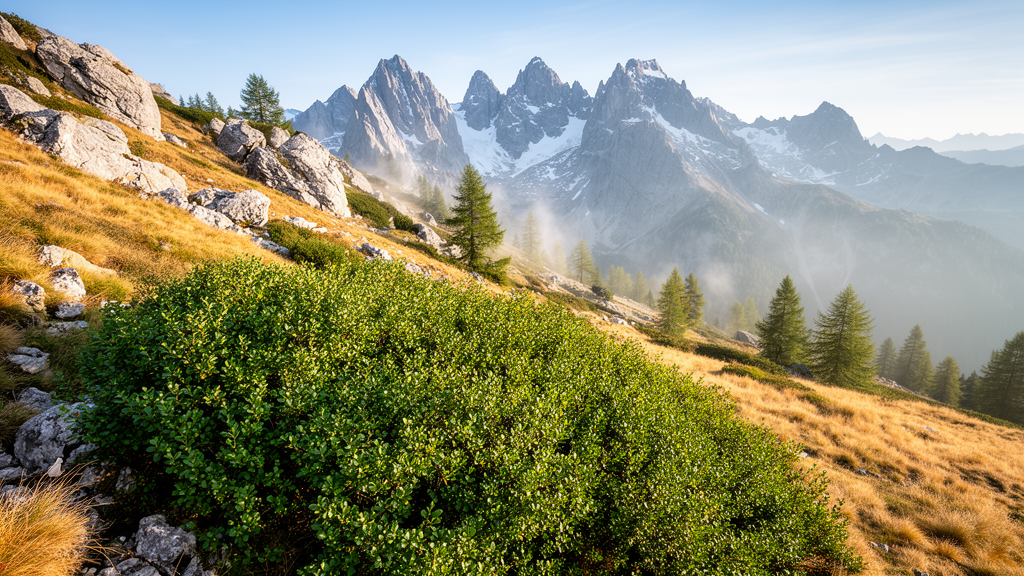
Field investigations within the treeline ecotone of the Central Tyrolean Alps demonstrate that expanding thickets of green alder consume and transpire considerably more water than adjacent subalpine vegetation. A two-season field study conducted on Mount Patscherkofel in Austria tracked the water dynamics of Alnus alnobetula across distinct topographic aspects and elevations. The research team found that total stand evapotranspiration from green alder patches averaged 4.3 millimeters per day, driven by active canopy transpiration averaging 3.6 millimeters per day. These measured water loss rates significantly exceed the transpiration figures documented for neighbouring grasslands, dwarf shrub communities, and isolated Swiss stone pine trees, indicating that the rapid encroachment of green alder into alpine zones fundamentally reshapes the local hydrological cycle.
Across arctic and alpine environments over recent decades, shrub expansion has altered terrestrial ecosystem structures and local biogeochemical flows. Within the European Alps, socioeconomic shifts including declining livestock grazing pressure and the outright abandonment of marginal high-elevation pastures have substantially accelerated the proliferation of Alnus alnobetula, previously classified as Alnus viridis. While the deciduous shrub has historically inhabited avalanche tracks and steep north-facing gullies where groundwater and runoff remain abundant, ecological surveys reveal that it is increasingly invading sun-exposed slopes characterized by thin, skeletal soils and intermittent drought stress.
Despite extensive historical lysimeter and sap flow monitoring of dwarf shrubs, meadows, and subalpine conifer forests in the Central Tyrolean Alps, the specific canopy water use of green alder stands has remained poorly quantified. Earlier leaf-level gas exchange trials indicated that green alder maintains open stomata during periods of intense solar irradiance without the midday depression in gas exchange typical of conservative alpine plants. To assess whether stand-level water consumption mirrors this behavior, researchers deployed field instrumentation to monitor sap flow across varying slope aspects and soil moisture gradients.
The field experiment was established on Mount Patscherkofel between 1950 and 2200 meters above sea level on slopes dominated by gneisses, mica schists, and shallow Haplic Podzol soils. Long-term meteorological data recorded at the summit weather station indicate a mean annual air temperature of 0.8 degrees Celsius and mean annual precipitation of 889 millimeters, with peak rainfall arriving during the summer months. The researchers selected eighteen representative stems across three designated monitoring sites: one located near the lower ecotone boundary near the continuous forest limit, a second situated at the high tree limit on a leeward north-facing aspect, and a third located 150 meters away on a wind-exposed south-to-southeast facing slope. Selected stems ranged from 20 to 25 years in age, with stem diameters between 38 and 48 millimeters and stand densities spanning six to seven stems per square meter.
To capture sap flux within the woody stems, researchers installed Granier-type constant power thermal dissipation sensors into the outer xylem on the northern face of each stem, approximately twenty centimeters above the soil surface. Each sensor assembly consisted of two ten-millimeter probes positioned fifteen centimeters apart vertically, with the upper probe continuously heated at 0.15 watts while the unheated lower probe served as an ambient stem temperature reference. Because Alnus alnobetula possesses diffuse-porous xylem where conductive sapwood spans the entire cross section without sharp heartwood differentiation, xylem water transport was integrated over the entire stem area. Automated data loggers recorded half-hourly averages derived from continuous per-minute measurements throughout two consecutive growing seasons, spanning June 21 through September 9 in 2023 and 2024.
Environmental sensors positioned adjacent to each stand recorded air temperature, relative humidity, pyranometer-derived solar radiation, and cup-anemometer wind velocity at two meters above the ground, while soil probes registered moisture content and temperature within the five to ten centimeter rooting zone. To evaluate soil drought stress, researchers calculated relative extractable water from volumetric moisture readings, defining significant deficit thresholds when values fell below forty percent of extractable capacity. Shrub understory evapotranspiration, encompassing direct soil evaporation and sparse floor vegetation water loss, was calculated via the soil water budget method across rainless periods. Combining stand-level canopy transpiration with understory evapotranspiration yielded the daily total stand water use for each topographic setting.
Meteorological conditions differed sharply between the two observational seasons, subjecting the shrub stands to contrasting moisture regimes. The 2023 season proved markedly wetter, delivering 422 millimeters of precipitation, whereas the 2024 monitoring period recorded only 223 millimeters of rainfall, leading to extended soil moisture depletion. During 2024, soil water deficit persisted across 54 percent of the study period at the lower forest limit site and 31 percent at the windward southern site. At the forest limit, shallow soil moisture dropped below seventeen percent by volume for forty-three consecutive days. Despite this prolonged topsoil dry spell, daily mean normalized sap flow density showed no significant reduction, demonstrating that green alder transpiration remains remarkably insensitive to topsoil water exhaustion.
Regression analyses revealed that green alder sap flow is almost entirely governed by atmospheric evaporative demand rather than shallow soil moisture fluctuations. Normalized sap flow density exhibited strong, statistically significant linear correlations with incoming solar radiation across all study plots, registering determination coefficients between 0.46 and 0.72. Similarly, vapor pressure deficit accounted for 39 to 74 percent of the daily variation in sap flux, fitting an exponential saturation function where sap velocity increased rapidly under low atmospheric dryness before leveling off once vapor pressure deficits exceeded seven hectopascals. Porometer measurements confirmed stomatal conductance rates reaching up to 300 millimoles per square meter per second, with uninterrupted daytime leaf transpiration even under elevated leaf water potential tension.
Across the monitored growing seasons, total stand evapotranspiration accumulated between 294 and 403 millimeters per season, with canopy transpiration accounting for 78 to 86 percent of stand water loss while understory soil evaporation contributed 14 to 22 percent. Across both years, daily mean canopy transpiration remained stable between 3.5 and 3.7 millimeters per day across all three sites, while daily total evapotranspiration averaged between 4.3 and 4.4 millimeters per day.
When compared against historical hydrological data from the Central Tyrolean Alps, the water consumption of green alder stands substantially exceeds that of native subalpine vegetation. Furthermore, total evapotranspiration from alder thickets surpassed the 1.5 to 2.4 millimeters per day recorded in neighboring alpine grasslands and dwarf shrub communities by 40 to 56 percent. The authors note that while canopy rainfall interception was not directly measured, the findings confirm that expanding green alder stands significantly deplete local catchment water stores, potentially reducing downstream streamflow while influencing alpine slope stability and snowpack dynamics.
To scale sap flow measurements up to entire stands, the researchers quantified cumulative sapwood area across the three study locations. The stand-specific sapwood area reached 96 square centimeters per square meter of ground area at the lower forest limit, 61 square centimeters per square meter at the southern treeline plot, and 33 square centimeters per square meter at the northern treeline site. Because the multi-stemmed shrub possesses diffuse-porous xylem where conductive tissue spans the full cross section, sap velocity was treated as uniform across each stem, an assumption supported by potometer trials on cut stems. Furthermore, sap flow density showed no significant correlation with individual stem diameter across the study plots, keeping the calculated stand upscaling error below seven percent when sampling six stems per site.
Several physiological and microclimatic factors explain the high water consumption observed in green alder compared to surrounding vegetation. Unlike alpine conifers and herbaceous species that limit water loss through stomatal closure, green alder exhibits anisohydric behavior, maintaining open stomata without a midday depression in gas exchange. Moreover, the taller shrub canopies, which reach up to 350 centimeters, remain far better aerodynamically coupled to the atmosphere than low-stature dwarf shrubs and grasslands, enhancing boundary layer conductance. Exposure to strong southerly Föhn-type winds further accelerates alder transpiration, whereas identical winds typically prompt stomatal narrowing in isolated stone pine trees. When topsoil moisture drops during dry spells, the shrubs appear to rely on root systems that penetrate into deeper parent material debris, possibly assisted by specialized axial xylem parenchyma adaptations that support water transport under drought.
The authors also evaluated rainfall interception, citing earlier regional findings where canopy interception accounted for approximately 11 percent of growing season precipitation in green alder stands. While lower than the 18 percent reported for treeline forests and close to grassland ranges, alder stands still drive massive net moisture losses. The researchers emphasize that ongoing shrub encroachment not only threatens downslope water yields, but also diminishes plant biodiversity, impedes conifer seedling recruitment, and increases hazards from shallow landslides and snow avalanches.
Subject of Research: Canopy transpiration and total evapotranspiration of Alnus alnobetula shrub stands within the subalpine treeline ecotone of the Central Tyrolean Alps
Article Title: Sap flow characteristics and canopy transpiration of Alnus alnobetula within the treeline ecotone of the Central Tyrolean Alps
Article References: Wieser, G., Oberhuber, W., & Gruber, A. (2026). Sap flow characteristics and canopy transpiration of Alnus alnobetula within the treeline ecotone of the Central Tyrolean Alps. Alpine Botany, 136(1), 79-89. https://doi.org/10.1007/s00035-026-00351-9
Image Credits: AI Generated
DOI: 10.1007/s00035-026-00351-9
Keywords: Alnus alnobetula, green alder, sap flow, canopy transpiration, evapotranspiration, treeline ecotone, Central Tyrolean Alps, Mount Patscherkofel, shrub encroachment, soil water deficit, vapor pressure deficit, solar radiation, Pinus cembra, alpine hydrology, thermal dissipation probe, stomatal conductance
News Source: Drew Townsend. (November 24, 2026). Green Alder Encroachment Elevates Water Loss Across Tyrolean Alpine Treelines. Scienmag.