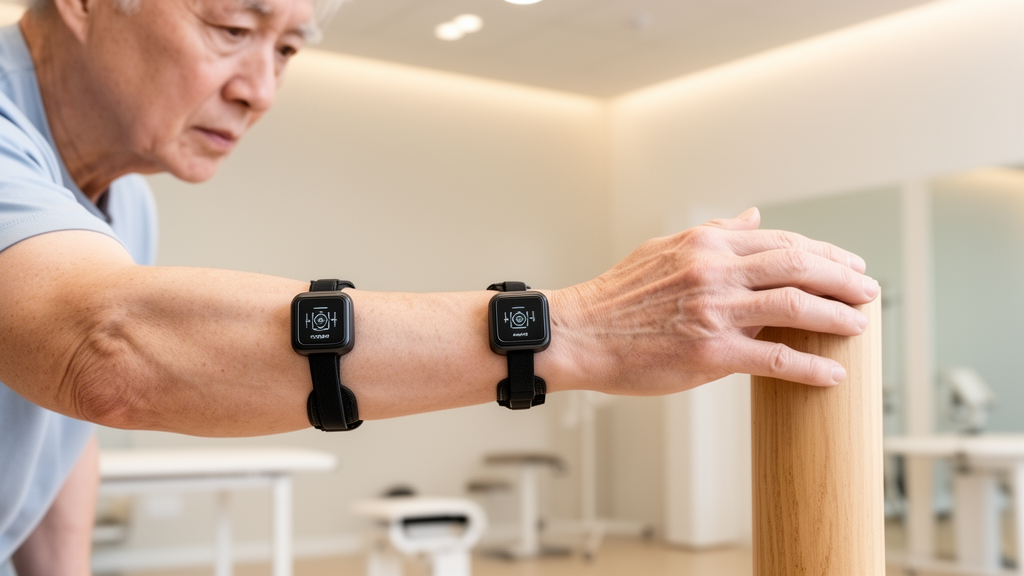
A fully automated machine-learning framework can identify and temporally segment upper-extremity functional movements in stroke patients, offering a proof-of-concept for remote motor monitoring. Developed to support recovery assessment during routine activities of daily living, the system analyzes inertial sensor recordings to classify purposeful arm actions without relying on individual patient calibration.
Upper-extremity motor recovery remains one of the most challenging aspects of rehabilitation following a stroke, typically requiring repetitive and intensive practice. Because clinical care is increasingly transitioning toward home-based rehabilitation programs, objectively monitoring upper-limb functional activities during everyday tasks has become essential for tracking patient performance and recovery trajectories over time.
Wearable Inertial Measurement Units, combined with modern machine-learning architectures, have substantially advanced motion analysis in rehabilitation research. However, empirical evidence has remained constrained under naturalistic activities of daily living. Existing methods face persistent obstacles regarding temporal movement segmentation and transferring algorithmic models to unseen patients without extensive per-patient training.
To investigate these challenges, researchers gathered sensor recordings from fifteen stroke patients equipped with wearable Inertial Measurement Units. The experimental sessions were carried out within a clinical rehabilitation kitchen under progressively less constrained conditions, simulating the variable and unscripted physical demands encountered during domestic activities.
The evaluation concentrated on three distinct functional movements fundamental to daily independence: Reaching, Lifting, and Supination or Pronation. Initial testing examined a deep-learning architecture that integrated a Convolutional Neural Network, a Bidirectional Long Short-Term Memory network, and an Attention mechanism to classify movement types within predefined ground-truth segment boundaries.
Investigators tested this classifier under two distinct operational paradigms: a subject-specific baseline and a group-cohort scenario designed to determine whether per-patient model training could be minimized. When evaluated within ground-truth segment boundaries, the group-cohort scenario surpassed the subject-specific approach, demonstrating effective cross-patient generalization.
The group-cohort architecture was subsequently expanded into a fully automated movement-identification framework. To process unconstrained continuous movement streams, the developers incorporated an “Unknown” classification category for non-target motions and integrated a Hidden Markov Model sequence decoder capable of performing temporal segmentation across continuous time-series data.
Across automated testing, the framework delivered reliable segment identification, achieving its highest classification accuracy for Lifting actions with an F1-score of 0.84. In addition, the majority of correctly detected segments demonstrated Intersection-over-Union values greater than 0.50, while overall movement duration was well preserved for both Lifting and Supination or Pronation.
In contrast, Reaching proved to be the most challenging action for the framework to accurately detect and temporally preserve, recording an F1-score of 0.63. The authors noted that these findings establish an incremental proof-of-concept supporting future evaluations of continuous upper-extremity functional movement monitoring in patients’ actual homes.
Subject of Research: Automated upper-extremity movement segmentation and identification in stroke rehabilitation
Article Title: Towards at-home stroke rehabilitation: fully automated identification and temporal segmentation of upper-extremity functional movements during activities of daily living
Article References: Akbari, S., Horemans, H. L. D., Bussmann, J. B. J., Evers, M., & Zgonnikov, A. (2026). Towards at-home stroke rehabilitation: fully automated identification and temporal segmentation of upper-extremity functional movements during activities of daily living. Journal of NeuroEngineering and Rehabilitation. https://doi.org/10.1186/s12984-026-02220-2
Image Credits: AI Generated
DOI: 10.1186/s12984-026-02220-2
Keywords: stroke rehabilitation, upper-extremity recovery, inertial measurement units, temporal segmentation, activities of daily living, movement identification, rehabilitation engineering, sensor monitoring, reaching movements, lifting movements, supination pronation, hidden markov models, deep learning, clinical kitchen, at-home rehabilitation, wearable sensors
News Source: Cassandra Pierce. (November 24, 2026). Automated Sensor System Identifies Upper-Limb Functional Movements in Stroke Patients. Scienmag.