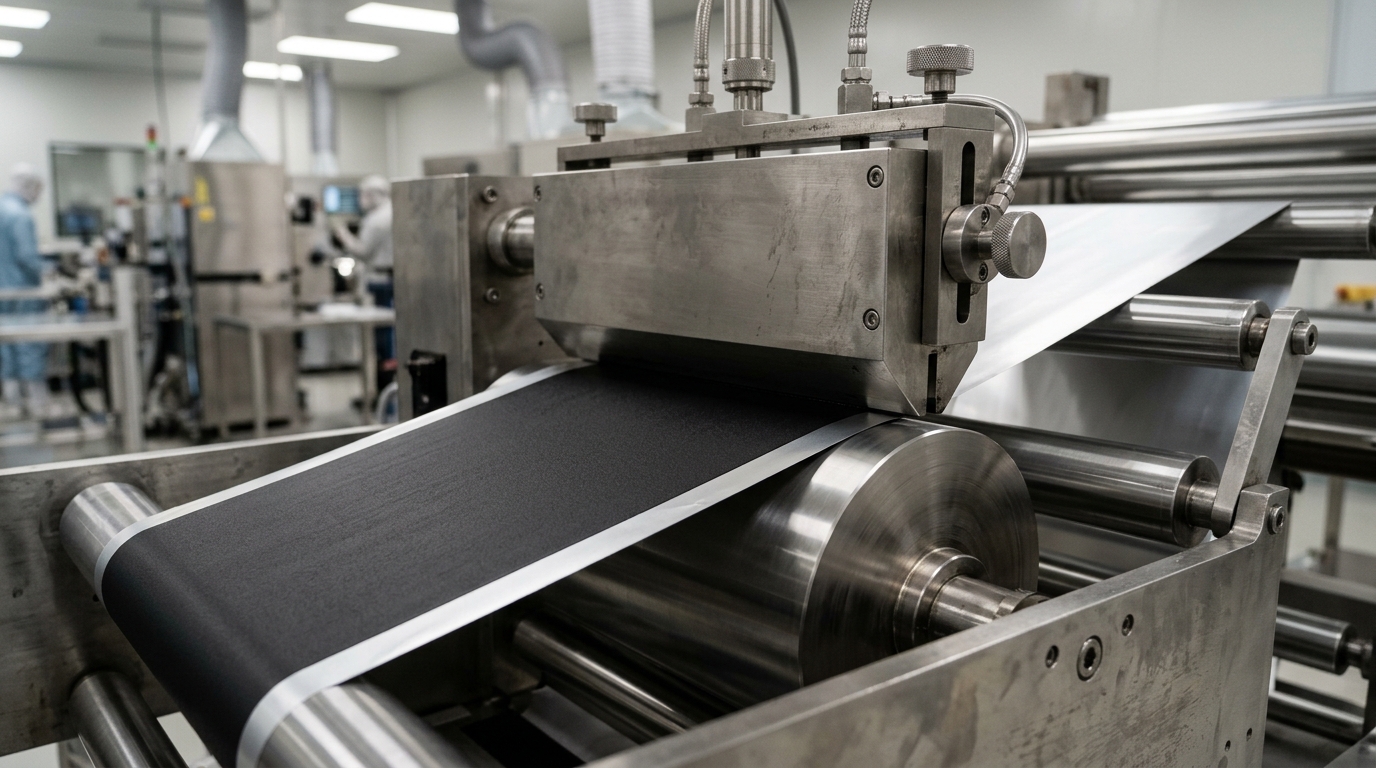
A research team led by scientists at CIDETEC in Spain, collaborating with CIC energiGUNE and ARKEMA, has successfully demonstrated the pilot-scale manufacture of high-loading nickel-rich composite cathodes for quasi-solid-state lithium metal batteries. Moving beyond the confines of small coin-cell demonstrations that dominate solid-state battery research, the investigators produced composite positive electrodes from a one-kilogram slurry batch using an industrial roll-to-roll coating line. The resulting single-layer pouch cells achieved an areal capacity of 2.5 milliampere-hours per square centimeter and delivered an initial discharge capacity of 188 milliampere-hours per gram at a C-tenth rate. Furthermore, the pouch cells sustained extended cycling over eighty-five cycles following rigorous rate tests with a Coulombic efficiency approaching one hundred percent. This engineering achievement provides a clear and practical pathway for translating high-energy solid-state battery chemistries from benchtop synthesis directly into existing roll-to-roll electrode processing infrastructure without requiring radical alterations to industrial equipment or sacrificing electrochemical performance.
Solid-state batteries represent one of the most promising frontiers in energy storage technology, offering substantial improvements in operational safety and energy density over conventional lithium-ion cells. Coupling metallic lithium anodes with nickel-rich layered oxide cathodes, particularly lithium nickel manganese cobalt oxide containing eighty percent nickel, enables theoretical energy densities capable of meeting stringent targets for electric mobility. However, solid-state configurations face considerable manufacturing and interfacial challenges. While inorganic all-solid-state batteries based on sulfide or oxide electrolytes demand high stack pressures and stringent dry-room controls, quasi-solid-state systems based on polymer electrolytes offer a balanced compromise. By incorporating a quasi-solid polymer electrolyte, cells avoid free-flowing flammable liquid phases while stabilizing the lithium metal negative electrode. Crucially, polymer-based configurations allow electrodes to be processed via conventional wet slurry casting, yet previous efforts have frequently failed to combine industrially relevant areal loadings with thermal compatibility under standard electrode-drying conditions.
Within a quasi-solid-state battery, the composite cathode functions as a complex multiphase system where every component serves an interdependent electrochemical and mechanical purpose. The cathode active material particles serve as the lithium intercalation host, while the interparticle pore space must be occupied by an ion-conducting catholyte matrix. This matrix typically comprises a polymer binder that ensures structural integrity, a dissociated lithium salt supplying mobile charge carriers, and a plasticizer that lowers activation energy for ionic migration within the pore channels. Dispersed throughout this catholyte is a network of conductive carbon black additives connecting every active material particle to the current collector foil. Because liquid electrolyte does not spontaneously infuse the dry electrode during operation, both ionic and electronic percolation pathways must be established during slurry mixing and wet coating. The electrochemical reaction can proceed only where cathode active material particles maintain simultaneous electronic contact and ionic connectivity throughout the full electrode thickness.
Achieving this dual-percolation network requires an exacting volumetric balance between the catholyte matrix and the internal pore structure of the cathode active material skeleton. If the volume of the catholyte is insufficient to fill the available pore volume, residual microscopic voids break ionic percolation, leaving active material electrochemically dormant and unavailable for reversible cycling. Conversely, if the catholyte volume substantially exceeds the available pore volume, ionic transport is maintained only at the severe cost of diluting the active material loading, lowering cell-level volumetric energy density, and disrupting the electronic network of conductive carbon. This volumetric optimization is further complicated by processing constraints. Calendering electrodes to achieve optimal densification can fracture delicate active particles or increase ionic tortuosity if pursued excessively. Moreover, standard composite cathode fabrication requires evaporating carrier solvents in drying ovens, an operation that can unintentionally drive out volatile catholyte components, alter formulation ratios, and degrade electrochemical kinetics.
The choice of plasticizer within the polymeric catholyte represents the central vulnerability in continuous industrial processing. Widely used cyclic carbonates such as fluoroethylene carbonate have long been favored in laboratory formulations because they lower interfacial resistance and foster beneficial lithium-fluoride-rich protective interphases. However, thermal characterization via isothermal thermogravimetric analysis at eighty degrees Celsius revealed that fluoroethylene carbonate undergoes rapid and continuous mass loss, evaporating entirely after approximately thirty minutes. Comparative testing of other molecular plasticizers, including ethylene carbonate, propylene carbonate, and succinonitrile, demonstrated persistent mass losses ranging from seven to twenty-two percent over one hundred minutes. Such unhindered evaporation alters the final catholyte stoichiometry inside the electrode, compromising polymer distribution, ionic percolation, and overall microstructure. In contrast, the ionic liquid 1-butyl-1-methylpyrrolidinium bis(trifluoromethanesulfonyl)imide exhibited negligible weight loss across the identical thermal window, confirming its resilience under thermal drying conditions.
To evaluate whether this thermal robustness translates directly to processed electrode coatings, the investigators formulated complete cathode mixtures incorporating lithium bis(fluorosulfonyl)imide salt, poly(vinylidene fluoride-co-hexafluoropropylene) binder, and either fluoroethylene carbonate or the ionic liquid plasticizer. Dynamic thermogravimetric analysis from forty to seven hundred degrees Celsius confirmed that the fluoroethylene-carbonate-based electrode lost 4.6 weight percent below one hundred fifty degrees Celsius, matching the evaporation profile of the neat carbonate. Conversely, the ionic-liquid-based composite electrode lost only 1.1 weight percent below one hundred fifty degrees Celsius and exhibited negligible mass loss up to three hundred degrees Celsius, well above industrial solvent evaporation windows. Because running continuous roll-to-roll coating lines at low drying temperatures leads to incomplete solvent removal and causes electrodes to adhere during automated winding, the thermal stability of the ionic liquid enables drying temperatures up to one hundred twenty degrees Celsius, establishing a reproducible manufacturing route without compositional drift.
Building upon the selection of the thermally robust ionic liquid, the research team optimized the relative catholyte fraction and active material content across four distinct cathode formulations. The internal catholyte composition was held at a fixed weight ratio of one part polymer, two parts lithium salt, and seven parts ionic liquid, while the total catholyte loading varied from 14.2 to 20.4 weight percent, corresponding to theoretical pore-free volume fractions between thirty-two and forty-two percent. In one targeted formulation, designated CAT_05, the cathode active material content was elevated to 81.3 weight percent by decreasing the conductive carbon black from 5.6 to 4.5 weight percent while maintaining the total catholyte at 14.2 weight percent. Electronic conductivity measurements of calendered coatings revealed that electronic transport was governed predominantly by carbon black concentration, declining from 0.182 to 0.083 Siemens per centimeter when carbon black was decreased. Nevertheless, all formulations maintained conductivity well within reported values for porous electrodes, confirming unbroken electronic percolation.
Electrochemical evaluation of these formulations in laboratory coin cells paired with quasi-solid polymer electrolytes revealed that discharge capacity correlated inversely with catholyte loading. Formulations containing 14.2 weight percent catholyte delivered the highest specific capacities across all discharge rates, with the active-material-enriched CAT_05 formulation delivering 210 milliampere-hours per gram at a C-twentieth rate and 146 milliampere-hours per gram at a one-C rate. The relative rate retention between one C and C-twentieth remained consistent at sixty-eight to seventy-two percent across all tested compositions, proving that adding excess catholyte beyond thirty volume percent yields no measurable kinetic advantage while unnecessarily penalizing active mass. Electrochemical impedance spectroscopy of symmetric cathode cells displayed an absence of the forty-five-degree Warburg-type impedance feature that characterizes severe bulk ionic resistance. Upon returning to a C-tenth cycling rate, coin cells recovered ninety-five to ninety-nine percent of initial capacity, demonstrating that polarization at elevated rates is purely kinetic rather than degradative.
Validation of the optimized formulation at pilot scale was achieved by mixing a one-kilogram slurry batch of the active-material-enriched formulation and coating it onto carbon-coated aluminum foil current collectors using a three-zone industrial roll-to-roll line operating at temperatures between one hundred ten and one hundred twenty degrees Celsius. The resulting pilot-scale cathode, designated CAT_06, attained an areal capacity of 2.48 milliampere-hours per square centimeter, an active material mass loading of 13.84 milligrams per square centimeter, and a calendered bulk density of 2.95 grams per cubic centimeter. Field-emission scanning electron microscopy confirmed that the pilot-manufactured coating exhibited a crack-free, homogeneous morphology virtually identical to laboratory coatings, featuring spherical active material secondary particles uniformly embedded within the composite catholyte matrix. Furthermore, the electronic conductivity of the pilot-scale coating was measured at 0.0825 Siemens per centimeter, matching laboratory-scale values and confirming that large-scale continuous mixing faithfully preserved the dispersed conductive network.
Crystallographic and electrochemical impedance characterizations further verified structural preservation during the pilot-scale transition. X-ray diffraction patterns of the pilot-coated electrodes matched pristine active material powder and laboratory samples, showing fully resolved doublets characteristic of the well-ordered layered alpha-sodium ferrite crystal structure without detectable secondary phase formation or lattice parameter shifts. When assembled into symmetric two-electrode cells, the pilot-scale electrodes exhibited impedance profiles identical in shape to laboratory counterparts, verifying that ionic transport channels remained unobstructed during automated roll-to-roll handling. Although the pilot cells demonstrated a higher overall area-specific resistance of ninety-five ohm-square centimeters compared to fifty-eight ohm-square centimeters for laboratory electrodes, the difference was attributed to variations in current collector foil thicknesses and surface contact interfaces rather than intrinsic defects in the active composite layer.
To provide definitive proof of feasibility under practical conditions, the researchers assembled single-layer pouch cells incorporating the pilot-coated cathode, a seventy-micrometer supported quasi-solid polymer electrolyte membrane, and a fifty-micrometer metallic lithium foil anode. The pouch cells were placed inside rigid fixtures under a constant-gap initial stack pressure of approximately 0.3 megapascals. Following formation cycling, the pouch cell delivered an initial discharge capacity of 188 milliampere-hours per gram at C-tenth, representing ninety-three percent of the capacity achieved by laboratory coin cells under identical cycling parameters. In subsequent rate capability testing, the pilot-line pouch cell demonstrated outstanding kinetic stability, matching the coin-cell capacity of approximately 150 milliampere-hours per gram at a one-C discharge rate and exhibiting a lower relative capacity loss across increasing currents than its laboratory-scale predecessor.
During extended galvanostatic cycling at a constant C-tenth rate following rate capability assessments, the single-layer pouch cell sustained eighty-five additional cycles, completing one hundred twenty-one total cycles while retaining seventy-seven percent of its post-rate-test capacity with Coulombic efficiency remaining near one hundred percent. In contrast, benchmark laboratory coin cells experienced accelerated capacity degradation after seventy cycles, accompanied by rapid polarization growth. Mean discharge voltage tracking confirmed that pouch cell operating potential declined by only 1.4 millivolts per cycle compared to 1.9 millivolts per cycle in coin cells, indicating that the pouch cell architecture better mitigates interfacial resistance buildup between metallic lithium and the polymer electrolyte. By demonstrating stable operation, high active-material loading, and full compatibility with existing roll-to-roll machinery, this pilot-scale investigation provides a robust template for the commercial scale-up of next-generation quasi-solid-state lithium metal batteries.
Subject of Research: Pilot-scale manufacturing of high-loading composite cathodes for quasi-solid-state lithium metal batteries
Article Title: Development and pilot-scale validation of high-loading NMC811 composite cathodes for quasi-solid-state lithium metal batteries
Article References: Cazorla Soult, M., García-Calvo, O., Cobos, M., Braccini, J., Descalzo, A., Boaretto, N., Godillot, G., Urdampilleta, I., & Kvasha, A. (2026). Development and pilot-scale validation of high-loading NMC811 composite cathodes for quasi-solid-state lithium metal batteries. Frontiers in Batteries and Electrochemistry, 5, 1984419. https://doi.org/10.3389/fbael.2026.1984419
Image Credits: AI Generated
DOI: 10.3389/fbael.2026.1984419
Keywords: quasi-solid-state batteries, lithium metal batteries, composite cathodes, NMC811, pilot-scale manufacturing, roll-to-roll coating, polymeric catholyte, ionic liquids, PYR14TFSI, fluoroethylene carbonate, areal capacity, pouch cells, thermogravimetric analysis, electrode densification, dual percolation, calendering, solid polymer electrolyte, slurry processing
News Source: Neil Sanderson. (November 24, 2026). Pilot-Scale Roll-to-Roll Process Validates High-Loading Composite Cathodes for Solid-State Batteries. Scienmag.